| Written by Constance Stickler
Table of contents:
- Why Temperature Control Is Non-Negotiable
- The Regulatory Backbone of the Cold Chain
- Who sets the rules globally?
- Where Do National Regulations Diverge—and Why Does it Matter?
- Digitalisation and the Future of Cold Chain Regulations
- What This Means for Operators and Logistics Providers
- FAQ
- Takeaway
- Glossary
Why Temperature Control Is Non-Negotiable
Essentially, cold chains are about maintaining a defined temperature range from origin to consumer, across all modes of transport, be it trucks, vessels, trains or barges. For food, this is intended to slow down ripening, while for pharmaceuticals, it's about preserving molecular stability. The margin for error is very small for many of these highly sensitive goods.
A break in the cold chain doesn't always lead to visible damage—and that's precisely what makes it so dangerous. Seafood may still look perfectly fine, but it could contain harmful bacteria. Vaccines may appear unchanged, but they may have lost their effectiveness. In both cases, the consequences only become apparent later.
For regulatory authorities, the cold chain is therefore a system of public safety, with a vital need for documentation, traceability, and validation.
The Regulatory Backbone of the Cold Chain
Regulations for cold chains are generally based on four standardised pillars:
Temperature control: This is the central element. The temperature ranges defined for a specific shipment must be strictly adhered to, monitored, and continuously documented. Whether there are permissible deviations is precisely defined. To better understand the significance of this aspect: A study published in the International Journal of Pharmaceutics highlights that up to 20% of temperature-sensitive health products (up to 50%, when it comes to vaccines) are damaged during transport due to interruptions in the cold chain. (1) For food products, it's about 14%. (2)
Traceability: Every product must be traceable at every stage of the supply chain. This includes location data, temperature history, and handling conditions during transport and storage. What is not recorded is considered not to have happened. Companies that continue to rely on manual controls or fragmented systems are increasingly at risk – not only operationally, but also legally.
Hygiene and handling standards: These regulate how storage, transport, and transhipment of goods must be carried out. This is particularly essential for food products, as contamination risks must be considered in addition to temperature. Therefore, it is essential to precisely regulate and adhere to the cleanliness of storage and transport equipment, the separation of incompatible goods, and the procedures for loading and unloading (see also: cold chain requirements).
Accountability: From the manufacturer to the transporters, the warehouse provider, and finally the retailer, each party must demonstrate compliance with the regulations within their respective area of responsibility. According to the WHO's GDP (Good Distribution Practices) guidelines, every entity involved in the supply chain must have clearly documented roles and responsibilities, supported by training and quality assurance systems.
These four principles are therefore universally valid. Differences, however, lie in how strictly they are enforced and how much responsibility is attributed to individual actors or to the system as a whole. Through consistency in compliance with regulations, amazing results could be achieved. A World Bank report concludes that improvements in cold chain infrastructure and compliance in developing countries could significantly reduce food losses—often estimated in the range of 20% or more, depending on the supply chain. (3) Monitoring solutions that require low initial investments can make a very important contribution, allowing them to be used even in less affluent regions of the world or in small-scale applications (only one or a few reefers at a time).
Who Sets the Rules Globally?
While the rules are implemented at the national and regional levels, their foundations usually originate from international organisations. These bodies do not enact laws, but rather establish globally recognised standards that are adopted by national regulatory authorities – sometimes strictly, sometimes selectively.
The World Health Organisation (WHO) plays a central role in this, having established best practices, particularly the Good Distribution Practice (GDP) guidelines for pharmaceutical and other medical products. (4)
Examples:
- All activities must ensure that the quality, identity, and integrity of medical/pharmaceutical products are maintained from the manufacturer to the point of dispensing, including returns and recalls.
- Every party in the supply chain must prevent damage, contamination, mix‑ups, falsification, and degradation under their responsibility.
- All entities in the chain must apply due diligence and documented procedures so operations can be verified and inspected against regulatory requirements.
- Documentation and record‑keeping must allow rapid tracking, recall, and investigation of any product throughout the entire distribution process.
The Food and Agriculture Organisation of the United Nations (FAO), together with the Codex Alimentarius Commission, establishes global food safety standards. The Codex guidelines particularly affect countries that adhere to international trade frameworks. (5)
Examples:
- Ensure every stage (receiving, processing, storage, distribution) follows prerequisite hygiene programs like HACCP, with equipment designed to avoid temperature fluctuations, air leaks, or warm air ingress.
- Use monitored cold chain storage with adequate airflow, segregation, and protection against contamination or equipment failure.
- Implement temperature recording, staff training, and deviation procedures to detect excursions, enabling rapid evaluation, hold/release decisions, and corrective actions like recalls.
- Records must support traceability for the product's shelf life.
In addition to the international recognition of these guidelines, other organisations also encourage compliance. For example, the World Trade Organisation (WTO), through its Agreement on Sanitary and Phytosanitary Measures (SPS Agreement), encourages countries to align their food safety regulations with international standards such as the Codex. This creates a form of indirect enforcement. Countries that deviate significantly from these standards may face trade disputes or trade barriers. Therefore, the alignment of regulations with internationally recognised standards is often driven by the need to participate in international trade.
Where Do National Regulations Diverge—and Why Does it Matter?
In principle, most countries agree on what needs to be done. The differences lie in the implementation.
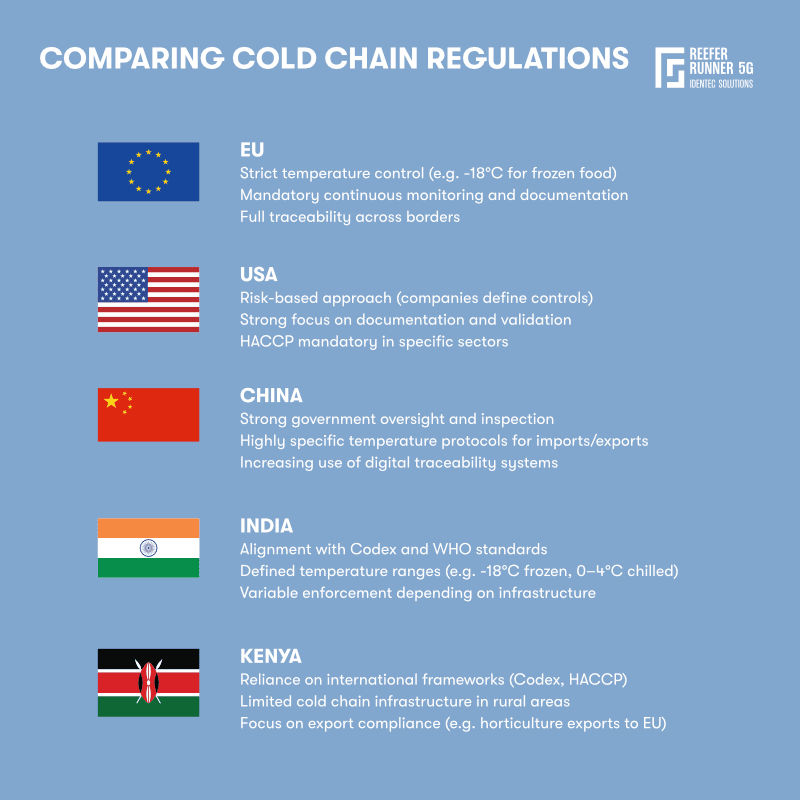
The intensity of enforcement varies considerably. While the EU, for example, applies uniform regulations across all member states, the US uses selective regulations, but expects strict internal controls. Emerging economies have also ratified some strict laws, but enforcement doesn't always live up to them.
Whether the laws can be implemented at all depends on several factors, such as the maturity of the infrastructure. Regulations are only as effective as the systems they rely on. Without reliable refrigeration, compliance remains theoretical.
Another difference is a country's level of digitalisation. While real-time monitoring, automated alerts, and digital audit logs are standard in developed markets, other countries continue to rely on manual processes.
These differences are particularly relevant because cold chains don't end at national borders. On the contrary, they often cross multiple countries. And a chain is only as strong as its weakest link.
Digitalisation and the Future of Cold Chain Regulations
The picture is now clear: cold chain regulations provide the framework, but operational practice determines whether the regulations are actually complied with and whether products and people are truly protected.
What measures, tools, and processes are needed to close the gap between theory and practice?
Temperature Monitoring and Control
Temperature and its maintenance are by far the most important factors in cold chain management. Regulations define limits, but monitoring ensures that these limits are met in real-time.
Sensors integrated into the refrigerated containers continuously record parameters such as temperature, as well as relative humidity, CO₂, and ethylene levels. Modern monitoring systems transmit this data to operators, ideally integrated directly into the central systems. If the container is traveling on a truck, train, vessel or barge, the data can also be transmitted via a 5G network, for example. This allows all current data to be accessed at any time. Should deviations occur, alerts are sent in real-time. These are visible on IoT dashboards and can also be sent directly to reefer managers via email or SMS, enabling them to immediately address the issue.
Ideally, such systems also monitor the power status, allowing for early detection if, for example, a reefer needs to be reconnected because it has been disconnected from power for too long (especially important during unloading and loading) or if the power supply has been interrupted. Changing setpoints remotely is also possible with some such systems.
Data Management and Traceability
Monitoring reefers generates large amounts of data. This data is collected, stored, and analysed. This allows operators to keep track of all reefers at all times and identify operational weaknesses by observing patterns in temperature deviations, alarm frequency, and response times. The data is also crucial for audits, which increasingly require digital records.
Power Supply and Mechanical Reliability
Maintaining a reliable temperature is only possible with a sufficient power supply. In addition to having emergency power systems in place, regular maintenance of compressors, insulation, and refrigerant levels is one of the measures that reduces the likelihood of deviations and failures.
Alarm Response and Escalation Procedures
The worst-case scenario: An alarm is triggered, but no one responds. Warnings and alarms are only valuable if they are acted upon. Therefore, response protocols (responsibility, deadlines), escalation chains (decision levels), and potentially automated interventions must be defined. This clearly demonstrates that even fully compliant monitoring is only effective if the response from humans or machines is timely.
Documentation and Compliance with Regulations
Refrigerated container monitoring systems are increasingly expected to:
- Provide auditable logs for regulatory authorities
- Ensure cross-border traceability, which is essential for export compliance
- Document all operations related to goods handling, including power outages, alarms, and corrective actions.
Insufficient documentation can lead to the rejection of shipments, fines, or product recalls.
What This Means for Operators and Logistics Providers
Those working in the cold chain don't just transport goods. They manage risks on behalf of customers, end consumers, and regulatory authorities.
Cold chain regulations must therefore be integrated into daily operations and supported by training, technology, and accountability. The safest approach is to align operations with the strictest applicable standards. This reduces complexity and strengthens resilience.
Finally, you should be aware that the cold chain is only as strong as its weakest link. Collaboration along the supply chain is not optional—it is essential (see also: cold chain shipping).
FAQ
How was the WHO's GDP developed?
The concept of Good Distribution Practice (GDP) has evolved over several decades, driven by the increasing complexity of global pharmaceutical supply chains.
It emerged from the broader Good Manufacturing Practice (GMP), which was formalised in the 1960s to ensure drug quality during production. However, it became increasingly clear that product integrity does not end when a product leaves the factory. With the expansion of international trade in the 1980s and 1990s, distribution risks—particularly temperature fluctuations and counterfeit medicines—became more prominent.
For this reason, the first specific GDP guidelines were introduced in the early 2000s to provide a structured framework for the storage, transport, and handling of medicines.
A significant milestone was reached in 2010 when the WHO published its updated GDP for pharmaceutical products, further aligning distribution practices with risk management principles and the realities of global supply chains.
Takeaway
Cold chain regulations are more harmonised today than ever before. Global frameworks provide a common foundation, and most countries worldwide operate with largely similar temperature ranges, hygiene principles, and traceability requirements.
However, the real challenge lies beyond regulation.
Differences in infrastructure, enforcement, digitalisation, and operational discipline mean that compliance cannot be automatically achieved. The same shipment can be transported through highly controlled environments and still fail at a single weak point—often in handling, transhipment, or a delayed response to a deviation.
In this context, the further dissemination of standardised measures and technologies, such as real-time monitoring of refrigerated containers, is essential to enable effective regulation implementation in all countries and regions.
Ultimately, the cold chain is not defined by the rules that govern it, but by the consistency with which those rules are followed.
Delve deeper into one of our core topics: Cold Chain Monitoring
Glossary
Auditable logs are secure, tamper‑evident, chronological records of system events, user actions, configuration changes, and data access that provide a verifiable audit trail for compliance, security investigations, and forensic analysis. They capture essential metadata—who performed the action, what was changed, when and where it occurred, and the outcome—while ensuring immutability through cryptographic hashing, digital signatures, or blockchain to prevent alteration. Auditable logs support regulatory requirements and enable reconstruction of incidents or proof of due diligence. (6)
Phytosanitary measures are regulatory actions taken by governments to protect plants, crops, and ecosystems from pests, diseases, and invasive species during international trade. These include inspections, treatments (fumigation, heat, irradiation), certifications, quarantine, and import restrictions based on pest risk assessments. They are governed by the International Plant Protection Convention (IPPC) and the WTO SPS Agreement to ensure science-based, non-discriminatory trade while preventing agricultural damage. Examples: phytosanitary certificates for fruit exports, area-wide pest eradication programs. (7)
References:
(1) https://doi.org/10.1016/j.ijpharm.2010.09.001
(2) https://www.fao.org/3/ca6030en/ca6030en.pdf
(4) https://iris.who.int/server/api/core/bitstreams/3bfa1a91-528f-4894-a2df-ce6b7fbe2e55/content
(5) https://www.fao.org/fao-who-codexalimentarius
(6) Calder, Alan; Watkins, Steve. (2015) IT Governance: An International Guide to Data Security and ISO27001/ISO27002. Kogan Page, 7th ed.
(7) Waite, B.H. (2001). Phytosanitary Measures for International Trade. ACIAR.
Note: This article was partly created with the assistance of artificial intelligence to support drafting.

Author
Conny Stickler, Marketing Manager Logistics
Constance Stickler holds a master's degree in political science, German language and history. She spent most of her professional career as a project and marketing manager in different industries. Her passion is usability, and she's captivated by the potential of today's digital tools. They seem to unlock endless possibilities, each one more intriguing than the last. Constance writes about automation, sustainability and safety in maritime logistics.
Related Articles
Related Product