| Written by Constance Stickler
Table of contents:
- Why Visibility Has Become a Competitive Advantage
- Where Do Container Terminal Tracking Technologies Support Business Processes?
- Which Container Terminal Tracking Technologies Are Used?
- FAQ
- Takeaway
- Glossary
Imagine a container terminal handling 15,000 container movements daily. Every hour, hundreds of containers are unloaded from ships, transported across the terminal, stacked, picked, and loaded onto trucks or trains. Behind each movement lies a complex coordination process involving cranes, terminal tractors, warehouse equipment, drivers, planners, and digital systems.
This scale is not unusual for modern mega-terminals. The world's busiest container ports handle tens of millions of TEU annually. And on August 1, 2026, the terminal operations of Port of Shanghai set a container throughput record: 203,881 TEU in a single day. This represents a 9% increase over the previous record, set on June 9 of the same year. A single operating shift alone achieved a record 71,728 TEU. (1)
The modern dimensions are therefore enormous, also on the shipping side. The largest container ships currently in service, from the MSC Irina series, can transport up to 24,346 TEU. They and their only slightly smaller counterparts are pushing ports worldwide to their limits, as a single ship call can trigger thousands of individual container movements. (2)
The operational challenge becomes clear: thousands of goods are moving simultaneously across large terminal sites (smart port technology), and each container must be identified, located, and transshipped at the right time.
Why Visibility Has Become a Competitive Advantage
A modern container terminal is one of the most dynamic operating environments in global logistics. Cranes are constantly loading and unloading, ships, trucks, and trains arrive, and container handling equipment (CHE) transports and stacks containers and refrigerated containers, all of which must be constantly monitored (for more about CHE, see: CHE operator). Thousands of systems are in operation simultaneously, and any delay or misplaced container can disrupt the carefully coordinated workflow.
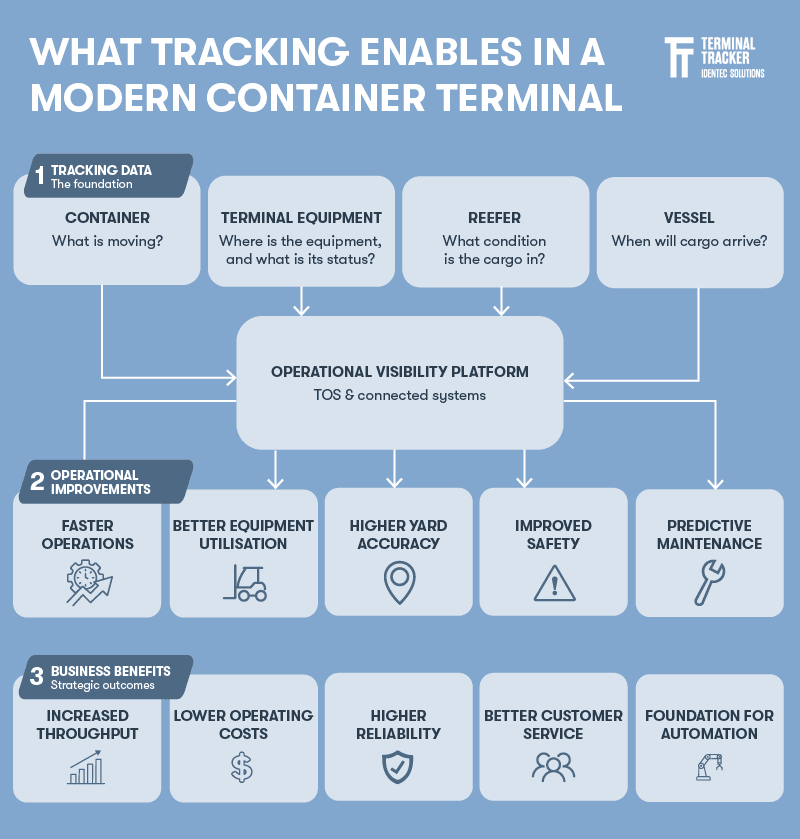
Under these conditions, operational efficiency depends critically on knowing where the assets are located, what they are doing, and what the next steps should be. Tracking provides added value here: Modern tracking technologies not only capture locations but also offer the real-time visibility necessary for informed operational decisions. They help dispatchers allocate equipment more efficiently, planners monitor container flows, maintenance teams quickly locate assets, and operators are immediately notified of events requiring attention.
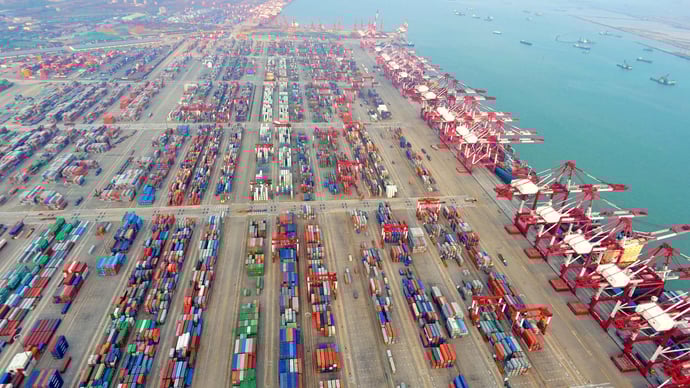
The importance of tracking increases with the growing size and complexity of terminals. Small facilities may still be able to manage for a while with radio communication, manual updates, and operator experience, but this has long ceased to be an option for medium and large facilities. With terminal areas spanning several hundred hectares—the mega-project Tuas Port will occupy 1,337 hectares upon completion (3)—searching for a misplaced container, using the wrong equipment, or dispatching a technician to the wrong reefer area can lead to significant delays that impact the entire operation.
Visibility is a fundamental requirement, and the same information that enables automated order placement, optimised equipment routes, and accurate inventory on-site also improves safety by helping to avoid collisions, monitor restricted areas, and facilitate faster emergency response.
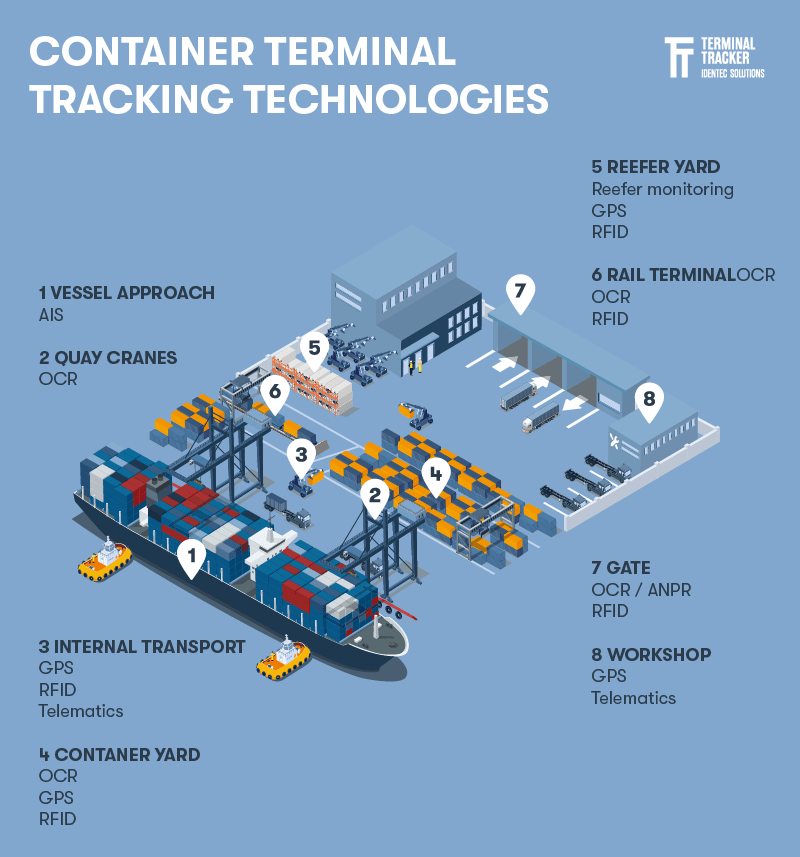
It's important to understand that not every business process requires the same level of tracking. Some activities simply require confirmation that an object has passed a specific location, such as a truck entering through a gate. Others require continuous, highly accurate positioning, such as the secure control of automated equipment on the terminal premises. Container terminals therefore typically combine several complementary technologies—including OCR, RFID, GPS, and vehicle telematics—to ensure optimal visibility for every operational process.
To select the right solution, it is essential to understand where tracking is used, how these technologies interact, and what the strengths and weaknesses of each approach are:
Where Do Container Terminal Tracking Technologies Support Business Processes?
Tracking technologies are integrated into virtually every operational process of a modern container terminal. The underlying goal is always the same – knowing the location and status of goods – but the required level of transparency varies considerably. Some processes simply require confirmation that an object has passed a specific point, while others rely on continuous, highly accurate positioning to enable automated decision-making.
Gate Operations: Creating a Digital Checkpoint
At the terminal gate, containers, trucks, and drivers are identified, authorised, and assigned to the corresponding job in the terminal operating system (TOS). Gate tracking focuses primarily on identification rather than continuous location tracking. Upon truck arrival, OCR (optical character recognition) cameras automatically capture container numbers, while ANPR (automatic number plate recognition) systems identify the vehicles. Some terminals also use RFID tags to identify drivers, trailers, or carriers without manual intervention.
The information is immediately transferred to the terminal operating system (TOS), where appointments are verified, documents are checked, and the next destination within the terminal is assigned.
Yard Operations: Knowing Exactly Where Every Container Is
In a yard, thousands of containers can stretch across numerous rows and blocks, while equipment constantly moves them between ships, storage areas, rail terminals, and truck lanes. Accurate container tracking is therefore essential.
Depending on the required level of accuracy, terminals employ various technologies to ensure clarity across the terminal area. OCR systems can confirm container locations when mounted to CHE. PDS (position detection systems), such as RFID (radio-frequency identification) or GPS (global positioning system), track assets as they pass through fixed checkpoints.
Equipment Dispatching: Sending the Right Machine to the Right Job
Container terminals operate large fleets of container handling equipment (CHE), including terminal tractors, reach stackers, rubber-tired gantry cranes (RTGs), rail-mounted gantry cranes (RMGs), empty container stackers, and forklifts.
Vehicle tracking makes it possible to identify the best-positioned machine for the next job, rather than assigning them according to predefined routes or operator preferences.
Vessel Operations: Coordinating Thousands of Container Moves
The estimated time of arrival of container ships is usually determined via the Automatic Identification System (AIS). This allows terminals to plan berth allocation and the deployment of cranes and subsequent equipment well in advance - see also: PDS automation.
As at the gate, OCR systems identify the containers as they are lifted by the quayside cranes. Device tracking confirms every transport movement from the quay to the assigned storage location. The terminal operating system (TOS) continuously compares planned and completed movements.
Reefer Operations: Responding Quickly to Temperature Risks
Refrigerated containers require significantly more attention than standard dry containers because they rely on a continuous power supply and controlled conditions.
Tracking helps operators not only identify the refrigerated container that triggered an alarm but also pinpoint its exact location within the terminal. Modern refrigerated container monitoring systems combine location information with operational data such as temperature, control alarms, power status, and equipment condition.
Rail Operations: Improving Intermodal Coordination
Many container terminals serve as intermodal hubs where goods are efficiently transferred between ships, trucks, and rail. Rail transport requires precise coordination, as train loading follows predefined wagon sequences and departure schedules.
Optical character recognition (OCR) technology is primarily used to identify arriving wagons, confirm container positions, and ensure that the correct units are loaded onto the correct wagons.
Maintenance and Asset Management: Tracking More Than Containers
Asset tracking helps maintenance teams quickly locate equipment, monitor utilisation, and schedule maintenance based on current data and patterns rather than fixed maintenance intervals. Vehicle telematics optimises this process by collecting engine diagnostic data, hydraulic pressures, battery status, tyre pressure, and other performance indicators that support predictive maintenance.
Safety and Security: Protecting People, Equipment and Cargo
Container terminals are hazardous environments where large mobile machinery operates in close proximity to trucks, maintenance personnel, and external service providers. Tracking technologies help monitor the movements of vehicles, equipment, and, in some cases, personnel. The location data collected supports collision avoidance systems, monitors access to restricted areas, and improves emergency response by identifying the location of employees during evacuations or incidents.
Tracking also enhances terminal security by ensuring the traceability of container movements, logging access events, and supporting the investigation of operational irregularities. Every logged movement contributes to more transparent and accountable operations, promoting both regulatory compliance and continuous improvement of operational processes.
Which Container Terminal Tracking Technologies Are Used?
There is no single tracking technology that can meet all the operational requirements of a container terminal. Some business processes require continuous, real-time positioning with sub-meter accuracy, while others simply need to confirm that a truck or container has passed a specific checkpoint. Environmental conditions, infrastructure costs, the required accuracy, and the type of object being tracked all influence the choice of the most suitable technology.
For this reason, several complementary technologies are used:
GNSS/GPS: Tracking Mobile Equipment Across Large Areas
Global Navigation Satellite Systems (GNSS), and its most well-known representative, GPS (Global Positioning System), are frequently used to track mobile objects outdoors, for example, in various vehicles at container terminals.
GNSS receivers calculate their position using signals transmitted by satellites in Earth's orbit. Since the infrastructure is already in place worldwide, terminals only need receivers installed on the objects to be tracked.
The technology works well in open areas, but its accuracy is typically limited to a few meters and can decrease near tall stacks of containers, cranes, or buildings, where satellite signals are partially blocked or reflected. Therefore, differential GNSS (DGNSS) is used, which means that fixed reference stations are installed on the terminal premises. These base stations compare their actual position with the one received from the satellite and send any error data to the mobile receivers, which then correct their position data.
RFID: Reliable Identification at Fixed Locations
Unlike GPS, RFID does not continuously determine location. Instead, it records when an object with an RFID tag passes a fixed reader. This makes it ideal for monitoring operational processes.
An RFID system consists of electronic tags attached to objects and readers installed at strategic locations such as terminal gates, crane tracks, control stations, or level crossings. As soon as an object with an RFID tag enters the reader's detection range, its unique identification number is automatically captured and transmitted to the terminal operating system (TOS).
RFID tags can be passive or active. Passive tags have no internal power supply and are activated by the radio signal from the reader. Active tags, used on container terminals, have their own battery, allowing them to communicate over significantly greater distances and support additional functions. Through intelligent design, such as an optimised beacon rate (signal transmission rate) and energy-saving mode, these tags can operate for extended periods (up to several years) before battery replacement is required.
OCR: Turning Images into Operational Data
Optical character recognition (OCR) has revolutionised the automation of container handling facilities by eliminating much of the manual data entry traditionally associated with container processing. OCR systems use high-resolution cameras and specialised software to recognise container numbers, licence plates, hazardous materials markings, and even visible container damage.
ANPR is an application of OCR and uses cameras and image-processing/OCR techniques to automatically identify vehicle registration plates.
However, the technology is highly dependent on image quality. Dirty containers, poor lighting conditions, heavy rain, snow, or damaged markings can affect recognition accuracy and, in some cases, necessitate manual verification. Nevertheless, continuous advancements in camera technology and artificial intelligence have made OCR one of the most widely used automation technologies in container handling.
Vehicle Telematics: Combining Location with Equipment Data
In addition to tracking vehicle locations, operators also want to know if equipment is available, how it is being used, and whether there are any signs of technical problems.
Telematics systems collect data from vehicles and their electronic control systems, sensors, and other connected components. Depending on the equipment and system architecture, this can include engine operating hours, fault codes, fuel or energy consumption, battery information, tyre pressure, speed, and other equipment parameters.
Besides the insights this information provides for dispatchers and operations managers, it also enables maintenance teams to perform condition-based and predictive maintenance.
AIS: Tracking Vessels Before They Reach the Terminal
Before a ship reaches its berth, the terminal needs to know its location, its estimated arrival time, and whether its movement is in line with the operational schedule.
The automatic identification system (AIS) is a maritime communication and tracking system that automatically exchanges information between appropriately equipped ships and land-based systems. Depending on the available data, AIS can provide information such as ship identity, position, course, speed, heading, navigation status, destination, and ship type, thus contributing to the calculation of the estimated time of arrival and berth occupancy.
Reefer Monitoring: Tracking Location and Cargo Conditions
Even for reefers, location tracking is only half the battle. A refrigerated container must remain within the specified operating conditions for its entire stay at the terminal. Therefore, their monitoring systems record data such as temperature readings, alarm messages, performance status, setpoints, and other device parameters.
If the data does not meet the values necessary to ensure the integrity of the goods, alarms are triggered so that early intervention is possible.
The Bigger Picture: PDS and IoT
GPS/GNSS, RFID, OCR, AIS, telematics, and refrigerated container monitoring each address a specific aspect of the transparency challenge. Their true value is only realised when the generated information is combined and integrated with operational systems.
Two generic concepts are particularly relevant at this level:
Position Detection Systems (PDS)
A PDS is a system solution for determining the position of objects within a defined operational environment. Instead of relying on a single tracking technology, it combines positioning or detection infrastructure, communication, data processing, and software to provide terminal applications with usable location information.
In a container terminal, PDS information can support processes such as equipment scheduling, container handling, yard operations, and automated workflows. In conjunction with the TOS or other operating systems, location data can be compared with planned tasks and used to trigger the next operational step.
Internet of Things (IoT)
The Internet of Things is an even broader concept. It describes networked physical objects, sensors, communication networks, and software that collect, exchange, and process data.
The Internet of Things (IoT) provides the connectivity and data exchange layer that enables the aggregation of information from these diverse sources. This allows for the acquisition of information about an object's location, identity, activity, and status.
Ultimately, the terminal doesn't need tracking data for its own sake. It needs reliable information that can be linked to operational processes. When identification, positioning, device data, condition monitoring, and scheduled tasks are combined, tracking forms the basis for improved decision-making, automation, and control across the entire terminal.
FAQ
What Is Turnaround Time, and How Does Tracking Improve It?
Turnaround time is the time required to complete a defined operational process, such as a truck's visit to a terminal, a vessel's port call, or a train handling operation. In container terminals, it is a key performance indicator for terminal capacity. Tracking contributes to the optimisation of various types of turnaround times:
Truck turnaround time
This can be reduced through automated gate access, precise container localisation, and efficient equipment scheduling; all measures that minimise driver waiting time.
Vessel turnaround time
Loading and unloading operations can be completed more quickly through better coordination of quayside cranes, terminal tractors, and yard equipment.
Rail turnaround time
Loading operations can be carried out more efficiently when railcars and containers are automatically identified.
Equipment cycle time
Scheduling systems can assign the nearest available machine to each job, minimising unnecessary travel and idle time.
Takeaway
Container terminal tracking is about more than just knowing the location of an asset. Its true value lies in linking identification, positioning, equipment status, cargo conditions, and operational plans to create a comprehensive picture of terminal operations.
Different processes require different types of transparency. OCR and RFID help identify containers and equipment, GNSS/GPS and PDS provide location information, telematics systems reveal equipment condition and usage, AIS supports vessel planning, and refrigerated container monitoring protects temperature-sensitive goods.
The greatest benefits arise when these technologies work together, and the collected information is integrated into operational systems such as the terminal operating system (TOS). This enables faster decision-making, better equipment utilisation, more precise container handling, increased security, and a more robust foundation for automation.
As container terminals handle ever-increasing volumes and face growing pressure to operate more efficiently, reliably, and transparently, shipment tracking is becoming more than just an operational tool. It is becoming a key competence for managing complex terminal processes and converting real-time data into better performance.

Delve deeper into one of our core topics: Smart Port
Glossary
AIS (Automatic Identification System) is a maritime communication and tracking system that automatically exchanges information between suitably equipped ships, shore stations, and sometimes satellites. Using VHF radio, a vessel broadcasts data such as its identity, position, course, speed, heading, navigational status, destination, and ship type. Other vessels and coastal authorities can display this information to improve situational awareness, vessel traffic management, search and rescue, and collision avoidance. AIS supplements, rather than replaces, radar and visual watchkeeping because its data may be incomplete or inaccurate. (4)
RFID (radio-frequency identification) is a contactless technology that uses radio waves to identify and track objects. An RFID system normally consists of a tag, a reader, an antenna, and software or a database. The tag stores identifying information and sends it to the reader when detected. Unlike a barcode, this technology usually does not require direct line of sight, and readers can often detect several tagged items at once. In logistics, RFID can track products, pallets, containers, vehicles, and assets, improving inventory accuracy, visibility, and automated recording throughout the supply chain. (5)
References
(2) https://unctad.org/publication/review-maritime-transport-2024
(3) https://www.mpa.gov.sg/maritime-singapore/port-of-the-future
(4) Transportation Research Board (2003): Shipboard Automatic Identification System Displays: Meeting the Needs of Mariners. National Academies Press.
(5) Finkenzeller, Klaus (2010): RFID Handbook: Fundamentals and Applications in Contactless Smart Cards, Radio Frequency Identification and Near-Field Communication. John Wiley & Sons.
Note: This article was partly created with the assistance of artificial intelligence to support drafting.

Author
Conny Stickler, Marketing Manager Logistics
Constance Stickler holds a master's degree in political science, German language and history. She spent most of her professional career as a project and marketing manager in different industries. Her passion is usability, and she's captivated by the potential of today's digital tools. They seem to unlock endless possibilities, each one more intriguing than the last. Constance writes about automation, sustainability and safety in maritime logistics.