| Written by Mark Buzinkay
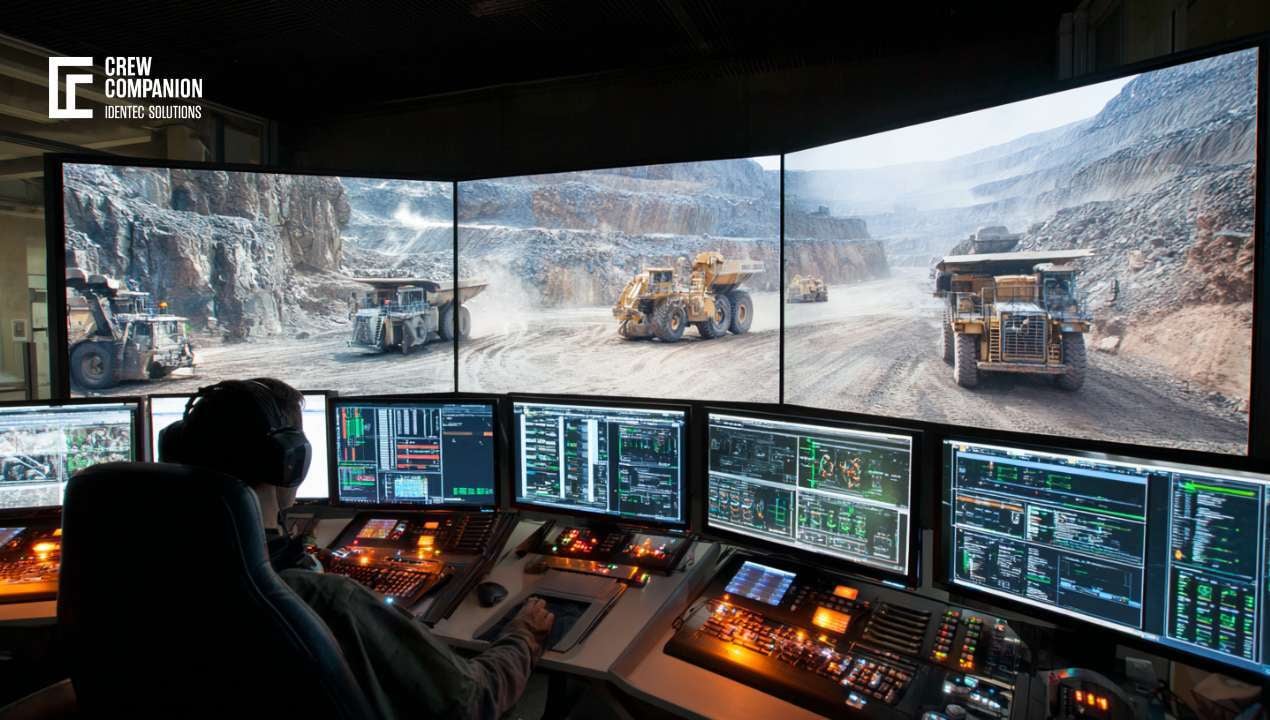
Table of contents:
- From Data to Digital Reality
- What Is a Digital Twin? Understanding the Core Concept
- Digital Twin vs. Simulation: Why Real-Time Changes Everything
- Digital Twin in Mining Operations: From Equipment to Entire Mines
- Worker Safety Monitoring: The Human-Centric Digital Twin
- Toward Fully Integrated, Human-Aware Mining Systems
- FAQ
- Takeaway
- Glossary
From Data to Digital Reality
Mining has always been a data-intensive industry—but only recently has it become truly data-driven. As operations move deeper underground, further offshore, and into increasingly remote environments, the complexity of managing assets, processes, and people continues to grow. At the same time, pressure is mounting to improve productivity, reduce downtime, and—most critically—enhance safety.
Traditional monitoring systems, while valuable, often provide only fragmented insights. A dashboard might show equipment status, another system might track production metrics, and yet another might monitor environmental conditions. What’s missing is a unified, real-time understanding of how all these elements interact.This is where the concept of a digital twin comes into play. By creating a dynamic, virtual representation of physical mining operations, companies can move beyond static data and into a world of continuous, real-time intelligence. A digital twin doesn’t just reflect what has happened—it shows what is happening now and helps predict what will happen next.
This article explores how the concept of a digital twin in mining evolves from a general technological idea into a powerful operational tool—and ultimately into a critical enabler of worker safety.
What Is a Digital Twin? Understanding the Core Concept
At its core, a digital twin is a virtual representation of a physical object, process, or system that is continuously updated with real-time data. In mining, this could mean anything from a single haul truck to an entire underground operation, including infrastructure, material flows, and environmental conditions.
A digital twin is built on three fundamental components. First, there is the physical entity—such as a machine, a ventilation system, or even a worker. Second, there is the digital model, which mirrors the structure and behaviour of that entity. Third, and most importantly, there is the data connection that links the two, typically enabled by IoT sensors, telemetry systems, and real-time locating technologies.
What makes a digital twin particularly powerful is this continuous data exchange. Sensors capture information such as temperature, vibration, location, or gas concentration, and feed it into the digital model. The model then updates in real time, reflecting the current state of the physical world with remarkable accuracy.
Digital twins can exist at different levels. Asset twins focus on individual pieces of equipment, allowing operators to monitor performance and predict maintenance needs. Process twins model workflows such as ore extraction or material transport, enabling optimisation of throughput and efficiency. At the highest level, system twins integrate multiple assets and processes into a comprehensive view of the entire mine.
The benefits are significant. Operators gain real-time visibility, enabling faster and more informed decision-making. Predictive analytics can identify potential failures before they occur. Scenario testing allows teams to explore “what-if” situations without disrupting actual operations.
However, despite these advantages, digital twins are often confused with another well-established concept: simulation. Understanding the difference is key to appreciating their full value.
Digital Twin vs. Simulation: Why Real-Time Changes Everything
Simulation has long been used in mining to model processes and test scenarios. Engineers can simulate production increases, evaluate different mine designs, or assess the impact of new equipment. These models are powerful but typically static. They rely on predefined assumptions and datasets, and once the simulation is complete, the model does not evolve unless it is manually updated.
A digital twin, by contrast, is dynamic. It is continuously fed with live data from the field, allowing it to reflect the current state of operations at any given moment. Instead of representing a hypothetical scenario, it represents reality—constantly changing, constantly updating.
This distinction has profound implications. A simulation might answer the question, “What would happen if production increased by 10%?” A digital twin, on the other hand, can answer, “What is happening right now, why is it happening, and what is likely to happen next?”
In mining, where conditions can change rapidly due to geological variability, equipment wear, or environmental factors, this real-time capability is crucial. A static model cannot capture sudden changes in ventilation performance or unexpected equipment failures. A digital twin can.Another key difference lies in feedback. Simulations are typically one-directional: inputs are defined, outputs are generated. Digital twins create a feedback loop. Data flows from the physical system into the digital model, and insights are generated, which can then be used to adjust operations in real time.
In this sense, a digital twin is not just a tool—it is a living system. It evolves alongside the mine, learning from data and continuously improving its accuracy and usefulness.
With this distinction in mind, the next step is to explore how digital twins are actually applied within mining operations.
Digital Twin in Mining Operations: From Equipment to Entire Mines
The implementation of a digital twin in mining begins at the operational level, where data is generated continuously by machines, infrastructure, and environmental systems. By capturing and integrating this data, mining companies can build digital representations that mirror the complexity of real-world operations.
One of the most common applications is equipment monitoring. Haul trucks, drilling rigs, and conveyor systems are equipped with sensors that track performance metrics, including engine health, load levels, and utilisation rates. A digital twin aggregates this data, allowing operators to monitor equipment in real time and identify signs of wear or inefficiency before they lead to failures.
Beyond individual assets, digital twins can model entire processes. Material flow, for example, can be tracked from extraction to processing, revealing bottlenecks and inefficiencies. Ventilation systems can be simulated and optimised using real-time data, ensuring airflow is directed to where it is needed most while minimising energy consumption.
At the system level, a digital twin integrates multiple layers of data into a unified operational view. This includes not only equipment and processes, but also environmental conditions such as temperature, humidity, and gas concentrations. The result is a comprehensive, real-time model of the mine.
Enabling this level of integration requires a robust technology stack. IoT sensors provide the raw data, while real-time locating systems (RTLS) track the position of assets and personnel. Connectivity solutions—often combining edge computing with cloud platforms—ensure that data can be processed and transmitted even in challenging underground environments.
The business value of this approach is substantial. Predictive maintenance reduces downtime and extends equipment life. Operational optimisation improves productivity and lowers costs. Decision-making becomes faster and more accurate, as managers can rely on real-time insights rather than delayed reports.
However, most implementations of digital twins in mining have historically focused on machines and processes. While this delivers clear efficiency gains, it overlooks a critical component of any mining operation: the people.To unlock the full potential of digital twins, the human element must be integrated into the model.
Worker Safety Monitoring: The Human-Centric Digital Twin
Mining remains one of the most hazardous industries in the world, with risks ranging from exposure to gases and extreme temperatures to equipment collisions and structural instability. Improving safety has always been a priority—but traditional approaches are often reactive, relying on incident reporting and post-event analysis.
A digital twin introduces a fundamentally different approach: proactive and predictive safety management.
By incorporating workers into the digital model, mining companies can create a “human-centric” digital twin. This involves combining multiple data sources, including real-time location miner tracking, wearable devices, and environmental sensors. The result is a dynamic representation of each worker’s position, condition, and surroundings.
Real-time locating systems play a central role in tracking personnel movement throughout the mine. This data can be overlaid with environmental information such as gas levels, temperature, or dust concentration. If a worker enters a hazardous area, the system can immediately detect the risk and trigger alerts.
Wearable technologies add another layer of insight. Sensors can monitor factors such as heart rate, fatigue levels, or exposure to harmful conditions. When integrated into the digital twin, this data enables a deeper understanding of how workers interact with their environment.
The applications are extensive. Geofencing can be used to prevent access to dangerous zones. Proximity detection can reduce the risk of collisions between workers and heavy machinery. Real-time vehicle and miner monitoring ensures that exposure limits are not exceeded.
Perhaps most importantly, digital twins enhance emergency response. In the event of an incident, operators can instantly identify the location of all personnel, track evacuation progress, and determine who may still be at risk. This level of visibility can significantly reduce response times and improve outcomes.
The key shift is from reactive to predictive safety. Instead of responding to incidents after they occur, mining companies can anticipate risks and take action before harm is done.
From a strategic perspective, this aligns closely with broader trends in digitalisation. Systems such as personnel-on-board tracking, access control, and crew management naturally integrate into a digital twin framework. Together, they create a unified platform that connects operations and safety in real time.
Toward Fully Integrated, Human-Aware Mining Systems
The evolution of the digital twin in mining reflects a broader transformation in the industry. What began as a tool for modelling equipment and processes is rapidly becoming a central platform for managing entire operations.
By combining real-time data, advanced analytics, and integrated systems, digital twins provide a level of visibility and control that was previously impossible. They enable mining companies to optimise performance, reduce costs, and respond more effectively to changing conditions.However, the true potential of digital twins goes beyond operational efficiency. By incorporating the human element, they become a powerful tool for improving safety and protecting lives.
As mining continues to embrace automation and digitalisation, the most successful operations will be those that integrate machines, processes, and people into a single, coherent system. Digital twins offer a path toward this future—a future where mines are not only smarter and more efficient, but also safer and more resilient.
In the end, the value of a digital twin is not just in what it can model, but in what it can prevent.
FAQ: Digital Twin in Mining
What is a digital twin in mining?
A digital twin in mining is a real-time virtual representation of physical assets, processes, or entire mining operations, continuously updated with data from sensors, IoT devices, and tracking systems to provide live insights and predictive capabilities.
How does a digital twin differ from a simulation in mining?
While simulations are static models used to test predefined scenarios, a digital twin continuously evolves using live operational data, enabling real-time monitoring, analysis, and predictive decision-making.
How can digital twins improve worker safety in mining?
Digital twins enhance worker safety by integrating real-time location tracking, environmental monitoring, and wearable data to identify hazards, prevent incidents, and support faster, more effective emergency response.
Takeaway
A digital twin in mining is not only a tool for operational efficiency but a critical enabler of mining safety. By integrating real-time miner tracking with environmental and operational data, digital twins provide continuous visibility into worker location, exposure, and risk. This allows mining companies to move from reactive incident response to proactive safety management, reducing hazards and improving emergency response. Ultimately, combining digital twins with miner tracking creates a safer, more transparent mining environment where protecting people becomes a core part of digital operations.
Delve deeper into one of our core topics: Miner safety
Glossary
Simulation is a method of modelling real-world systems using mathematical or computational representations to analyse behaviour under predefined conditions. In mining and engineering, simulations are typically static or scenario-based, allowing users to test “what-if” situations without affecting actual operations. They rely on assumptions and historical data rather than continuous real-time input, making them useful for planning and design but limited in capturing dynamic, evolving environments. (4)
References:
(2) ResearchGate.net: https://tinyurl.com/yrwxhbdr
(4) Averill M. Law: Simulation Modeling and Analysis.
Note: This article was partly created with the assistance of artificial intelligence to support drafting. The head image was created by AI.