| Written by Mark Buzinkay
Table of contents:
- Overall System Layout of Ship-Shaped Offshore Units
- FPSO Topsides Facilities and Functions
- Modular Design of FPSO Topsides
- Integration of FPSO Topsides with Mooring and Export Systems
- FAQs
- Takeaway
- Glossary
Overall System Layout of Ship-Shaped Offshore Units
Floating Production, Storage, and Offloading (FPSO) vessels represent one of the most versatile offshore production solutions for deepwater oil and gas developments. Unlike fixed platforms, FPSOs combine hydrocarbon processing, storage and offloading functions in a single floating vessel. This flexibility allows operators to develop remote or deepwater fields where conventional infrastructure, such as pipelines and fixed platforms, may not be economically viable.
A typical FPSO is an integrated offshore production system composed of several major subsystems. These include the hull structure, topsides facilities, subsea production infrastructure, mooring systems and export systems. Among these, the FPSO topsides play a central role because they contain the process equipment that transforms raw well fluids into stabilised hydrocarbons ready for storage or export.
The hull of the FPSO is usually derived from tanker designs or purpose-built ship-shaped structures. It contains large cargo tanks used to store crude oil before it is offloaded to shuttle tankers. The hull also supports the topsides modules and accommodates auxiliary systems such as ballast tanks, machinery spaces, accommodation areas and utility systems.
Connected to the FPSO are subsea wells that produce a mixture of crude oil, natural gas, water and sometimes sand or other impurities. These fluids travel through subsea flowlines and risers to the vessel. Once the fluids reach the deck level, they are routed into the FPSO topsides processing facilities. Here, multiple stages of separation and treatment are used to isolate oil, gas, and water streams.
Because the topsides modules are heavy and complex, their arrangement must be carefully planned during the early stages of FPSO design. Weight distribution, structural support, equipment accessibility and safety zones are all critical factors. Poor arrangement can negatively affect vessel stability, maintenance operations and emergency response procedures (see also: emergency response kit for FPSOs).
In addition to processing equipment, the FPSO topsides must accommodate utilities such as power generation units, water treatment plants, heating systems and control rooms. These systems are required to support continuous production operations in harsh offshore environments where maintenance access may be limited.
Another key element in the overall system layout is the integration between the FPSO topsides and the vessel’s station-keeping system. FPSOs typically remain at the same location for many years while producing hydrocarbons from a field. This requires robust mooring systems that maintain the vessel’s position relative to the subsea wells. The interaction between vessel motion and process equipment must therefore be considered during design.
Export infrastructure is also an integral part of the system layout. Once hydrocarbons are processed and stabilised on the FPSO topsides, they must be transferred to shore via pipelines or shuttle tanker offloading. The design of offloading systems must account for vessel motion, environmental conditions and safety requirements.
In summary, the FPSO is not merely a ship with processing equipment installed on its deck. Instead, it is a highly integrated offshore production facility where structural engineering, marine systems and process technology converge. Within this complex arrangement, the FPSO topsides serve as the operational core of the installation, enabling the conversion of raw reservoir fluids into transportable energy resources.
FPSO Topsides Facilities and Functions
The FPSO topsides consist of the processing facilities located above the vessel’s main deck. These installations are responsible for treating the fluids produced from subsea reservoirs and preparing them for storage, export or reinjection.
Well fluids arriving from the subsea production system are typically composed of crude oil, natural gas, produced water and solid particles. The main objective of the FPSO topsides is to separate these components and ensure that each stream meets operational and environmental requirements.
The first stage of processing usually occurs in primary separators. These large pressure vessels separate gas, oil and water through gravity and pressure control mechanisms. Gas rises to the top of the separator, oil forms the middle layer, and water settles at the bottom. From there, each stream is routed to additional treatment systems.
Crude oil undergoes stabilisation processes to remove dissolved gases and reduce vapour pressure. Stabilised oil is then transferred to the cargo tanks within the FPSO hull for temporary storage. The oil remains in these tanks until it is offloaded to shuttle tankers or exported through pipelines.
Natural gas separated during the process can be treated in several ways depending on field requirements. In some cases, gas is compressed and exported through pipelines. In others, it may be reinjected into the reservoir to maintain pressure or enhance oil recovery. When export infrastructure is unavailable, gas may be used for onboard power generation or flared in accordance with environmental regulations.
Produced water must also be treated before discharge or reinjection. Water treatment systems remove residual hydrocarbons and solids to ensure compliance with offshore environmental standards. Advanced filtration systems, hydrocyclones and flotation units are commonly used in FPSO topsides water treatment facilities.
Beyond the core hydrocarbon processing equipment, FPSO topsides include numerous supporting systems that enable continuous operation. Power generation systems provide electricity for pumps, compressors, instrumentation and living quarters. These power systems often rely on gas turbines or diesel generators.
Utilities such as heating, ventilation and air conditioning are also critical components. Offshore environments present extreme conditions, including humidity, salt exposure and temperature variations. Maintaining controlled operating conditions ensures both equipment reliability and crew safety.Another key aspect of FPSO topsides design is safety. Offshore hydrocarbon processing involves flammable fluids and high pressures, making safety systems essential. Fire and gas detection systems continuously monitor the environment for leaks or hazardous conditions. Emergency shutdown systems enable rapid isolation of process equipment in the event of abnormal conditions.
Structural considerations also play a major role in topsides design. Equipment modules must be supported by the vessel’s deck structure while withstanding dynamic loads caused by waves and vessel motion. Engineers must ensure that the hull structure can safely carry the combined weight of processing modules, piping systems and equipment.
Because FPSO topsides contain complex piping networks and heavy machinery, maintenance accessibility must be carefully planned. Equipment spacing, walkways and crane access points are incorporated to allow safe inspection and repair activities during the vessel’s operational life.
Through these integrated systems, the FPSO topsides function as a floating processing plant capable of operating continuously in remote offshore locations.

Read more about emergency response training offshore!
Modular Design of FPSO Topsides
Due to the complexity and size of offshore processing equipment, FPSO topsides are typically designed using a modular construction approach. Instead of building the entire process facility as a single structure, engineers divide it into multiple modules that can be fabricated separately and installed on the vessel during integration.
Each module typically houses a specific group of process equipment or utilities. Examples include separation modules, gas compression modules, power generation modules and water treatment modules. This modularisation simplifies construction and allows different parts of the facility to be built simultaneously at separate fabrication yards.
Modules are constructed onshore under controlled conditions, where fabrication quality and safety can be more easily maintained. Once completed, the modules are transported to the shipyard or integration site, where they are lifted onto the FPSO hull using heavy-lift cranes.
The modular approach offers several advantages. One of the most significant is reduced construction time. By building modules in parallel rather than sequentially, project schedules can be shortened. This is particularly important in offshore developments where delays can significantly increase costs.
Another benefit is improved fabrication quality. Constructing modules in specialised yards allows greater control over welding procedures, equipment installation and inspection processes. This helps ensure that the FPSO topsides meet strict engineering and safety standards before installation offshore.
Modularisation also simplifies transportation and installation. Large modules can be transported by heavy lift vessels or barges to the integration yard. During installation, cranes lift each module onto prepared deck supports, where it is secured and connected to other systems.
However, modular design introduces its own engineering challenges. Each module must be designed to withstand transportation and operational loads once installed on the vessel. Structural interfaces between modules and the hull must also be carefully engineered to distribute weight and dynamic forces safely.
Another challenge involves piping and electrical integration. Because modules are fabricated separately, connections between them must be carefully planned. Extensive piping networks and cable systems link modules once installed on the FPSO topsides.
Weight control is another critical aspect of modular design. The combined weight of all topsides modules can reach tens of thousands of tonnes. Engineers must ensure that the hull structure can support this weight without compromising vessel stability or structural integrity.
Additionally, modules must be arranged to maintain safe separation between hazardous and non-hazardous areas. Equipment handling flammable hydrocarbons must be located away from living quarters and control rooms. Fire walls, blast walls and safety zones are incorporated to mitigate risks.
Through careful planning and engineering, modular construction enables the efficient realisation of large offshore processing facilities. This approach has become standard practice in the design of modern FPSO topsides.
Integration of FPSO Topsides with Mooring and Export Systems
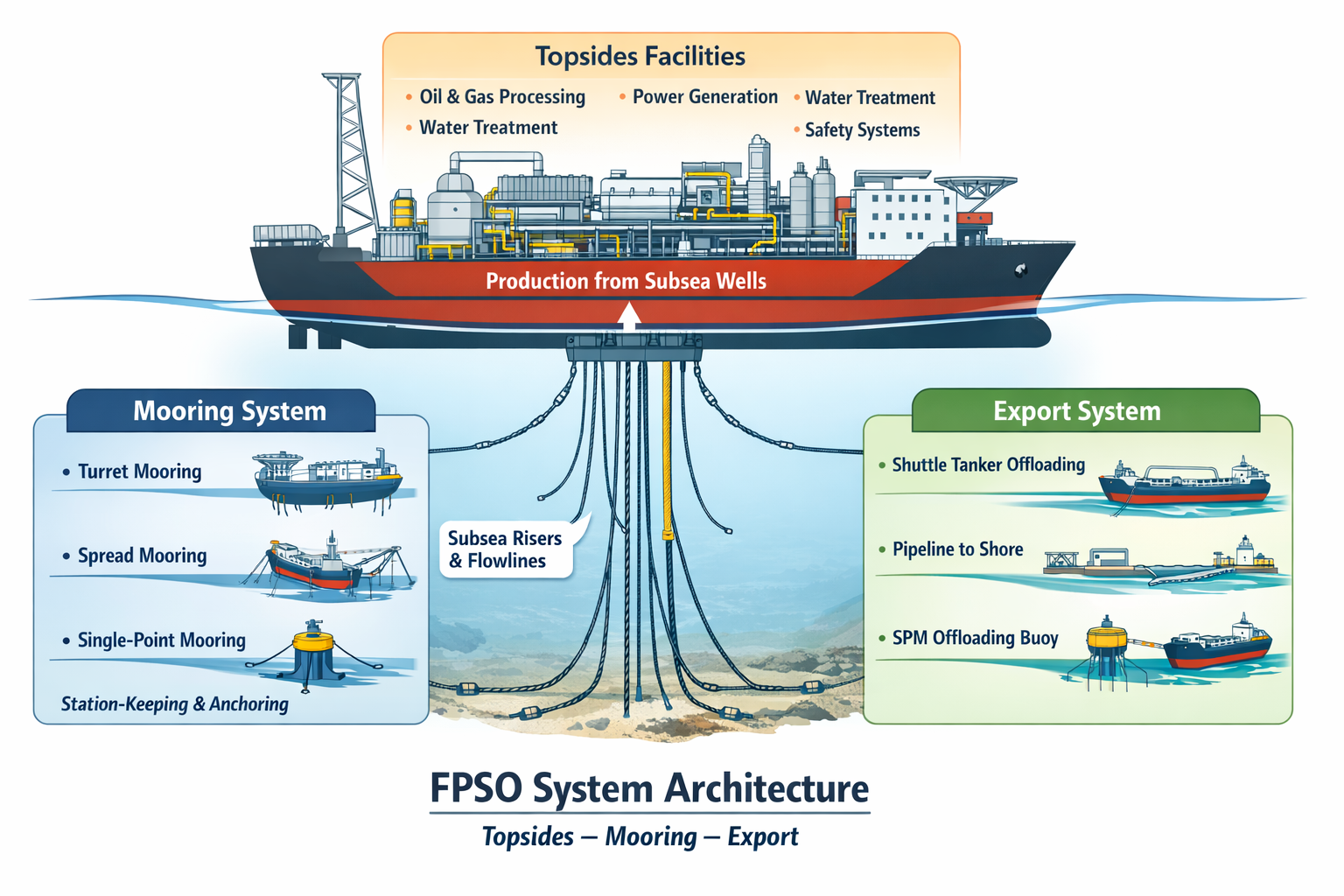
The design of FPSO topsides cannot be considered in isolation from other vessel systems. In practice, the topsides must function seamlessly with the mooring system and export infrastructure to ensure safe and efficient offshore production.
One of the most important interactions occurs between the topsides and the vessel’s station-keeping system. FPSOs are typically moored to the seabed using either turret mooring systems or spread mooring arrangements. These systems maintain the vessel’s position relative to the subsea wells while allowing controlled motion in response to waves, wind and currents.
In turret mooring systems, the FPSO is connected to a fixed turret structure that contains mooring lines and risers. The vessel can rotate around the turret, allowing it to align naturally with environmental forces. This weathervaning capability reduces stresses on mooring lines and subsea risers.
The risers that transport hydrocarbons from the seabed to the vessel often pass through the turret and connect directly to the FPSO topsides processing facilities. As a result, the topsides design must accommodate these riser connections and ensure safe routing of fluids into the processing system.
Spread mooring systems, in contrast, use multiple mooring lines anchored around the vessel. While this approach provides strong positional stability, it limits the vessel’s rotational capacity. As a result, spread-moored FPSOs are typically used in regions with relatively mild environmental conditions.
Export systems represent another critical interface with the FPSO topsides. After hydrocarbons are processed and stabilised, they must be transported to shore. In many offshore developments, oil is stored within the FPSO hull and periodically transferred to shuttle tankers.
During tandem offloading operations, the shuttle tanker positions itself behind the FPSO. Flexible hoses connect the two vessels, allowing crude oil to be pumped from storage tanks to the tanker. The FPSO topsides include pumping and control systems that regulate the transfer process.In some cases, pipelines transport oil or gas directly to onshore processing facilities. When pipelines are available, the FPSO topsides must include export pumps and metering systems that ensure accurate flow measurement and pressure control.Environmental conditions play a major role in offloading operations.
Wind, waves and currents can cause relative motion between the FPSO and the shuttle tanker. Offloading equipment must therefore be designed to accommodate movement while maintaining safe transfer of hydrocarbons.
Operational coordination between topsides processing systems and export operations is also essential. Oil production rates must be balanced with storage capacity and tanker arrival schedules. Efficient coordination ensures continuous production without exceeding storage limits.
Safety considerations remain paramount throughout these FPSO operations. Emergency shutdown systems, quick-release couplings and spill containment systems are installed to minimise environmental risks during hydrocarbon transfer.Ultimately, the FPSO topsides serve as the operational hub of the offshore production system. By integrating hydrocarbon processing with mooring and export infrastructure, these facilities enable reliable energy production in some of the world’s most challenging marine environments.
FAQ: FPSO Topsides
What are FPSO topsides?
FPSO topsides are the processing facilities installed on the deck of a Floating Production, Storage and Offloading vessel. They contain the equipment required to treat well fluids produced from subsea reservoirs. This includes separation units, gas compression systems, water treatment facilities, power generation equipment and safety systems. In essence, the FPSO topsides function as a floating processing plant that transforms raw hydrocarbons into stabilised oil and gas suitable for storage, export or reinjection.
Why are FPSO topsides designed as modules?
FPSO topsides are typically constructed as separate modules because offshore processing facilities are extremely large and complex. Modular construction allows different sections of the process plant to be fabricated simultaneously in specialised yards and later installed on the vessel. This approach improves construction efficiency, reduces project schedules and ensures better quality control during fabrication. It also simplifies transportation, installation and future upgrades of individual modules.
How do FPSO topsides connect to subsea wells?
Hydrocarbons produced from subsea wells are transported to the FPSO through flowlines and vertical risers. These risers bring the mixture of oil, gas and water from the seabed to the vessel. In turret-moored FPSOs, the risers usually pass through the turret and connect directly to the FPSO topsides processing systems. Once onboard, the fluids enter separation and treatment equipment where they are processed before storage or export.
Takeaway
The safe and reliable operation of offshore production systems depends heavily on well-designed FPSO topsides. These facilities integrate hydrocarbon processing, utilities and safety systems within a highly constrained marine environment. Robust structural design, effective fire and gas protection systems, and careful layout planning help ensure safe operations even under harsh offshore conditions. Ultimately, properly engineered FPSO topsides play a critical role in maintaining FPSO vessel and rig safety while enabling continuous energy production in remote offshore fields.

Delve deeper into one of our core topics: Emergency Response Management
Glossary
A hydrocarbon is an organic chemical compound composed exclusively of hydrogen and carbon atoms. Hydrocarbons are the fundamental components of crude oil and natural gas and form the basis of most fossil fuels used in energy production. They occur naturally in underground reservoirs and are formed over millions of years by geological processes. Hydrocarbons are commonly classified into groups such as alkanes, alkenes, alkynes and aromatic compounds, depending on their molecular structure and bonding characteristics. (2)
References:
(1) Paik, J. K., & Thayamballi, A. K. (2007). Ship-shaped offshore installations: Design, building, and operation. Cambridge University Press.
(2) Speight, J. G. (2014). The Chemistry and Technology of Petroleum, 5th Edition. CRC Press.
Note: This article was partly created with the assistance of artificial intelligence to support drafting.