| Written by Constance Stickler
Table of contents:
- Why Ports Are Key Players in the Climate Transition
- What Defines a “Green Port” Today?
- How Are Green Port Initiatives Evolving Today?
- What Are the Biggest Challenges?
- What Should Terminal Operators and Port Authorities Do Now?
- FAQ
- Takeaway
- Glossary
Why Ports Are Key Players in the Climate Transition
A significant portion of maritime emissions is concentrated in and around ports. Ships in port continue to consume fuel, terminal facilities require diesel and electricity, and hinterland transport generates additional emissions. If global supply chains are to become truly sustainable, ports are one of the few places where multiple sources of emissions can be addressed simultaneously.
Regulations are being tightened worldwide, particularly in Europe (an example is the AFIR - Alternative Fuels Infrastructure Regulation). Policymakers are no longer limited to mere incentives—they are setting clear expectations. Shore power connections, emissions reporting, and incentives for cleaner fuels are becoming standard practice. At the same time, shipping companies, cargo owners, and investors are pushing for more environmentally friendly logistics chains. Ports are where sustainability promises are either confirmed or exposed.
Ports occupy a very special position. They connect sea and land, bring together a multitude of stakeholders, and increasingly function as energy hubs. This makes them an environment where systemic change is truly possible. Electrification, alternative fuels, and digitalisation interact, reinforce each other, and can be scaled.
However, this transformation is uneven. Some ports have been forging ahead for years and decades, investing and experimenting. Others are still struggling with feasibility and financing. The gaps lie in technology and strategy.
Waiting, however, is not a viable option. The direction is clearly defined, and the crucial question now is how quickly ports can measurably implement their self-imposed and legally mandated goals. All efforts to increase sustainability must be implemented in such a way that they do not impair the efficiency on which global trade is based. This is precisely where green port initiatives prove their value.
What Defines a “Green Port” Today?
Not too long ago, a port was considered "green" as soon as a few environmental measures were implemented: compliance with regulations, emissions monitoring, and perhaps a pilot project for renewable energy.
Today, however, a green port is defined by how deeply sustainability is integrated into its operations, decision-making processes, and long-term strategy. It's about fundamentally rethinking and transforming how the port functions as a system.
Prevention is better than reaction One of the most significant changes is the shift towards proactive rather than reactive action. Instead of reacting to regulations, leading ports are setting their own, more ambitious targets. This often happens in coordination with overarching frameworks such as the World Ports Sustainability Program (WPSP), launched in 2018 by the International Association of Ports and Harbors (IAPH). Their goals go far beyond reducing emissions and include energy efficiency, air quality, biodiversity and even the port's relationship with the surrounding community.
Energy
A key element of this transformation is energy management. Modern ports not only consume energy, they produce, manage, and distribute it. Shore power, on-site renewable energy sources, and the first serious steps toward hydrogen or alternative fuels are all part of this overall picture. Examples include the trial operation of a hydrogen-powered straddle carrier at the Tollerort container terminal in Hamburg (1) and the "CleanH2Shipping" project, which aims to "develop and implement a viable hydrogen ecosystem for European inland navigation." (2)
Digitisation
Data is not just a reporting tool, but the backbone of the optimisation. Meaningful progress is much easier when energy consumption can be understood in real-time and emissions can be tracked across the entire operation. Furthermore, those who can simulate different scenarios are much better able to manage expectations more realistically.
Beyond the gates
The focus now extends beyond the terminal area. A port cannot truly call itself green if its emissions are merely shifted elsewhere. Therefore, hinterland connections – rail, inland waterway, and intermodal solutions – are now part of the equation. The same applies to collaboration with shipping companies and logistics partners. The most progressive ports are not only improving their own environmental footprint; they are actively shaping greener supply chains.
Efficiency
Performance doesn't have to be sacrificed for sustainability. On the contrary, well-developed initiatives demonstrate that they can reinforce each other. Lower energy consumption reduces costs. Better planning minimises downtime. Cleaner operations attract customers who are under pressure to reduce their CO₂ emissions.
How Are Green Port Initiatives Evolving Today?
The past decade was characterised by experimentation. The current phase focuses on expanding proven approaches: moving away from small, isolated pilot projects and toward structured programs supported by policy measures, funding, and compelling economic analyses.
Regulation
Regulation is one of the biggest drivers of sustainable development. Europe, in particular, is playing a leading role in this area. Ports are expected to enable clean shipping. Requirements for shore power, alternative fuel infrastructure, and emissions transparency are becoming increasingly stringent. What was once considered an "early adopter" is rapidly becoming the standard.
Financing
Thanks to initiatives (such as those of the European Commission), ports now often have better access to support for large-scale infrastructure projects. This is crucial for effective measures like shore power systems or grid expansions, which require significant upfront investments. The difference from the past is that these investments are no longer considered speculative, but increasingly necessary and unavoidable.
Green shipping corridors
These are operational routes where ports, shipping companies, and logistics providers are focusing on low-emission or zero-emission solutions. This is leading to very concrete developments – ports are investing in bunkering infrastructure for alternative fuels, harmonising standards, and coordinating schedules with shipping companies.
Energy
While isolated solutions, such as the installation of solar panels, were prevalent in the past, ports today take a systemic approach. How can locally generated renewable energy be fed into the shore power supply? How can electricity be stored to stabilise the supply? Which alternative fuels should be included in the long-term energy mix? These integrated approaches clearly demonstrate the maturity of the industry.
Digitalisation
The same path is being taken in IT. Instead of siloed solutions, networked platforms are being developed that link operational data with energy consumption and emissions monitoring. This enables something that was previously impossible to this extent: real-time decision-making. Whether it concerns equipment utilisation, berth occupancy, or the reduction of idle times, their optimisation contributes directly to emissions reduction.
Inland ports
Ports on rivers are also being considered. They are positioning themselves as key factors for more environmentally friendly hinterland transport. This broader network perspective is essential because emissions don't end at the dock.
Despite uncertainties around standards, the availability and long-term viability of some technologies (for example, alternative fuels), decisions must now be made in some cases, even though all the answers are not yet available. However, the general direction is clear.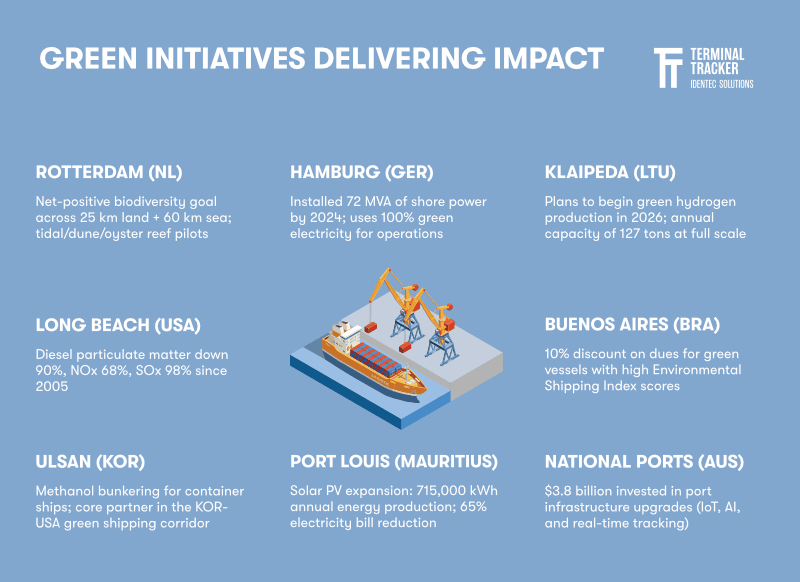
What Are the Biggest Challenges?
The complexity of creating a truly green port lies in the financial and operational cooperation, particularly given the differing priorities of the various stakeholders.
The biggest hurdle remains investment. Shore power, grid expansion, electrified facilities, hydrogen infrastructure – all of this is expensive. The sometimes uncertain amortisation periods necessitate careful prioritisation and often slow down broader implementation.
Significant coordination is required. A port can install shore power, but if ships aren't equipped or operators choose not to use it for cost reasons, the impact remains limited. The same applies to alternative fuels: infrastructure without demand doesn't work, but demand doesn't arise without infrastructure.
Data—or the lack thereof—is another point of friction. Although digitalisation has become virtually ubiquitous, its implementation varies considerably. Many ports continue to struggle with fragmented systems and inconsistent data standards. Without comparable data, however, it is very difficult to optimise processes, track progress, and make sound calculations about the economic viability of further investments. This is particularly relevant when emissions need to be measured across multiple stakeholders.
Electrification and new energy systems are bringing about changes in operational planning and execution. Issues such as charging cycles, energy availability, and peak load management are now on the agenda.
The training of the workforce must take all these changes into account. New technologies require new skills, whether in energy management, digital systems, or the maintenance of electrified facilities. Only those who invest in infrastructure and personnel can fully reap the benefits (see also: predictive maintenance).
Adding to all these challenges is the uncertainty: not all technologies are equally mature, and not all can be scaled equally. Especially with alternative fuels like hydrogen, ammonia, and methanol, many questions regarding costs, safety, availability, and long-term profitability remain unanswered. Yet ports must make decisions today that will shape their infrastructure for decades to come, often without complete clarity about which solutions will prevail.
In short: there is no shortage of ideas for sustainability. The challenge lies in their implementation under uncertainty. This is where the fate of many ports diverges: they either gain momentum or fall behind.
What Should Terminal Operators and Port Authorities Do Now?
The first step is positioning. Not every initiative has the same impact, and not every port has the same starting conditions. Electrification, shore power, and energy efficiency measures are often the most effective levers. The latter, in particular, should not be underestimated. Optimising routes and orders saves fuel, which means fewer emissions. The same applies to fleet transparency. Optimally configured and maintained vehicles and equipment consume less energy. Finally, preventing unnecessary relocations also represents a saving: if containers are positioned correctly and are therefore easily locatable at all times, unnecessary movement is minimised.
The next step is integration. Isolated, individual projects rarely reach their full potential. Shore power, for example, is only truly effective when it is aligned with energy procurement, pricing models, and ship usage. The same applies to digital tools – data is only valuable when it connects systems and supports decisions across the entire operation. Integration with the Terminal Operating System (TOS) offers significant operational improvements.
Coordination and consistency are key. Communication is necessary not only between internal departments, but also externally with shipping companies, logistics providers, solution providers, and energy partners.
Measurability and transparency are prerequisites for success. Data must therefore be considered a key asset. Only real-time knowledge of operational processes and energy consumption allows for effective optimisation and verification of results. Sustainability KPIs are equally important. Only defined key performance indicators allow us to assess whether the set goals are being achieved.
It's important to remain pragmatic. Not every decision needs to be perfect, especially in an environment where technology and regulation are constantly evolving. Those who wait for absolute certainty often remain inactive. Staying flexible allows ports to start with what's feasible today and adapt to changing conditions later.
As with all transitions, leadership plays a crucial role. Since traditional boundaries are being crossed—technical, operational, and commercial—a clear direction and a willingness to make long-term decisions are essential. There must be a roadmap that balances short-term successes with long-term positioning.
Ports don't need to have all the answers right now. But they must take action—in a way that makes ambitious goals measurable, scalable, and ultimately competitive.
FAQ
How Do Green Port Initiatives Support the Development of Green Corridors?
Green corridors are only as effective as the ports along their path. This illustrates the shift of green port initiatives from internal improvements to pioneering system-wide change.
A vessel that wants to operate on a low-emission or zero-emission route needs access to sustainable infrastructure such as shore power and alternative fuel supplies at both ends (and any stopovers in between). Ports that invest in these capacities attract shipping companies willing to choose environmentally friendly routes with lower operational risk.
Truthful green shipping and its communication are based on transparency. This, in turn, requires emissions recording, energy monitoring, and operational transparency to measure the impact along the entire route, not just at individual hubs. Two examples of emerging green corridors for container ships are the short-sea distances Oslo-Rotterdam (3) and the Green Baltic X-PRESS (4).
Takeaway
Green port initiatives are no longer limited to isolated measures and symbolic projects. They are evolving into an operational framework in which new technologies, terminal processes, and supply chain partners are aligned with measurable sustainability.
The ports that can best put their goals into practice will lead the transformation. This requires more than just investments in infrastructure; sustainable practices must be integrated into systems, stakeholder engagement, and decision-making processes. This demands real-time transparency, consistent data, and clearly defined KPIs.
At the same time, a degree of uncertainty remains due to evolving technologies and standards. The key is to remain pragmatic: start with what is feasible, scale what has proven successful, and remain flexible enough to adapt to new circumstances.
On the surface, it's about regulatory compliance and living up to environmental responsibility. In reality, both depend on control: The ability to understand what is happening across the entire operation, to react in real-time, and to continuously improve. The ports that can do this effectively will shape the competitive landscape in the years to come.

Delve deeper into one of our core topics: Smart Port
Glossary
Shore power (also called cold ironing) supplies electrical power from the port grid to ships at berth (look also for: , allowing auxiliary engines and generators to shut down. High-voltage cables connect the vessel to shore-side transformers and frequency converters that match ship requirements (typically 6.6–11 kV, 60 Hz). This reduces fuel consumption, emissions (NOx, SOx, PM), noise, and engine wear during idle periods. Common for container and reefer vessels, cruise ships, and ferries, shore power supports onboard systems, lighting, refrigeration, and hotel loads while complying with port emission regulations. (5)
The World Ports Sustainability Program (WPSP) is a global initiative to promote sustainability in ports worldwide. Its goal is to support ports in achieving the 17 UN Sustainable Development Goals (SDGs) by sharing best practices and strengthening international cooperation in the supply chain. The program focuses on climate-friendly infrastructure, the energy transition, security, governance, and connections to the local community. (6)
References:
(2) https://zbt.de/en/projects/cleanh2shipping-hydrogen-ecosystem-for-inland-shipping/
(3) https://assets.ctfassets.net/gk3lrimlph5v/7zsVf5G9wzNPhEjFPjCrFC/f2918a81c76b734952c6ed4024ef42d9/
Annual_progress_report_on_green_shipping_corridors_2025.pdf
(4) https://www.orca-ai.io/blog/maritime-green-corridors/
(5) Notteboom, Pallis, Rodrigue (2022). Port Economics, Management and Policy. Routledge.
(6) https://sustainableworldports.org/
Note: This article was partly created with the assistance of artificial intelligence to support drafting.

Author
Conny Stickler, Marketing Manager Logistics
Constance Stickler holds a master's degree in political science, German language and history. She spent most of her professional career as a project and marketing manager in different industries. Her passion is usability, and she's captivated by the potential of today's digital tools. They seem to unlock endless possibilities, each one more intriguing than the last. Constance writes about automation, sustainability and safety in maritime logistics.