| Written by Mark Buzinkay

Table of contents:
- What Is Incident Analysis?
- Common Biases in Incident Analysis
- Why These Biases Matter
- Best Practices for Objective Incident Analysis
- FAQs
- Takeaway
- Glossary
What Is Incident Analysis?
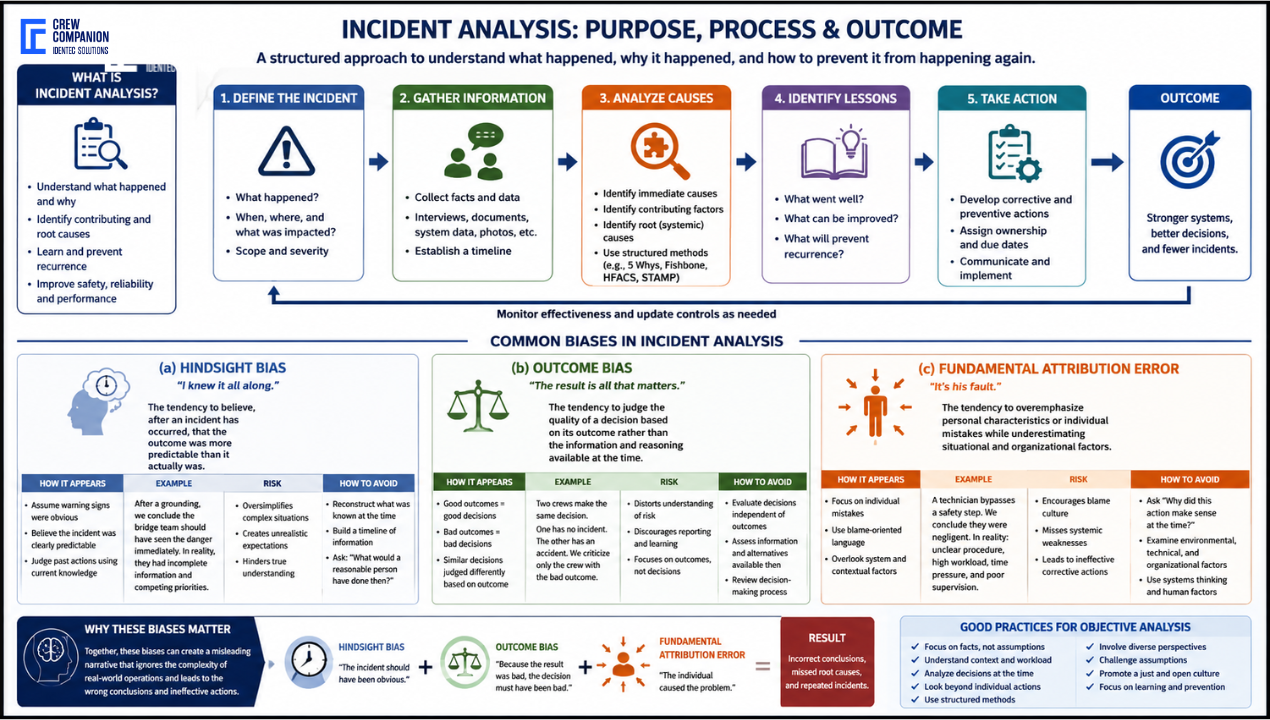
Incident analysis is the structured examination of an incident, accident, near miss, equipment failure, operational disruption, or safety event to determine what happened, why it happened, and how to prevent recurrence.
Organisations across industries—including offshore energy, maritime operations, manufacturing, aviation, healthcare, and logistics—use incident analysis to improve safety, operational reliability, and organisational learning. While the severity of incidents may vary, the underlying objective remains the same: understanding the chain of events and conditions that led to an undesirable outcome.
A comprehensive incident analysis goes beyond identifying a single cause. Most incidents arise from a combination of technical, organisational, environmental, and human factors. For example, an offshore worker injury may involve equipment issues, communication breakdowns, procedural deficiencies, workload pressures, and environmental conditions simultaneously (learn more: Fail safe design for safer offshore installations).
Modern safety science emphasises that incidents rarely result from a single mistake. Instead, they emerge from interactions within complex systems. Consequently, effective investigations focus on identifying both immediate causes and deeper systemic factors.
Typical steps in incident analysis include:
- Defining the incident and its scope
- Collecting evidence and factual information
- Establishing a timeline of events
- Identifying direct and contributing causes
- Evaluating organisational and systemic factors
- Developing corrective and preventive actions
- Monitoring the effectiveness of implemented improvements
Organisations that conduct thorough incident analyses gain valuable insights that strengthen risk management programs, improve procedures, enhance training, and foster a culture of continuous improvement.
(see also: emergency response kit for FPSOs).

Common Biases in Incident Analysis
Human judgment plays a significant role in every investigation. Unfortunately, investigators are susceptible to cognitive biases that can distort the interpretation of evidence and lead to inaccurate conclusions. Three of the most influential biases in incident analysis are hindsight bias, outcome bias, and fundamental attribution error.
Hindsight Bias
Hindsight bias refers to the tendency to view an event as having been more predictable after it has occurred than it actually was before the outcome was known. Often called the “I knew it all along” effect, hindsight bias can significantly distort incident investigations.
When investigators already know the outcome, they naturally interpret past events through that knowledge. Warning signs may appear obvious, decisions may seem reckless, and alternative actions may appear self-evident. However, individuals involved in the incident did not have the same information investigators had after the fact.
Consider an offshore vessel that loses position in adverse weather. Following the incident, investigators may conclude that operators should have recognised the danger much earlier. Yet at the time, the crew may have faced uncertain forecasts, incomplete sensor data, and competing operational demands.
The primary danger of hindsight bias is that it oversimplifies complex situations. It creates an illusion of predictability and may lead organisations to underestimate uncertainty, ambiguity, and operational complexity.
Investigators influenced by hindsight bias often ask:
- Why didn’t they see the problem?
- Why didn’t they stop the operation?
- Why didn’t they recognise the warning signs?
More productive questions include:
- What information was available at the time?
- How did conditions appear from the operators’ perspective?
- Why did the chosen actions seem reasonable under those circumstances?
To mitigate hindsight bias, investigators should reconstruct events chronologically and evaluate decisions using only information available before the incident occurred.
Outcome Bias
Outcome bias occurs when people judge a decision primarily by its result rather than by the information and reasoning available at the time.
This bias is especially problematic because good decisions do not always produce good outcomes, and poor decisions do not always produce bad outcomes. Randomness, uncertainty, and external factors can influence results.
Imagine two offshore maintenance teams facing similar operational conditions. Both teams decide to proceed with a task after conducting risk assessments. One team completes the work without incident, while the other experiences an equipment failure that results in an injury.
Because investigators focus on the negative outcome, they may conclude that the second team’s decision was flawed. However, if both teams had similar information and followed established procedures, the decision-making process itself may have been entirely reasonable.
Outcome bias can lead organisations to:
- Overlook successful risk management practices
- Focus excessively on negative outcomes
- Miss opportunities to improve decision-making processes
- Discourage transparent reporting
A robust incident analysis evaluates the quality of decisions independently of their outcomes. Investigators should assess whether the decision was justified based on available information, organisational procedures, training, and operational constraints.
Fundamental Attribution Error
Fundamental attribution error is the tendency to overemphasise personal characteristics or individual mistakes while underestimating situational and organisational influences.
In incident investigations, this bias often manifests as a focus on operator error. Investigators may conclude that a worker was careless, inattentive, or negligent without adequately considering the environment in which decisions were made.
For example, an offshore technician may bypass a procedural step during maintenance. A superficial investigation might attribute the incident solely to non-compliance. However, deeper analysis may reveal factors such as:
- Excessive workload
- Inadequate staffing
- Poorly designed procedures
- Equipment limitations
- Production pressures
- Organizational norms
The fundamental attribution error encourages a blame-oriented approach that overlooks systemic weaknesses. As a result, corrective actions may focus on retraining or disciplining individuals while failing to address underlying organisational vulnerabilities.
Modern human factors research emphasises that people generally act in ways that make sense within their local context. Effective investigators therefore ask:
- Why did this action appear reasonable at the time?
- What conditions influenced the decision?
- What organisational factors shaped behaviour?
By understanding context rather than assigning blame, organisations can identify more effective preventive measures. (1)
Read more about emergency response training offshore!
Why These Biases Matter
The consequences of bias in incident analysis extend far beyond inaccurate investigation reports. Biases influence corrective actions, organisational learning, safety culture, and ultimately future risk exposure.
When hindsight bias dominates an investigation, organisations may develop unrealistic expectations regarding hazard recognition and decision-making. Personnel are expected to identify risks that were not actually obvious at the time.
Outcome bias can distort risk assessments by creating a false relationship between outcomes and decision quality. This can lead to inconsistent evaluations of similar actions and discourage open reporting of near misses.
Fundamental attribution error can be particularly damaging because it reinforces blame cultures. Employees become reluctant to report errors, near misses, and safety concerns if they believe investigations will focus solely on individual fault.Together, these biases create a misleading narrative:
- The hazard was obvious.
- The decision was poor.
- The individual caused the problem.
Such conclusions may appear logical but often fail to explain why the incident occurred within the broader system.
Organisations that ignore these biases risk implementing ineffective corrective actions. For example, retraining an employee may have little impact if the real issue involves procedural complexity, inadequate staffing, or flawed equipment design.
Conversely, organisations that recognise cognitive biases are better positioned to uncover systemic vulnerabilities and strengthen overall resilience.Effective incident analysis therefore serves two critical functions:
- Preventing recurrence of specific incidents.
- Improving organisational understanding of how complex systems fail.
The latter objective is particularly important in high-risk industries such as offshore energy, maritime transportation, and industrial operations, where incidents rarely result from a single cause. (2)
Best Practices for Objective Incident Analysis
Achieving objectivity in incident analysis requires a deliberate and systematic approach. While biases cannot be completely eliminated, organisations can implement practices that significantly reduce their influence.
Establish a Detailed Timeline
Creating a chronological reconstruction of events helps investigators understand what information was available at each point in time. Timelines reduce hindsight bias by separating knowledge available before the incident from information discovered afterwards.
Separate Facts from Interpretations
Investigations should clearly distinguish verified facts from assumptions, opinions, and hypotheses. This helps prevent preconceived beliefs from influencing conclusions.
Examine the Operational Context
Always analyse human actions within their operational environment. Factors such as workload, fatigue, communication quality, supervision, and environmental conditions must be considered alongside individual decisions.
Focus on Systems Rather Than Individuals
A systems-thinking approach recognises that incidents emerge from interactions among people, technology, procedures, and organisational structures. This perspective helps identify systemic vulnerabilities rather than assigning blame.
Use Human Factors Principles
Human factors analysis examines how design, procedures, organisational culture, and environmental conditions influence human performance. Incorporating these principles improves understanding of why actions made sense to those involved.
Involve Multiple Perspectives
Multidisciplinary investigation teams reduce the likelihood of individual biases influencing findings. Diverse expertise encourages critical discussion and challenges assumptions.
Evaluate Decisions Using Available Information
Investigators should assess decision quality based on information known at the time, not on the eventual outcome. This practice directly counters both hindsight bias and outcome bias.
Promote a Learning Culture
Organisations should emphasise learning rather than punishment. Employees are more likely to report incidents and participate openly in investigations when they trust that the process seeks improvement rather than blame.
Verify Corrective Action Effectiveness
Incident analysis does not end when recommendations are issued. Organisations should monitor whether corrective actions effectively reduce risk and address underlying causes. When applied consistently, incident analysis becomes a powerful tool for improving safety, reliability, and operational performance. (3)
FAQ
What is the primary purpose of incident analysis?
The primary purpose of incident analysis is to understand why an incident occurred and identify measures that can prevent similar events from happening again. The process supports organisational learning, risk reduction, and continuous improvement.
Why is hindsight bias dangerous in investigations?
Hindsight bias makes past events appear more predictable than they actually were. This can lead investigators to unfairly judge decisions, overlook uncertainty, and miss important contextual factors that influenced behaviour.
How can organisations reduce bias in incident analysis?
Organisations can reduce bias by reconstructing timelines, evaluating decisions based on available information, involving multidisciplinary teams, applying human factors principles, and focusing on systemic causes rather than individual blame.
Takeaway
Incident analysis is most effective when it seeks understanding rather than blame. By recognising hindsight bias, outcome bias, and fundamental attribution error, investigators can develop a more accurate picture of why incidents occur and implement corrective actions that address underlying causes. This approach is particularly important in offshore operations, where complex interactions between people, technology, procedures, and environmental conditions shape outcomes (read more about e-mustering). Objective incident analysis helps offshore organisations improve safety, strengthen operational resilience, and prevent future incidents through meaningful organisational learning.
Delve deeper into one of our core topics: Emergency Response Management
Glossary
A bias is a systematic tendency to think, judge, or interpret information in a particular way that can deviate from objective reality. Cognitive biases arise because the human brain uses mental shortcuts, known as heuristics, to process complex information efficiently. While these shortcuts often help people make decisions quickly, they can also lead to predictable errors in reasoning. In incident analysis, biases may influence how investigators interpret evidence, assess decisions, and assign causes, potentially leading to incomplete or inaccurate conclusions. (4)
References:
(1) https://humanfactors101.com/2016/10/09/human-error-human-performance-investigations/
(2) https://www.hse.gov.uk/humanfactors/topics/investigation.htm
(3) https://www.csb.gov/recommendations/
(4) Kahneman, D. (2011). Thinking, Fast and Slow. New York: Farrar, Straus and Giroux. ISBN: 978-0374533557
Note: This article was partly created with the assistance of artificial intelligence to support drafting and illustrating.