| Written by Mark Buzinkay
Table of contents:
- Why network connectivity has become essential in underground mining
- Understanding the different types of network connectivity in underground mines
- How network connectivity transforms underground mining processes
- Real-time localisation: Turning network connectivity into operational intelligence
- Designing a reliable network connectivity strategy for the mine of tomorrow
- FAQ
- Takeaway
- Glossary
Why network connectivity has become essential in underground mining
Underground mining has always depended on communication. For decades, miners relied primarily on radios, telephones and verbal instructions to coordinate production and respond to emergencies. Today, however, mining operations generate enormous amounts of digital information every second. Equipment continuously reports its operating status, environmental sensors monitor conditions throughout the mine, operators exchange production data in real time, and control rooms increasingly supervise autonomous or remotely operated machinery.
None of these processes can function efficiently without reliable network connectivity. Modern underground mines are becoming highly connected industrial environments. Digital transformation has fundamentally changed how mines operate, shifting decision-making from delayed reporting towards real-time operational awareness. Instead of analysing yesterday’s production figures, supervisors can now monitor equipment utilisation, vehicle movements, ventilation performance, and personnel locations in real time.
This shift delivers significant operational advantages. Production bottlenecks become visible immediately rather than after a shift has ended. Equipment failures can be detected before they lead to costly downtime. Maintenance teams receive live diagnostic information, while dispatchers can optimise traffic flows based on current conditions instead of historical assumptions.
Perhaps even more importantly, network connectivity has become a cornerstone of mine safety.
Underground environments are inherently challenging. Long tunnels, multiple production levels, constantly changing layouts, dust, humidity, heavy machinery and limited visibility all complicate communication. During emergencies, every second counts. Fast, reliable communication between underground personnel and surface control rooms allows incidents to be assessed more quickly and rescue operations to begin sooner.
Network connectivity also enables electronic personnel tracking, allowing mine operators to know where miners are during both routine operations and emergencies. When combined with environmental monitoring, gas detection, and automated alarms, connected systems provide valuable situational awareness that was impossible only a generation ago.
Beyond safety, connectivity supports virtually every operational process within a modern mine, including:
- Fleet management and equipment dispatch
- Autonomous and remotely operated machinery
- Ventilation on Demand (VoD)
- Predictive maintenance
- Environmental monitoring
- Video surveillance and analytics
- Digital inspections
- Electronic Permit-to-Work (ePTW)
- Production reporting
- Asset tracking
- Digital twins
- Artificial intelligence applications
Each of these systems depends on timely, reliable data exchange. In other words, network connectivity is no longer an optional IT service—it has become operational infrastructure comparable to electricity, ventilation or dewatering systems.
Another important development is the growing expectation that mines remain operational around the clock. Downtime caused by communication failures can interrupt production, delay maintenance activities and reduce overall productivity. Consequently, communication networks are increasingly designed with resilience and redundancy in mind, ensuring that critical safety services continue to operate even if one communication path becomes unavailable.
As mines continue to automate operations and introduce more connected equipment, the importance of network connectivity will only increase. Rather than supporting isolated systems, today’s communication infrastructure serves as the digital backbone that connects people, machines, and processes into a single integrated mining operation. (1)

Understanding the different types of network connectivity in underground mines
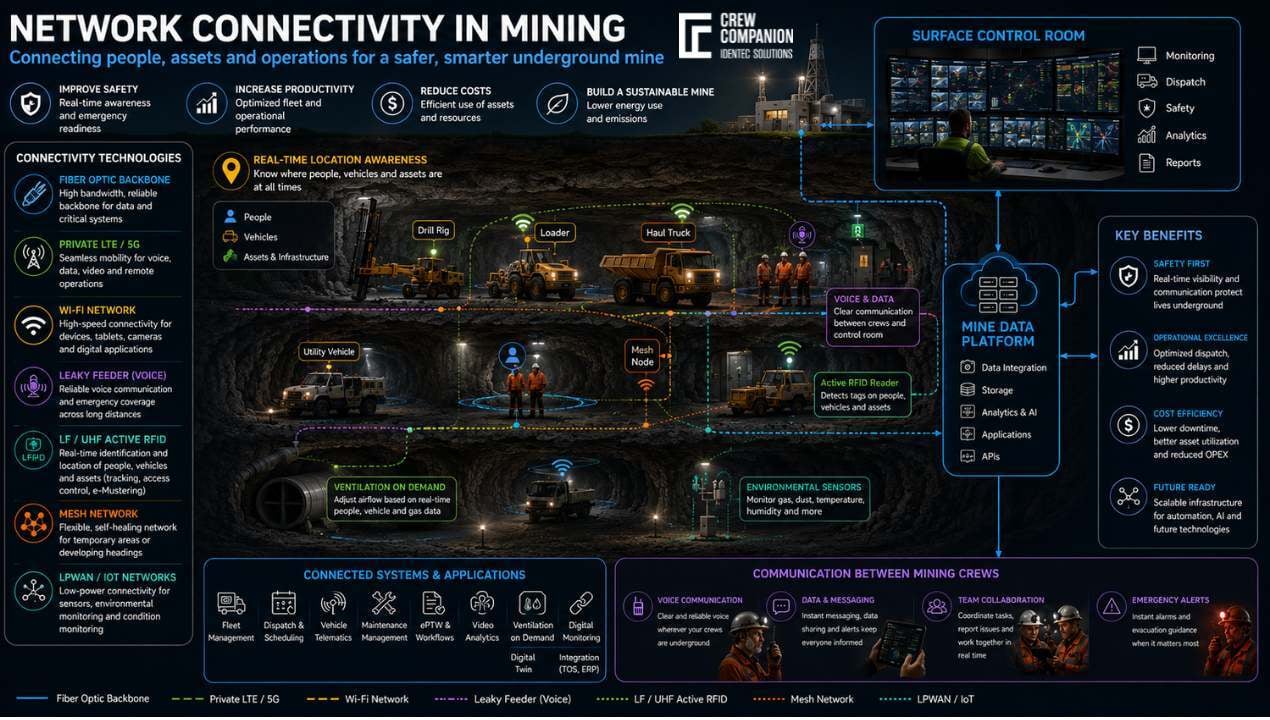
There is no single communication technology capable of meeting every requirement in an underground mine. Instead, successful operations typically combine several complementary network technologies, each selected based on the application, required bandwidth, mobility, reliability, and installation effort. The result is a layered communication architecture in which different networks perform different tasks while together creating a robust digital infrastructure.
Fibre optic backbone
Most modern mines use fibre optic cables as their primary communication backbone. Fibre provides extremely high bandwidth, low latency and excellent reliability over long distances, making it ideal for connecting underground communication rooms, substations, production levels and surface control centres. Because fibre is immune to electromagnetic interference, it performs well alongside heavy electrical equipment and high-power machinery. It also supports virtually unlimited future expansion as additional digital services are introduced.
The primary disadvantage is installation effort. Fibre requires physical cable installation, protection against mechanical damage, and regular extension as mining activities progress deeper underground. Nevertheless, because of its long lifespan and exceptional performance, fibre remains the preferred backbone technology in most large underground operations.
Wi-Fi networks
Wireless Local Area Networks (WLAN), commonly known as Wi-Fi, are widely used in underground mines to provide mobile connectivity for workers and equipment. Typical applications include handheld tablets, maintenance terminals, underground offices, production reporting, cameras and engineering workstations. Wi-Fi offers high data throughput and supports standard Internet Protocol (IP) communication, making it compatible with a broad range of industrial software and connected devices.However, Wi-Fi access points require continuous infrastructure deployment as production areas advance. Radio coverage can also be affected by tunnel geometry, intersections and moving equipment. Consequently, Wi-Fi is generally best suited to areas with relatively stable infrastructure rather than rapidly advancing production faces.
Private LTE and private 5G
Private cellular networks have become increasingly attractive for mining operations seeking seamless mobility across large underground areas.
Unlike conventional Wi-Fi, private LTE and private 5G are specifically designed for mobile users travelling between coverage zones. This makes them particularly suitable for connected vehicles, autonomous equipment, remote operation and high-definition video transmission. Private cellular networks also provide stronger quality-of-service management, allowing operators to prioritise mission-critical applications over routine data traffic.
Although deployment costs are generally higher than those of conventional wireless systems, private LTE and 5G can simplify network management while supporting large numbers of devices connected simultaneously.
Leaky feeder systems
Leaky feeder technology has served underground mining for more than four decades and remains one of the most widely deployed communication systems worldwide.
A specially designed coaxial cable acts as a distributed antenna, allowing handheld radios to communicate throughout long underground tunnels. The system is particularly well-suited for reliable voice communication and can also support limited data transmission, depending on the installed equipment.
Its greatest strengths are proven reliability, familiar operation and extensive coverage along mine roadways. Many existing underground mines continue to rely on leaky feeder systems as the primary communication platform for daily operations.
While newer broadband technologies provide significantly higher data rates, leaky feeder systems remain highly valuable for operational communication and emergency response.
Mesh networks
Wireless mesh networks consist of multiple interconnected nodes that automatically forward information through neighbouring devices. Instead of depending on a single communication path, data can often find alternative routes if individual nodes fail.
This flexibility makes mesh networking attractive for temporary installations, exploration projects and rapidly changing underground environments where infrastructure is frequently relocated. However, network performance depends on node density and topology, making careful planning essential for larger deployments.
Low-power wireless networks
Not every underground application requires high bandwidth. Battery-powered environmental sensors, condition-monitoring devices, and certain asset-tracking applications generate only small amounts of data but may need to operate for many years without maintenance.
Low-power wireless technologies—including LoRaWAN, Bluetooth Low Energy (BLE) and other Industrial Internet of Things (IIoT) solutions—address these requirements by prioritising energy efficiency over transmission speed.
These networks are particularly effective for monitoring environmental conditions, collecting equipment diagnostics, and supporting large-scale sensor deployments where frequent battery replacement would be impractical.
Active RFID (LF/UHF)
Active RFID systems operating in the Low Frequency (LF) and Ultra High Frequency (UHF) bands are widely used in underground mining to identify and locate personnel, vehicles and mobile assets. Unlike passive RFID tags, active RFID devices contain their own battery, allowing them to transmit signals over considerably longer distances while supporting real-time monitoring.
In many mines, LF technology is used to trigger precise location events at defined checkpoints such as tunnel intersections, refuge chambers, access points or loading areas. UHF communication is then used to transfer identification data over longer distances to nearby readers or communication gateways. This combination provides reliable detection even in challenging underground environments while maintaining low power consumption.
Typical applications include personnel tracking, vehicle identification, asset management, electronic mustering, access control, collision avoidance support and production reporting. Because active RFID generates relatively small amounts of data, it can either operate over a dedicated RFID infrastructure or integrate with existing communication networks such as fibre optic backbones, Wi-Fi, private LTE/5G or Industrial Internet of Things (IIoT) gateways.
The main advantages of active RFID include long battery life, proven industrial reliability, straightforward deployment and comparatively low installation costs when compared with high-bandwidth communication systems. As a result, active RFID continues to play an important role in underground mines where dependable identification and location awareness are more important than continuous broadband connectivity.
Readers depend on different network technologies. Most of the time, they use a wired connection to transfer data within the mining infrastructure.
Why do most mines combine several technologies
Rather than selecting a single communication technology, modern underground mines typically deploy several complementary networks.For example, fibre-optic cables may provide the backbone connecting production levels, while Wi-Fi delivers local broadband access, private LTE supports mobile vehicles, low-power IoT networks connect sensors, and leaky feeder systems continue to provide dependable voice communication.
This layered approach allows every application to operate on the technology best suited to its performance requirements while also improving resilience. If one communication system experiences disruption, critical services can often continue through alternative network paths or dedicated backup systems. The objective is therefore not simply to maximise bandwidth, but to build an integrated communication architecture that balances performance, installation effort, scalability, operational reliability and long-term cost.
How network connectivity transforms underground mining processes
Installing a communication network is not an objective in itself. The real value of network connectivity lies in the operational processes it enables. A mine with reliable digital infrastructure can make faster decisions, reduce manual work, improve equipment utilisation and significantly enhance safety. Rather than viewing communication networks as an IT investment, mining companies increasingly recognise them as a core production asset that supports every stage of the mining cycle.
From connected equipment to connected operations
Every underground mine consists of dozens of interconnected processes. Drilling, blasting, loading, hauling, crushing, ventilation, maintenance and inspections all depend on timely information. Historically, much of this information was exchanged manually using radio calls, paperwork or end-of-shift reports. As a result, decisions were often based on outdated information.
Network connectivity changes this model completely.
Modern equipment continuously exchanges operational data with mine control systems. Loaders report completed loading cycles, haul trucks transmit their current locations, pumps communicate their operating status, and ventilation systems adjust airflow according to production activities. Supervisors no longer need to wait until the end of a shift to understand what is happening underground—they can monitor operations in real time.
This continuous flow of information reduces delays between an event occurring and corrective action being taken. Equipment breakdowns can trigger immediate maintenance requests, traffic congestion can be resolved before queues develop, and production plans can be adjusted dynamically as underground conditions change.
Fleet management and dispatch optimisation
Underground mobile equipment represents one of the largest investments in any mining operation. Maximising fleet utilisation therefore has a direct impact on productivity and operating costs. Network connectivity enables fleet management systems to monitor the location, operating status and availability of every vehicle. Dispatch software can automatically assign equipment to production areas, optimise haul routes and balance workloads across multiple mining levels. Instead of relying on radio communication to coordinate vehicle movements, dispatchers receive continuous updates from connected equipment. This allows production schedules to adapt to changing conditions, reducing idle time and unnecessary travel.The benefits include:
- Higher equipment utilisation
- Reduced waiting times at loading and dumping points
- Improved fuel or energy efficiency
- Lower maintenance costs due to smoother traffic flow
- Increased production consistency
As mines introduce battery-electric vehicles (BEVs) and autonomous haulage systems, real-time communication becomes even more critical. Vehicle charging schedules, battery health and equipment availability can all be managed through the same digital infrastructure.
Predictive maintenance
Maintenance has traditionally followed either fixed service intervals or reactive repairs after equipment failures occurred. Both approaches have disadvantages. Scheduled maintenance may replace components that still have useful life remaining, while reactive maintenance can lead to expensive production interruptions.
Connected mining equipment generates continuous diagnostic information, including engine performance, hydraulic pressures, vibration levels, temperatures and fault codes. By analysing these data streams, maintenance teams can identify developing problems before failures occur. Predictive maintenance allows repairs to be planned during scheduled downtime rather than during unexpected breakdowns.The result is:
- Improved equipment availability
- Lower maintenance costs
- Reduced spare parts inventory
- Longer equipment lifetime
- Increased production reliability
Without reliable network connectivity, however, this continuous monitoring would not be possible.
Ventilation on Demand
Ventilation is one of the largest energy consumers in underground mining, often accounting for 30–50% of a mine’s total electricity consumption. Traditional ventilation systems operate continuously regardless of whether personnel or equipment are present in a particular section of the mine. This ensures safe air quality but consumes significant amounts of energy. Ventilation on Demand (VoD) changes this approach by adjusting airflow according to actual underground activity.
Using network connectivity together with personnel tracking, equipment positioning and environmental sensors, ventilation systems can automatically increase airflow where miners and diesel equipment are operating while reducing ventilation in inactive areas.The advantages include:
- Lower energy consumption
- Reduced operating costs
- Improved environmental conditions
- Better utilisation of ventilation infrastructure
- Lower greenhouse gas emissions where electricity is generated from fossil fuels
Because airflow adjustments depend on real-time information, VoD is only possible with a robust communication network linking sensors, tracking systems and ventilation controls.
Remote operation and automation
Mining automation continues to advance rapidly. Remote-controlled loaders, autonomous drilling rigs and automated haulage systems are becoming increasingly common, particularly in large underground operations.
These machines rely on low-latency communication to exchange commands, video streams and machine status with remote operators or autonomous control systems. Reliable network connectivity supports:
- Tele-remote operation
- Autonomous navigation
- Collision avoidance
- Equipment diagnostics
- Software updates
- Remote troubleshooting
The more autonomous a mine becomes, the greater its dependence on communication infrastructure.
Environmental monitoring
Underground conditions can change rapidly. Gas concentrations, temperature, humidity, dust levels and water inflows all require continuous monitoring. Modern sensor networks automatically collect environmental information and transmit it to central monitoring systems, where abnormal conditions immediately trigger alarms. Rather than requiring personnel to perform manual inspections throughout the mine, operators receive real-time environmental data that enables faster decision-making and earlier intervention.
Digital workflows
Many routine mining activities are becoming paperless.Inspection reports, maintenance work orders, safety observations, electronic Permit-to-Work (ePTW) systems and production reporting increasingly rely on mobile devices connected through underground communication networks.
Digital workflows reduce paperwork, improve data quality, and ensure information is available immediately rather than after manual transcription.
The cumulative effect may appear incremental, but across hundreds of workers and thousands of daily activities, these efficiencies contribute significantly to overall operational performance.
Ultimately, network connectivity transforms individual digital applications into an integrated operational ecosystem where information flows continuously between people, machines and management systems. (2)
Real-time localisation: Turning network connectivity into operational intelligence
While communication networks enable information to move throughout a mine, they do not, by themselves, indicate where people, vehicles, or equipment are located. This additional layer of operational awareness is provided by real-time localisation technologies. Combining network connectivity with positioning data transforms a communication system into an intelligent operational platform that supports both safety and productivity.
Knowing where people are
One of the most valuable applications of localisation technology is personnel tracking. Unlike traditional manual check-in systems, electronic localisation continuously identifies where miners are working underground. Depending on the deployed technology, location information may be available by zone, tunnel, production level or even with metre-level accuracy.
This provides significant advantages during both routine operations and emergency situations. Supervisors gain a live overview of workforce distribution, allowing them to verify whether personnel are entering authorised work areas, identify isolated workers and monitor compliance with safety procedures. During an emergency, control room personnel can immediately determine who may be affected, which escape routes remain available and whether all personnel have reached designated refuge chambers or muster locations. This rapid situational awareness reduces uncertainty during critical incidents and supports faster rescue coordination.
Tracking mobile equipment and assets
Personnel are only one part of underground operations.Mining companies also manage thousands of mobile and fixed assets including:
- Loaders
- Haul trucks
- Drill rigs
- Utility vehicles
- Pumps
- Mobile substations
- Refuge chambers
- Explosives magazines
- Tools and maintenance equipment
Searching for misplaced equipment wastes valuable production time. By combining localisation technologies with communication networks, operators can instantly identify the current position of critical assets. This improves asset utilisation while reducing unnecessary travel and equipment duplication.
Supporting traffic management
Underground traffic becomes increasingly complex as mines expand. Multiple vehicle types share narrow haul roads, intersections and loading points. Congestion reduces productivity and increases collision risks (see: collision avoidance system). Real-time localisation gives dispatch systems continuous information on vehicle movements, enabling dynamic monitoring and traffic management.
Applications include:
- Congestion detection
- Route optimisation
- One-way traffic management
- Priority control for emergency vehicles
- Collision avoidance support
- Automated dispatching
Rather than reacting to traffic problems after they occur, mine operators can proactively manage vehicle movements based on live operational conditions.
Production optimisation
Localisation data also provides valuable operational insight. By analysing equipment movement patterns over weeks or months, mining companies can identify bottlenecks, excessive waiting times, inefficient routes and underutilised assets. Examples include:
- Loader waiting time at draw points
- Queue lengths at crushers
- Truck cycle times
- Equipment utilisation rates
- Shift performance comparisons
- Production delays caused by congestion
These analyses help improve production planning while supporting continuous operational improvement.
Integrating localisation with other digital systems
The greatest value emerges when localisation is integrated with other connected technologies. Personnel location can automatically activate Ventilation on Demand. Equipment positioning can optimise fleet dispatch. Entry into hazardous areas can trigger access control rules or electronic Permit-to-Work verification. Maintenance systems can identify equipment requiring inspection based on its operating location, while digital twins can visualise underground operations in real time.
Artificial intelligence is beginning to combine these multiple data streams to identify operational patterns that would otherwise remain hidden. As machine learning models mature, they will increasingly recommend production adjustments, maintenance scheduling and safety interventions based on continuous operational data.
Building resilience through network design
As dependence on digital systems grows, mines must ensure that communication remains available even when individual components fail. Rather than operating every service on a single network, many mines separate critical functions across different communication technologies. For example:
- Emergency voice communication may continue to operate over a dedicated leaky feeder system.
- Personnel tracking may use an independent wireless infrastructure.
- High-bandwidth applications such as video analytics may operate on fibre and Wi-Fi.
- Environmental sensors may rely on low-power IoT networks designed for long battery life.
This layered architecture reduces the likelihood that a single failure will affect every operational process simultaneously.Redundancy may also include duplicate fibre routes, backup power supplies, alternative wireless paths and automatic failover between communication systems.
The objective is not only continuous production but also the maintenance of essential safety functions under all foreseeable operating conditions. As underground mining becomes increasingly digital, localisation and communication will continue to evolve together. Network connectivity enables the transport of information, while real-time positioning provides the context that transforms information into operational intelligence. Together, they create the connected mine—an environment where every decision can be based on accurate, live data rather than assumptions.
Designing a reliable network connectivity strategy for the mine of tomorrow
Selecting the right communication technology is only one part of building an effective underground communication system. The greater challenge lies in designing a network connectivity strategy that supports today’s operational requirements while remaining flexible enough to accommodate future technologies. Mines are dynamic environments. Production areas move, infrastructure expands, equipment changes and new digital applications are introduced throughout the life of the operation. Consequently, communication networks should be viewed as long-term operational infrastructure rather than one-time projects.
Balancing performance, installation effort and cost
Every network technology involves trade-offs. Fibre optic networks deliver exceptional bandwidth and reliability but require significant installation effort and physical protection. Wi-Fi provides high-speed wireless communication but depends on strategically positioned access points that must be extended as mining progresses. Private LTE and private 5G offer seamless mobility across large underground areas but require dedicated radio infrastructure and spectrum planning. Low-power IoT networks consume very little energy and support battery-operated sensors for years, although they are not suitable for high-bandwidth applications such as video transmission.
For this reason, successful mines rarely attempt to solve every communication requirement with a single technology. Instead, they deploy a layered architecture in which each network supports the applications for which it is best suited.
Installation costs should also be evaluated over the entire life cycle of the mine rather than only during initial deployment. A communication system that appears less expensive initially may require frequent relocations, additional maintenance, or repeated hardware replacements as the mine develops. Conversely, a more robust solution with higher upfront investment may reduce operating costs and improve reliability over many years.
Reliability and resilience through network redundancy
Communication failures in underground mines can have consequences far beyond temporary inconvenience. A network outage may interrupt production reporting, delay maintenance activities, prevent equipment dispatch or, in the worst case, affect emergency communication and personnel accountability.
For this reason, resilience has become a key design principle.
Many modern mines separate critical operational services across multiple communication networks rather than concentrating all applications on a single infrastructure.For example:
- Emergency voice communication may continue to operate on a dedicated leaky feeder network.
- Personnel localisation and electronic mustering may use an independent tracking infrastructure.
- Production systems, tablets and engineering applications may rely on fibre and Wi-Fi.
- Environmental and condition-monitoring sensors may communicate via dedicated low-power IoT networks.
This separation significantly reduces operational risk. Even if one network becomes temporarily unavailable due to equipment damage, maintenance work, or a local power interruption, essential safety functions can continue to operate.
Additional resilience measures include redundant fibre routes, backup power supplies, duplicated communication rooms, automatic failover mechanisms and continuous network health monitoring. Increasingly, mines are also implementing cybersecurity measures alongside physical redundancy to protect communication systems against unauthorised access and operational disruption.
Preparing for the connected mine
Digital transformation within mining continues to accelerate. Artificial intelligence, autonomous mobile equipment, battery-electric fleets, digital twins, predictive analytics and advanced safety systems all depend on continuous access to reliable operational data.
Future communication networks will therefore need to support growing numbers of connected devices, larger volumes of sensor data and increasingly demanding real-time applications. Scalability has become just as important as current performance. The most successful mining companies do not ask which communication technology is “best”. Instead, they ask which combination of technologies best supports their operational objectives, workforce safety and long-term mine development.
Ultimately, network connectivity is no longer simply about transmitting information. It provides the digital foundation upon which modern underground mining is built. When communication infrastructure is carefully planned, integrated with localisation systems and designed with resilience in mind, it enables safer operations, more efficient production and smarter decision-making throughout the entire mining life cycle.
FAQ
What is the best network connectivity technology for underground mining?
There is no universal solution. Most underground mines combine several technologies, including fibre-optic backbones, Wi-Fi, private LTE or 5G, leaky feeder systems, and low-power IoT networks. The most effective approach depends on the mine layout, operational processes, required bandwidth, mobility needs and long-term expansion plans.
Why is real-time localisation important in connected mines?
Real-time localisation provides continuous visibility of miners, vehicles and critical assets. This improves emergency response, personnel accountability, fleet dispatch, traffic management and asset utilisation. When integrated with communication networks, localisation data also supports applications such as Ventilation on Demand, collision avoidance and production optimisation.
Why should critical mining services operate on separate communication networks?
Separating essential services across different communication networks improves operational resilience. If one network fails, safety-critical functions such as emergency communication, personnel tracking, or environmental monitoring can continue operating independently. This layered architecture reduces operational risk while supporting both production continuity and worker safety.
Takeaway
Network connectivity is the digital backbone of modern underground mining, connecting people, equipment and operational processes through continuous real-time data exchange. Rather than relying on a single communication technology, successful mines combine complementary networks to maximise reliability, scalability and resilience (see also: mining technology). This integrated approach not only improves productivity and operational efficiency but also strengthens underground mine safety through reliable personnel localisation, emergency communication and environmental monitoring. At the same time, real-time traffic management reduces congestion, supports safer vehicle movements and creates a more predictable, efficient underground operation.

Delve deeper into one of our core topics: Miner safety
Glossary
Blasting is the controlled use of explosives to fracture rock and create access to ore bodies or advance underground excavations. Carefully designed blast patterns, explosive charges and initiation sequences optimise rock fragmentation while minimising ground vibration, overbreak and flyrock. Following a blast, the affected area must be ventilated to remove hazardous gases before personnel and equipment can safely re-enter. Effective blasting is therefore fundamental to both productivity and underground mine safety. (3)
References:
(1) National Institute for Occupational Safety and Health (NIOSH), Advanced Wireless Communication and Tracking Tutorial:
https://archive.cdc.gov/www_cdc_gov/niosh/mining/content/emergencymanagementandresponse/commtracking/advcommtrackingtutorial1.html (CDC Archive)
(3) SME Mining Engineering Handbook, edited by Peter Darling. Littleton, CO: Society for Mining, Metallurgy & Exploration (SME), 2011. See the chapters on drilling and blasting for a comprehensive overview of blasting design, explosives, fragmentation and underground blasting practices.
Note: This article was partly created with the assistance of artificial intelligence to support drafting. The head image was created by AI.