| Written by Mark Buzinkay
Table of contents:
- What Is the Open Cast Mining Method?
- Main Types of Open Cast Mining Methods
- Operational Challenges in Open Cast Mining
- Optimising Open Cast Mining with Fleet and Traffic Management Technology
- FAQs
- Takeaway
- Glossary
What Is the Open Cast Mining Method?
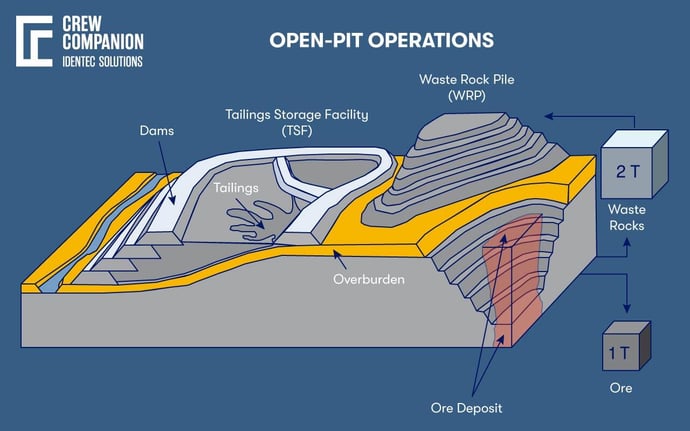
Open cast mining is a surface mining technique used to extract valuable minerals, ores, and geological materials from deposits near the ground surface. Unlike underground mining, open cast operations remove layers of soil and rock, known as overburden, to access the mineral body directly from above.
This mining approach is widely used because it offers lower operational costs, higher production capacity, and greater accessibility than underground methods. Large-scale open cast mines can operate continuously with massive excavators, haul trucks, conveyor systems, and drilling equipment. Common materials extracted using this method include coal, iron ore, copper, limestone, bauxite, and aggregates.
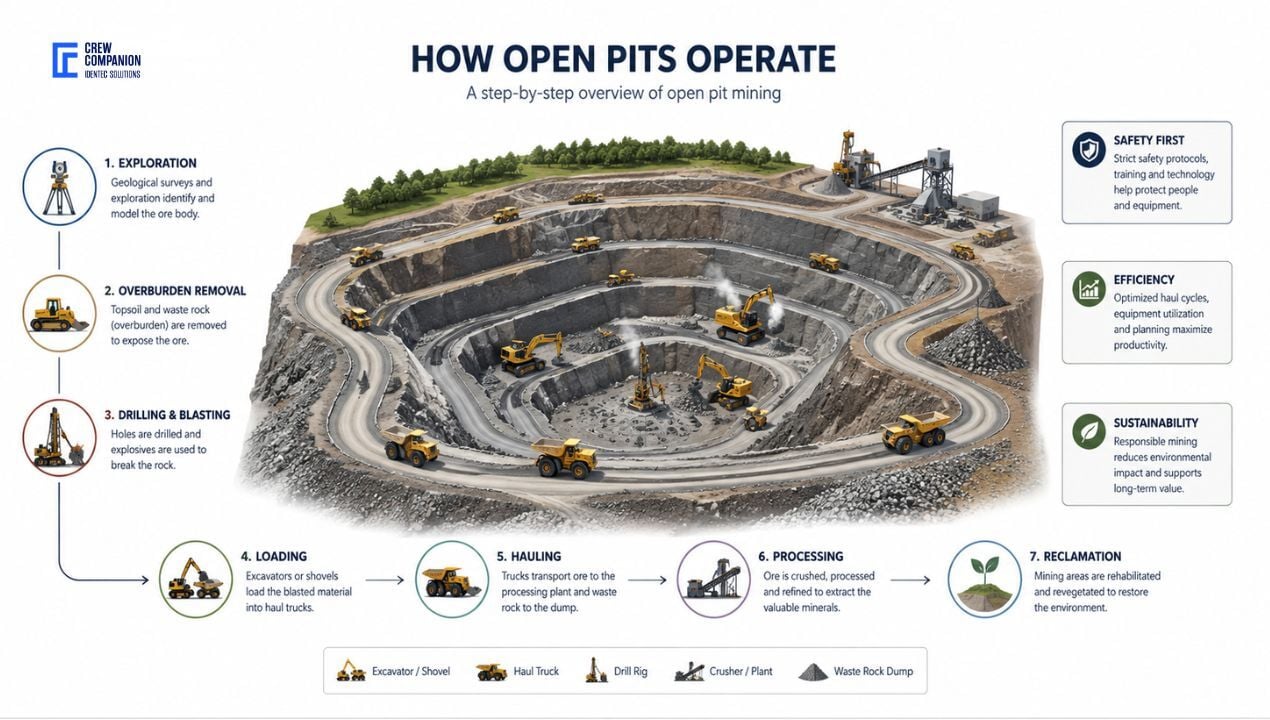
The basic workflow of the open cast mining method follows a structured sequence. Geological teams first survey and model the mineral deposit. Engineers then design benches, haul roads, drainage systems, and blasting zones. Once the planning stage is complete, overburden is removed using excavators or draglines. Drilling and blasting break up hard rock formations, allowing loading equipment to transfer material into haul trucks or conveyors for transportation to crushers and processing facilities.
Open cast mining operations are highly dependent on logistics and coordinated movement. Modern mines may operate hundreds of heavy vehicles simultaneously across vast areas. As a result, efficient traffic management and fleet coordination are now considered essential components of successful mining operations.
The scale of these sites creates complex operational challenges. Haul trucks must follow optimised routes, excavation equipment must maintain consistent loading cycles, and dispatch teams must react quickly to changing production conditions. Without proper coordination, bottlenecks, excessive idle time, fuel waste, and safety risks can significantly reduce profitability.As mining companies continue to pursue higher productivity and safer operations, the integration of electronic communication systems, real-time vehicle localisation, and automated fleet management has become increasingly important in modern open cast mining environments.

Main Types of Open Cast Mining Methods
Although the term “open cast mining method” is often used broadly, several different mining approaches exist within surface mining. Each method is designed for specific geological conditions, terrain characteristics, and mineral types.
Open Pit Mining
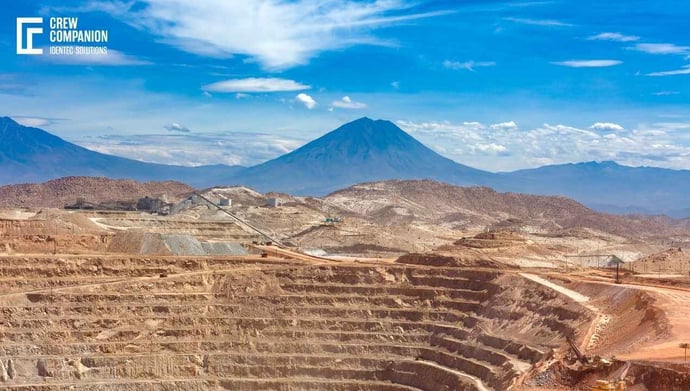
Open pit mining is one of the most common forms of open cast mining. It is typically used for metallic ores such as copper, gold, and iron ore. In this method, mining progresses downward in a series of stepped benches that create a terraced appearance.
The process begins with the removal of topsoil and overburden. Drilling rigs then create blast holes in the exposed rock (open pit blasting). Explosives fragment the material, allowing electric shovels or hydraulic excavators to load the ore into haul trucks. Waste rock is transported to dump sites, while ore is delivered to crushers or processing plants.
Bench design is critical in open-pit mining. Engineers must balance slope stability, accessibility, and efficient haulage routes. Roads are designed with wide turning radii and controlled gradients to support large mining trucks weighing hundreds of tons.
Traffic management is particularly important in open pit operations due to the large number of moving vehicles. Trucks continuously travel between loading points, crushers, workshops, and waste dumps. Poor coordination can create queues at loading areas, reduce excavator utilisation, and increase fuel consumption.
Modern mines therefore use digital dispatch systems that assign trucks dynamically based on production requirements and real-time conditions. GPS tracking allows operators to monitor vehicle locations and optimise haul cycles throughout the shift.
Strip Mining
Strip mining is commonly used for flat-lying deposits such as coal seams or phosphate layers. Instead of digging downward into a deep pit, miners remove material in long horizontal strips.
The process starts by removing overburden from the first strip. Once the mineral is extracted, the waste material is often deposited into the previously mined section. The operation then progresses systematically across the deposit.
Strip mining often relies on large, continuous excavation systems such as bucket-wheel excavators, draglines, and conveyor networks. These machines can move enormous quantities of material with relatively low operating costs.
Because strip mining operations often extend across long distances, transportation systems become a central operational concern. Conveyor systems may reduce truck dependency, but many sites still require haul trucks for auxiliary tasks and material transport.
Traffic flow in strip mines is generally more linear than in open pit mines. However, coordination remains essential because multiple excavation and transport systems operate simultaneously. Effective scheduling helps prevent equipment conflicts and ensures stable production rates.
Contour and Terrace Mining
Contour mining and terrace mining are commonly used in mountainous or hilly terrain. Instead of excavating large pits, mining follows the contours of the landscape.In contour mining, operators remove material along horizontal paths around a hillside. Terrace mining creates wider step-like platforms that provide access to equipment and transportation routes.
These methods are frequently used for coal extraction in regions with steep topography. However, the terrain creates operational limitations. Narrow haul roads, limited visibility, and unstable weather can significantly increase safety risks.
Vehicle coordination becomes especially important in these environments. Heavy trucks may share limited roadway space while navigating steep inclines and sharp turns. Mines therefore implement strict traffic rules, one-way haul systems, and controlled access zones to minimise accident risks.
Communication systems also play a major role. Operators must maintain constant contact with dispatch centres and nearby vehicles, especially during poor visibility or blasting activities
Quarry Mining
Quarry mining is another variation of the open cast mining method and is mainly used for extracting construction materials such as limestone, granite, sand, and gravel.
Although quarry operations are often smaller than metal or coal mines, they can still involve highly complex logistics. Drilling and blasting loosen rock formations, after which loaders or excavators transfer material to crushers and screening plants.
Quarries frequently experience heavy vehicle traffic due to mining equipment, contractor vehicles, and outbound transport trucks. Material must often move quickly between excavation zones, crushers, stockpiles, and shipping areas.
Efficient traffic planning helps avoid congestion and delays. Digital fleet systems can track loading times, waiting periods, and vehicle utilisation to optimise overall throughput.
Operational Challenges in Open Cast Mining
Despite its productivity advantages, the open cast mining method faces numerous operational challenges. Large mining sites involve continuous coordination between personnel, vehicles, machinery, and processing infrastructure. One of the biggest challenges is traffic congestion. Modern mines may operate hundreds of haul trucks simultaneously. If loading points, haul roads, or crushers become overloaded, vehicles can spend significant time waiting rather than transporting material. These delays reduce productivity and increase fuel consumption.
Equipment synchronisation is another critical issue. Excavators and loaders must maintain steady production rates, but inconsistent truck arrivals can disrupt operations. If too few trucks arrive, loading equipment sits idle. If too many arrive, queues develop, and cycle efficiency decreases.
Safety is equally important. Open cast mines contain large blind spots, steep haul roads, blasting zones, and heavy equipment operating in close proximity. Collisions between vehicles represent a major operational risk, particularly during night shifts or adverse weather conditions.
Communication limitations can further complicate operations. Many mines are located in remote areas where conventional communication infrastructure is unreliable. Dispatch teams require continuous connectivity to coordinate vehicles, respond to emergencies, and manage production schedules effectively.
Environmental and economic pressures also influence mining operations. Fuel consumption, tyre wear, emissions, and equipment downtime all contribute to operational costs. Mining companies increasingly seek methods to improve efficiency while reducing environmental impact.
Traditional manual coordination methods are often insufficient for modern high-volume mines. As operations expand, companies require automated systems capable of processing real-time information and supporting faster operational decisions.
This need has accelerated the adoption of digital fleet management, traffic monitoring, and communication technologies across the mining industry.
For security read more here: Mine site security
Optimising Open Cast Mining with Fleet and Traffic Management Technology
Technology now plays a central role in improving the efficiency and safety of the open cast mining method. Modern mines increasingly rely on electronic systems that provide real-time operational visibility and automated coordination.
Real-Time Fleet Management Systems
Fleet management systems enable mining companies to continuously monitor vehicle activity across the site. GPS and GNSS positioning technologies track the location, speed, and status of haul trucks, excavators, loaders, and support vehicles.
Dispatch software uses this information to assign vehicles dynamically based on operational requirements. Trucks can be automatically redirected to different loading points or dumping areas based on production priorities and queue lengths.
This real-time coordination improves equipment utilisation and reduces idle time. Mines can maintain smoother haul cycles, optimise fuel efficiency, and increase daily output.
Fleet management systems also generate detailed operational data. Managers can analyse cycle times, truck productivity, loading performance, and maintenance requirements to identify opportunities for improvement.
Traffic Management and Collision Avoidance
Traffic management has become increasingly important as mining operations grow larger and more automated. Mines must coordinate heavy vehicles moving across complex road networks while maintaining high safety standards.Digital traffic management systems help control vehicle movement through geofencing, route optimisation, and proximity detection technologies. Electronic speed limits and restricted access zones can be enforced automatically.
Collision avoidance systems use radar, RFID, cameras, LiDAR, and vehicle-to-vehicle communication to detect nearby equipment and warn operators about potential hazards. These systems are particularly valuable in areas with poor visibility or heavy traffic density.
Smart intersections can prioritise vehicle movement and reduce congestion at critical points. Some mines also implement digital right-of-way systems that coordinate truck access to narrow haul roads or loading zones.
Vehicle localisation technologies play a crucial role in these operations. Accurate positioning data enables dispatch systems to continuously monitor traffic flow and respond immediately to incidents or bottlenecks.
Communication Infrastructure
Reliable communication networks are essential for modern mining operations. Traditional radio systems remain important, but many mines are now deploying private LTE and 5G networks to support advanced applications.
These networks enable continuous data exchange between vehicles, operators, dispatch centres, and autonomous systems. Real-time communication improves operational coordination and supports faster emergency response.
Wireless communication also supports remote monitoring and semi-autonomous equipment control. Engineers can supervise operations from centralised control rooms while receiving live operational data from across the mine site.
Mesh communication systems provide additional redundancy in remote areas where conventional infrastructure may be limited. This improves network resilience and ensures uninterrupted communication between critical systems.
Worker and Asset Tracking
Electronic tracking technologies improve both safety and operational visibility. RFID tags, wearable devices, and real-time locating systems allow mines to track workers, vehicles, and equipment throughout the site (see also: RFID tag tracking system).
These systems help improve emergency response procedures by identifying personnel locations during evacuations or incidents. Maintenance teams can also track equipment usage patterns and schedule servicing more effectively.
Asset tracking reduces the time spent locating vehicles, tools, or mobile equipment. This improves operational efficiency and minimises unnecessary downtime.
Predictive Analytics and Automation
Advanced mines increasingly use artificial intelligence and predictive analytics to optimise production. Machine learning systems analyse operational data to predict equipment failures, optimise dispatch schedules, and improve traffic flow.
Autonomous haul trucks are becoming more common in large mining operations. These vehicles operate using integrated navigation, localisation, and communication systems that allow them to move safely without direct human control.
Digital twins and simulation software also help mining companies evaluate operational scenarios before implementing changes. Engineers can test traffic patterns, production schedules, and equipment configurations virtually to identify the most efficient strategies.
The integration of fleet management, communication infrastructure, and vehicle localisation technologies is transforming how open cast mines operate. Productivity, safety, and sustainability increasingly depend on intelligent operational coordination rather than excavation capacity alone.
FAQ
What is the difference between open cast mining and open pit mining?
Open cast mining is a broad term for surface mining methods, while open pit mining specifically refers to deep terraced excavations used to extract ore deposits. Open pit mining is therefore one type of open cast mining method.
Why is traffic management important in open cast mining?
Traffic management helps prevent vehicle congestion, reduce accidents, improve fuel efficiency, and optimize haul truck productivity. Modern mines depend on real-time fleet coordination to maintain safe and efficient operations.
Which technologies improve fleet management in mining?
Common technologies include GPS tracking, RFID systems, collision avoidance sensors, LTE and 5G communication networks, dispatch software, predictive analytics, and autonomous vehicle systems.
Takeaway
The open cast mining method remains one of the most productive and cost-efficient approaches for extracting near-surface mineral deposits. However, modern mining performance increasingly depends on operational coordination rather than excavation alone. Advanced vehicle localization, digital fleet management, and intelligent traffic control systems now help mining companies reduce congestion, improve safety, optimize haul cycles, and maintain real-time visibility across large mining sites. As automation expands, communication and positioning technologies will become even more critical for future mining operations.

Delve deeper into one of our core topics: Mining Security
GLOSSARY
A haul cycle in open cast mining describes the complete transportation sequence performed by a haul truck during material movement operations. The cycle typically includes positioning for loading, loading by an excavator or shovel, hauling the loaded material to a dump or crusher location, unloading, and returning empty to the loading point. Optimizing haul cycles is critical because cycle time directly affects mine productivity, fuel consumption, equipment utilization, and traffic efficiency across mining haul roads. (4)
References
(1) https://minedocs.com/23/IntechOpen-Mining-03202020.pdf
(2) https://www.sciencedirect.com/science/article/abs/pii/S0968090X23000694
(3) https://globalroadtechnology.com/haulage-systems-for-open-pit-mines/
(4) https://www.scielo.org.za/scielo.php?pid=S2225-62532018000500004
Note: This article was partly created with the assistance of artificial intelligence to support drafting. The head image was created with/generated by AI.

Related Articles
Related Product