| Written by Mark Buzinkay
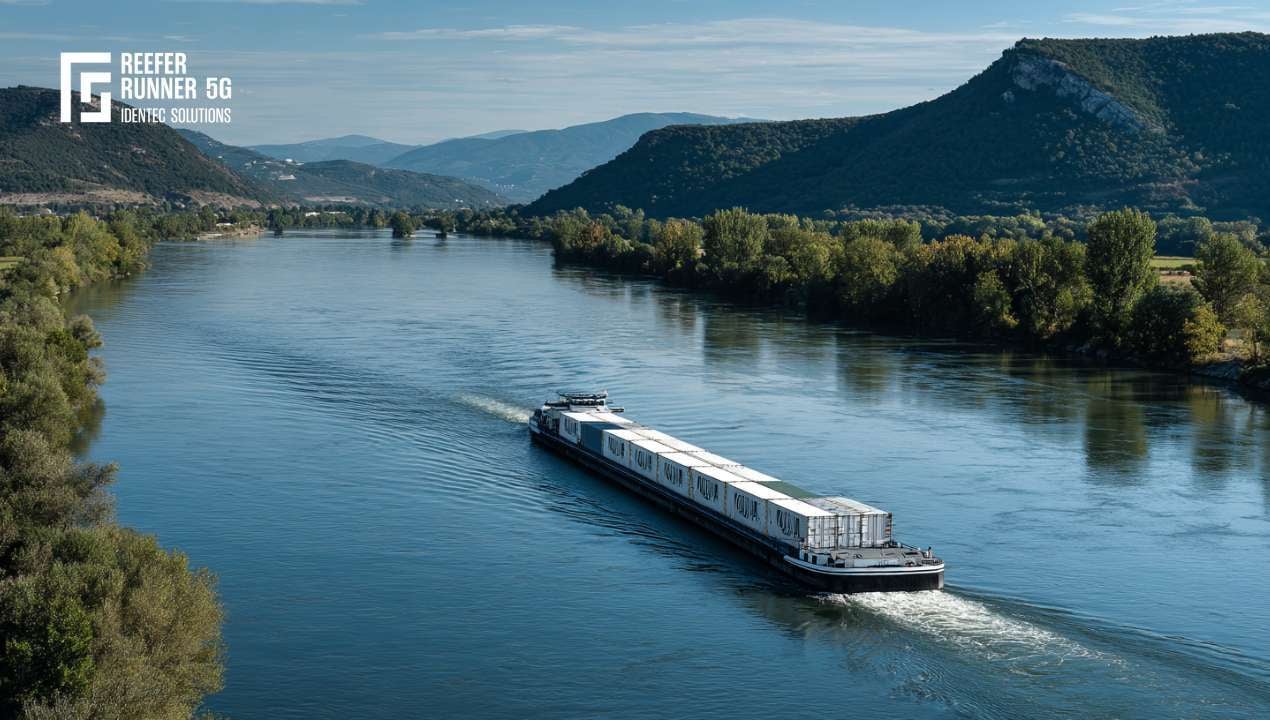
Table of contents:
- Industrial Strength Along the Rhône: The Region’s Economic Backbone
- EU Modal-Shift Policy Reshaping Logistics in the Rhône Valley
- Container and Cold-Chain Flows Driving a New Era on the Rhône
- FAQ
- Takeaway
- Glossary
Industrial Strength Along the Rhône: The Region’s Economic Backbone
From the Swiss Alps to the Mediterranean, the Rhône has evolved into one of Europe’s more discreet but decisive freight corridors. Over its 812-kilometre course, the river and its twin Saône axis move more than six million tonnes of cargo a year, linking inland France to global maritime routes via Marseille-Fos and Sète. Key river ports such as Lyon Edouard-Herriot, Vienne, Valence and Arles form the backbone of this logistics chain, spaced at regular intervals down the valley to capture industrial production and agricultural flows. (1)
At its northern end, the Lyon metropolitan area anchors the corridor. France’s second-wealthiest city has long been a manufacturing and financial centre, home to major banking, pharmaceutical, biotech and chemical groups. (2) That industrial base concentrates along the Rhône in the so-called “Chemical Valley” south of Lyon, one of Europe’s largest petrochemical parks, and further downstream at Les Roches-Roussillon, described as France’s largest chemical platform and explicitly designed around multimodal access by river, rail and motorway. (3) Here, bulk liquids, intermediates and speciality chemicals move in and out by barge, pipeline and rail wagon, tying the valley’s factories directly to Mediterranean refineries and export terminals.
Further south, the Rhône valley widens into one of Europe’s major agricultural basins. Grain, oilseeds and animal feed from the plains, alongside high-value foodstuffs and wine from the Rhône vineyards, generate steady two-way flows. Barges carry cereals and inputs such as fertiliser and animal feed to and from river silos, while refrigerated trucks and containers pick up processed food, beverages and ingredients bound for French retailers and overseas markets. The mix of heavy industry around Lyon and Valence with agrifood production in the Drôme, Vaucluse and Camargue gives the corridor a diversified cargo base that is less exposed to a single sector downturn.
At the seaward end, Marseille-Fos provides the deep-sea gateway. The industrial-port zone at Fos-sur-Mer, created in the 1960s on around 10,000 hectares, is one of Europe’s largest industrial-port areas, hosting a dense cluster of steel, petrochemical and energy facilities alongside container and bulk terminals. (4) The port has invested heavily in river and rail links so that roughly 6 per cent of its cargo now moves inland by barge along a 500-kilometre Rhône-Saône network, equivalent to around three million tonnes a year, with five regular river services each week. Regular barge shuttles and rail services connect Fos not only to Lyon and Mâcon but also to inland platforms that channel flows towards Switzerland, northern Italy and southern Germany.
Those cross-border links are coordinated through Medlink Ports, a development agency created in 2008 that brings together the seaports of Marseille-Fos and Sète with nine inland ports on the Mediterranean-Rhône-Saône axis, plus the river and rail infrastructure managers. The aim is to market the valley as a single low-carbon logistics system, offering shippers integrated barge–rail–road solutions and ready-to-use industrial land directly on the quay. For manufacturers, this means being able to locate plants or distribution centres in Lyon, Valence, Avignon or Arles and still access Asia-bound container services in Marseille in a single, consolidated move.
Behind the physical infrastructure sits the Compagnie Nationale du Rhône, the concessionaire responsible for most of the river since the 1930s. The French state entrusted CNR with the Rhône concession in 1934, giving it three intertwined missions: hydropower generation, navigation and irrigation. (5) This mandate has produced a chain of dams, locks and canals that secure water levels along roughly 470 kilometres of navigable river while supplying renewable electricity and agricultural water to the valley. That multi-purpose approach has effectively turned the Rhône from a wild alpine river into a managed transport corridor whose ports, industrial zones and farms are tightly interdependent. Energy-intensive industries benefit from proximity to hydropower, farmers gain a predictable water supply, and logistics operators secure a year-round route for bulk and containerised cargo into the heart of south-eastern France and beyond.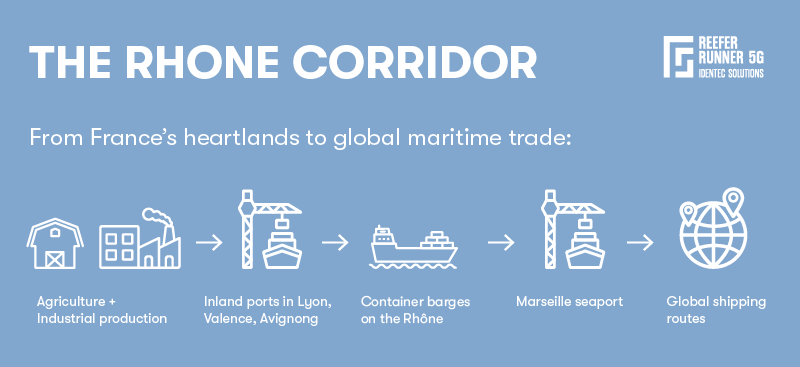
EU Modal-Shift Policy Reshaping Logistics in the Rhône Valley
When Brussels talks about “shifting freight from road to rail and water,” the Rhône valley is one of the test beds where the slogan is slowly becoming real infrastructure. The EU’s 2011 transport white paper set a headline goal that 30 per cent of road freight over 300km should move to rail or waterborne transport by 2030, rising to more than 50 per cent by 2050, underpinned by “efficient and green freight corridors.” (6) Inland waterways policy has been bundled into the NAIADES and NAIADES II programmes, which seek to remove bottlenecks, green barge fleets and integrate rivers more deeply into multimodal logistics chains.
On the map, the Rhône-Saône axis sits at the junction of two of these flagship EU corridors. The Mediterranean core network corridor formally links Marseille to Lyon and on to northern Italy, while the North Sea–Mediterranean corridor connects the inland waterways of the Maas, Rhine, Scheldt, Seine, Saône and Rhône to the ports of Marseille and Fos. (7) Both corridors are eligible for grants from the Connecting Europe Facility, which co-finances port hinterland links, rail capacity upgrades and inland waterway improvements along their routes. In practice, that has meant EU money flowing towards lock upgrades, rail terminals and digital traffic management systems intended to make barge and rail a credible alternative to trucking along the valley.
France has translated these European ambitions into its own energy-climate planning. The latest National Energy and Climate Plan, updated in 2024, explicitly singles out the “Mediterranean–Rhône–Saône” project, with a target to multiply the number of containers moved by water by 2.5 and double the rail share by 2030. (8) A parallel multi-annual energy plan calls for stabilising or increasing the modal share of rail and river freight and for transforming port governance on the Seine and Mediterranean–Rhône–Saône axes to support greener logistics chains. The extension of the Compagnie Nationale du Rhône’s concession to 2041 comes with five-year investment plans that include navigation improvements and low-carbon energy infrastructure along the river. (9)
At the seaward end of the corridor, the Port of Marseille Fos has made modal shift a centrepiece of its strategy. In 2024, the port invested about €99m, with roughly €20.8m earmarked specifically for rail projects to channel more containers inland by train and barge. Port figures show that upgraded rail and river facilities helped lift containerised rail traffic by 8 per cent and river traffic by 7 per cent in the same year, even as total tonnage remained roughly flat. (10) A recent brochure positions inland waterway transport on the Mediterranean–Rhône–Saône (MeRS) route as a “powerful driver” of low-carbon freight, noting that barge services now form a core part of Marseille’s hinterland strategy.
Further upstream, the policy message is translating into long concessions and sizeable private capital. In Lyon, a consortium led by CMA CGM has secured a 30-year sub-concession to operate and develop the Edouard-Herriot port’s container terminal, with planned investments of around €40 million in terminal expansion, new rail tracks and electrified handling equipment. Local reporting suggests total spending on the site, including a new container crane, could reach more than €60m, with the goal of lifting annual container throughput from about 101,000 units to 180,000 by the end of the decade and explicitly “doubling” river volumes on the axis. (11)
Further south, the Rhône Modal Shift consortium, led by German logistics group Rhenus, has just taken over the concessions for the inland ports of Vienne Sud and Portes-lès-Valence on a 25-year basis. The partners have been tasked with modernising quays, expanding intermodal yards and developing new logistics services as part of a broader plan to grow multimodal flows along the Mediterranean–Rhône–Saône corridor. Together with the investments by CMA CGM and others in Lyon and Arles, this amounts to a rolling programme of public-private projects aimed at making it easier for shippers to book a barge or rail rather than a truck.
The early results are visible but modest on a macro scale. Inland waterways still account for only about 2 per cent of freight in France as a whole. Yet, traffic on the Rhône between Lyon and Marseille has begun to rise, with the river operator CNR publicly targeting a doubling of fluvial traffic within ten years. That gap between national statistics and regional ambition captures the challenge facing EU transport policy: even on a corridor where the policy rhetoric, funding and local politics are unusually aligned, shifting significant volumes off the road remains a long-term project rather than a quick win.
Container and Cold-Chain Flows Driving a New Era on the Rhône
Container traffic on the Rhône is still modest by North European standards, but it is becoming the visible face of the valley’s logistics transition. The Compagnie Nationale du Rhône, which manages most of the river infrastructure, reports that barge services on the Rhône-Saône axis now carry around 4.5m tonnes of freight a year, including some 77,661 containers (in TEU) in a typical year, mainly serving industrial and port platforms spaced every 20km along the river. (12) This is a niche compared with the 1.45m TEU handled annually by the deep-sea terminals at Marseille Fos, but the barge shuttles knit that seaborne volume into the inland economy.
At the maritime end, Marseille Fos has spent the past decade turning itself into a container and reefer hub with a river hinterland. Its cold chain logistics is one of the port’s flagship activities, with capacity that has been tripled over recent years and fully privatised terminal operations. The main terminals at Fos – MedEurope, Terminal de la Méditerranée and Seayard – between them offer more than 1,000 refrigerated plugs for temperature-controlled containers and quay lengths up to 2.6km, making the Fos complex France’s largest container terminal zone. (13) The port’s logistics district at Fos Distriport and La Feuillane adds over three million square metres of warehouse and distribution space within 30km of the container berths, including temperature-controlled storage that allows Mediterranean food and drink cargoes to be transhipped onto barge or rail.
From these quays, a small group of specialist barge operators acts as the connective tissue of the Rhône corridor. A recent brochure on the Mediterranean–Rhône–Saône (MeRS) route lists Greenmodal, Logi Ports Shuttle and Combronde as the main container barge providers, running regular shuttles between Fos and inland ports such as Lyon, Vienne, Valence, Avignon and Arles. Their services are now embedded in a fully digitalised chain. Since late 2024, the MeRS route has been “100 per cent digitalised” for containers, with the CI5 cargo community system transmitting real-time data between sea and inland terminals. (14) An inter-terminal exchange zone at Fos, co-financed with CNR, has pushed the reliability of barge calls above 90 per cent, reducing missed connections and giving shippers more predictable door-to-door schedules.
Lyon, 320km upriver, is the main inland hub where this container traffic is concentrated and redistributed. The Edouard-Herriot port handled about 1.9m tonnes of cargo in 2023, including some 53,000 containers by river and 48,000 by rail, before Marseille-based liner group CMA CGM secured a 30-year sub-concession to run the container terminals. (15) The new operator plans to lift annual container throughput from roughly 101,000 units to 180,000 within six years through investments of more than €60m in new cranes, yard capacity and rail connections, effectively turning Lyon into an extended inland gate for Marseille. Smaller ports such as Vienne Sud, Portes-lès-Valence and Arles, now under long-term concessions to consortia led by logistics groups like Rhenus, are being upgraded in parallel to handle more boxes and bulk, ensuring that container flows do not stop at Lyon’s quays.
The cold chain runs through this system almost by stealth. Marseille Fos markets itself explicitly as a reefer gateway, with more than 1,000 plugs across its container terminals and dedicated phytosanitary and border inspection posts designed for food cargoes. Regional logistics providers in and around Fos-sur-Mer operate warehouses with thousands of square metres of chilled and frozen space; one operator alone advertises 6,000 square metres of reefer warehousing at Marseille/Fos, integrated with truck and container handling. (16) Reefer containers loaded with wine, olive oil, fresh produce, meat, and seafood from Provence and the Rhône-Alpes hinterland can move from factory gate to Fos by road, then continue by deep-sea service to North Africa, the Middle East or Asia – or in the opposite direction for imports. (17)
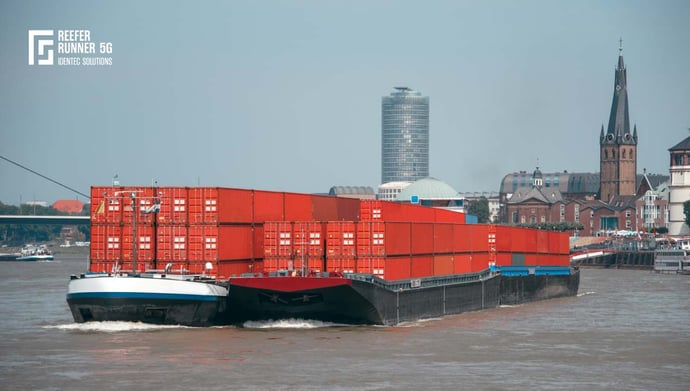
On the river itself, container barges carry a mix of consumer goods, automotive parts, chemicals, and foodstuffs. A recent feature on the Rhône’s “new wave” of barge traffic followed one such vessel, the 105-metre Zeus, loading 36 containers at Lyon – the equivalent of 60 to 80 lorries taken off the A7 motorway – for a 35-hour trip to Fos at 15–17km/h. For cold chain cargoes, the value is less about speed than about predictability: a reefer box of fruit or dairy that has already spent several weeks at sea is not especially sensitive to an extra day on the river, but it is extremely sensitive to temperature deviations (see also: cold chain requirements). That is where the combination of fixed reefer infrastructure in Fos, digital tracking systems along the corridor and the economies of scale of barge convoys begins to matter. It allows the Rhône, historically a bulk river, to position itself as a niche refrigerated artery linking the farms and factories of south-eastern France to global supermarket shelves.
FAQ: The Rhône Transport Corridor
Why is the Rhône considered a strategic freight corridor in France?
The Rhône connects France’s second-largest economic region around Lyon with the deep-sea terminals at Marseille Fos, creating a direct inland–maritime logistics spine. Its managed waterway system, maintained by the Compagnie Nationale du Rhône, supports reliable barge navigation, enabling industries, agrifood producers and logistics operators to move goods efficiently between inland Europe and global trade routes.
What types of cargo typically move along the Rhône?
The corridor handles a diverse mix of bulk and containerised goods, including chemicals, construction materials, agrifood products, manufactured goods and increasing volumes of temperature-controlled cargo in reefer containers. This diversity stabilises traffic throughout the year and supports both heavy industry and high-value food and beverage exporters across the Rhône valley.
How is the EU’s modal shift policy affecting river transport?
EU initiatives to move freight from roads to rail and inland waterways have brought investments into digital systems, improved locks, expanded terminals and upgraded barge services along the Rhône. These policies encourage shippers to choose lower-emission river transport, boosting container traffic, strengthening inland port networks and positioning the Rhône-Saône axis as a model for greener European logistics.
Takeaway
The Rhône corridor is evolving into one of Europe’s most important inland logistics routes, linking industrial centres, agricultural regions and global maritime networks through increasingly efficient barge and rail services. Its role in France’s decarbonisation and EU modal-shift efforts is accelerating investment and modernisation. At the same time, the rise of refrigerated container traffic is turning the river into a reliable cold-chain artery, where stable transit conditions, digital monitoring, and well-equipped ports support temperature-sensitive goods from farms and factories to international markets.
Delve deeper into one of our core topics: Cold Chain Monitoring
Glossary
Intermodal container transport refers to the movement of goods in standardised containers using multiple transport modes—typically ship, barge, rail and truck—without unpacking the cargo. Because the container remains sealed throughout the journey, handling costs fall, transit times shorten, and damage risks decline. This system enables seamless long-distance logistics, especially on corridors where ports, rail terminals and inland waterways are integrated into one network.
References:
(1) https://www.portseurope.com/category/industries/inland-ports-waterways/rhone-river/page/5/
(2) https://en.wikipedia.org/wiki/Industrial_history_of_Lyon
(3) https://www.oma.com/projects/vall-e-de-la-chimie-masterplan
(4) https://www.marseille-port.fr/en/filieres/industry
(5) https://www.cnr.tm.fr/en/cnr/history/
(6) https://eur-lex.europa.eu/legal-content/EN/TXT/PDF/?uri=CELEX%253A52011DC0144
(12) https://www.cnr.tm.fr/en/river-transport/setting-up-in-the-rhone-valley/
(13) https://www.marseille-port.fr/en/filieres/containers-reefers
(14) https://assisesdufleuve.fr/wp-content/uploads/2025/04/Plaquette_fluviale_A5_100325_EN_HD.pdf
(16) https://www.rdtlogistic.com/en/logistics/
(17) https://www.alconet-containers.com/reefers-france/
(18) Rodrigue, Jean-Paul, The Geography of Transport Systems, 5th ed., Routledge, 2020.
Note: This article was partly created with the assistance of artificial intelligence to support drafting.