| Written by Constance Stickler
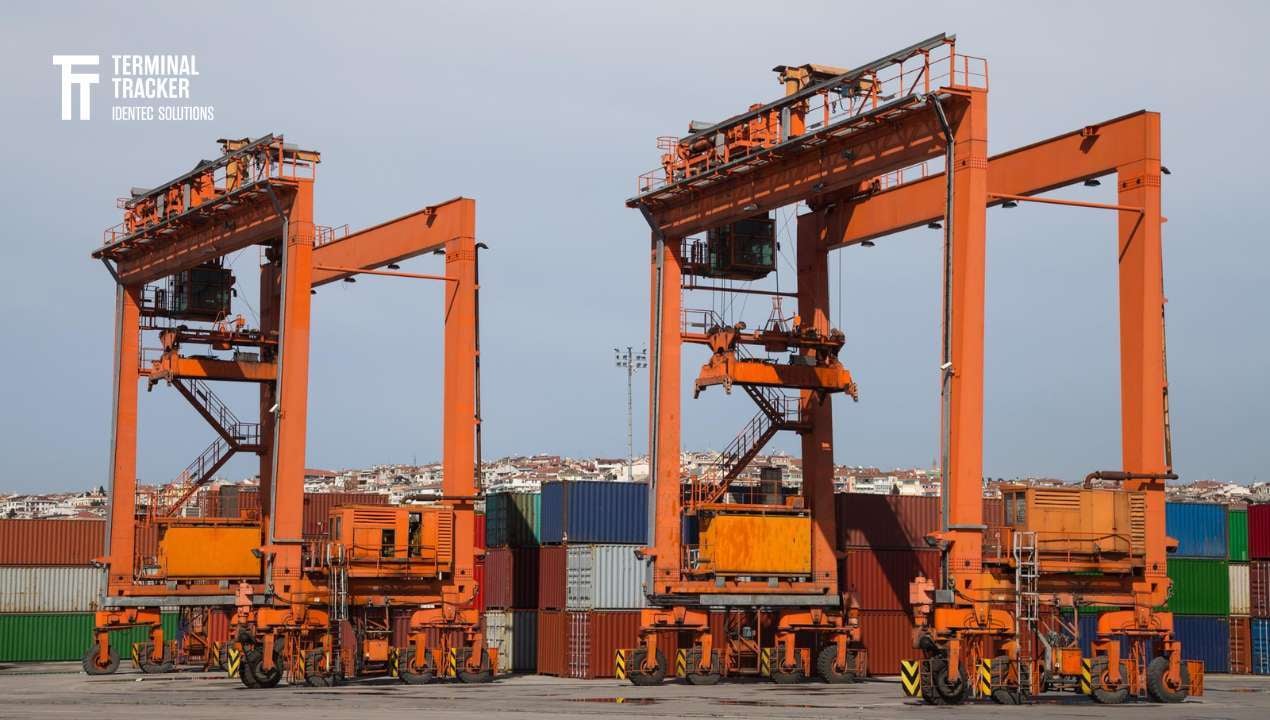
Table of contents:
- Setting the Scene: Why RTGs Still Matter in Container Terminals
- What Exactly Is a Rubber-Tyred Gantry Crane?
- RTGs in Daily Operations: From Container Lift to Yard Strategy
- Where Do RTGs Perform Best?
- Rubber-Tyred Gantry Crane Safety Considerations
- FAQ
- Takeaway
- Glossary
Setting the Scene: Why RTGs Still Matter in Container Terminals
Since their introduction in the mid-20th century—the first Rubber-Tyred Gantry crane was deployed in the late 1950s by Matson Marine (1)—RTGs have become the backbone of many container terminals. Unlike their rail-mounted counterparts (RMGs), RTGs do not require rigid infrastructure or precisely aligned blocks. This makes them ideally suited for independently scaling equipment at terminals with limited space, changing layouts, or mixed traffic volumes. In short, they are a perfect fit for the complex reality of most ports.
While early yard gantries with 1-over-3 stacking and a 22-30 t lifting capacity limitation were still widespread in the 1970s and 1980s, they were increasingly phased out in the late 1980s and replaced by RTGs with eight wheels and higher lifting capacity (up to about 41 t) (2). In a whitepaper published in 2021, Siemens cites a number of approximately 22,000 container cranes in operation, comprising 30% Ship to Shore (STS), 15% (RMGs), and 55% RTGs. (3)
What's remarkable is not only the continued proliferation of RTGs, but also their outstanding adaptability. Modern units form an interface between steel, software, and human decision-making. Pre-operational safety checks are increasingly digital. Sensors continuously monitor the cranes' condition. Proximity detection systems warn operators of hazards that were previously invisible. Partial automation supports steering, positioning, and stacking accuracy. Step by step, RTGs have integrated new levels of intelligence without sacrificing their core strength – adaptability (see also our Automation KPI Guide)
This is of great importance, as terminals rarely have the opportunity to start from scratch – existing facilities shape the industry. Terminal layouts have often evolved incrementally and must adapt to modern requirements. Under these conditions, full automation is often unrealistic and also undesirable. RTGs are well-suited for incremental improvements. Security systems can be added without redesigning the terminal. Connectivity can be integrated into existing fleets. Operators can be supported rather than replaced.
The human factor must also be considered. Visibility, situational awareness, fatigue, and decision-making under pressure directly impact safety and productivity. Any serious discussion about RTGs must therefore consider not only hardware and software, but also human interaction with them—especially given the increasing importance of assistance systems.We can thus understand RTGs as constantly evolving platforms that are shaping port operations worldwide. To understand where they are headed, we must first clarify what they are, how they can be used most effectively, and why they are so difficult to replace.
What Exactly Is a Rubber-Tyred Gantry Crane?
A rubber-tyred gantry crane is essentially a bridge crane on wheels. The structure consists of two vertical legs connected by a horizontal beam. A trolley travels along the beam, positioning the lifting mechanism. The crane spans the container stacks, allowing it to lift containers from trucks or terminal tractors and precisely place them within the block. The rubber tyres give the RTG lateral freedom of movement: it can move between blocks, adapt to changing layouts, and even be used in storage areas not originally designed for automation.
Most of them are designed to stack five to six containers high and six to eight containers wide, with one or two truck lanes underneath. Although the dimensions vary depending on the manufacturer and terminal requirements, the operating principle remains the same: vertical stacking combined with horizontal flexibility.From a component perspective, an RTG integrates several critical systems:
- Steel structure and portal frame, designed for high dynamic loads while maintaining stability during travel and lifting.
- Lifting system with wire ropes, winches, and motors for vertical movement.
- Traction mechanism for precise horizontal positioning of the spreader.
- Spreader, often telescopic, suitable for various container sizes and lockable to corner fittings.
- Rubber tyres and a steering system for multidirectional travel and block-to-block movement.
- Drive system, traditionally diesel-powered, increasingly hybrid or fully electric.
- Operator's cab, elevated for optimal visibility across the entire block, or replaced by remote control stations in semi-automated systems.
Rubber-tyred cranes differ from other container handling equipment not only in their design but also in their integration into the terminal's overall system. Rail-mounted cranes, for example, are based on fixed infrastructure and are ideally suited for highly structured, automated terminals. A reach stacker and a straddle carrier are not bound to rails and are therefore flexible, but have lower limits regarding stacking height and density. RTGs represent an intermediate position: They offer advantages in stacking compared to mobile systems but are significantly more flexible than rail-bound systems.
This flexibility explains their global prevalence. RTGs are particularly well-suited for terminals with mixed cargo volumes, fluctuating container flows, and frequent layout changes. Unlike rail systems, they tolerate uneven track surfaces, adapt to varying block lengths, and can be repositioned as operational priorities change. For many operators, this adaptability outweighs the efficiency gains promised by more rigid automation concepts.Of course, they have evolved significantly over time. Early generations were mechanically simple but operationally demanding and placed a high cognitive load on operators. Today's RTGs increasingly utilise assistance systems to support alignment, reduce oscillations, and improve stacking accuracy.

RTGs in Daily Operations: From Container Lift to Yard Strategy
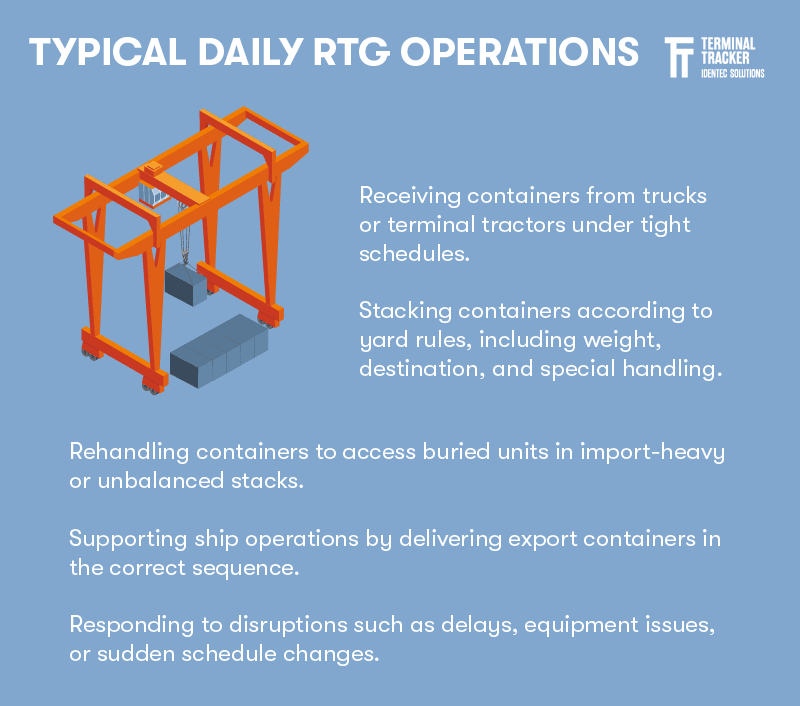
In its simplest form, an RTG cycle consists of taking over a container from horizontal transport (for example, a terminal tractor), lifting it, transporting it to its destination, and precisely placing it in the stack. In practice, however, each of these steps is affected by upstream and downstream factors. Truck arrival patterns, ship-handling times, terminal capacity, and equipment availability all affect the smooth operation of an RTG.
Most container yards are divided into blocks, each with a specific functional role—for example, import, export, empty containers, refrigerated containers, and containers with hazardous materials. Within these blocks, the strategy defined by the planners must be implemented. This might involve prioritising rapid truck handling in one block, high stacking density in another, or minimising transhipment before a ship window. The RTGs then physically execute these decisions.
The fact that rubber-tyred gantry cranes, unlike their counterparts, are not dependent on rails offers tactical flexibility. During peak times, cranes can be redistributed to alleviate bottlenecks. During quieter shifts, blocks can be grouped together to create space or to take advantage of maintenance windows.
The drivers play a central role in this. Even with TOS instructions and planning rules, RTG drivers constantly make micro-decisions: How do they approach a truck safely? How do they minimise swaying in strong winds? When do they interrupt operations due to congestion or risks? Their situational awareness often compensates for changes in planning data or unexpected yard conditions.
As terminals become more complex, the pressure on RTG operations increases. Higher stacking densities lead to more handling operations. Tighter schedules reduce recovery time. Mixed vehicle fleets introduce additional interfaces and risks. In this context, safety systems, operator assistance systems, and partial automation are gaining importance – not as a replacement for operational judgment, but as a support for it.
Where Do RTGs Perform Best?
They are particularly well-suited for medium- to high-throughput terminals where space is limited, but full automation is not (yet) feasible. In these environments, RTGs enable higher stacking density than reach stackers or empty container stackers, without the high capital expenditure and infrastructure required by rail-based systems. Therefore, they are a common choice in ports that have grown organically and were not built as greenfield automation projects.Several operating conditions favour the use of RTGs:
- Existing terminals with layouts that have developed gradually and cannot easily integrate rail or automated guided vehicles (AGVs).
- Mixed traffic environments with manned trucks, terminal tractors, and occasional pedestrian traffic.
- Variable traffic volumes, with seasonal peaks and troughs, require operational flexibility rather than fixed capacity.
- Incremental investment strategies where equipment upgrades are carried out over several years rather than in a single transformation project.
However, RTGs are not always the optimal choice. In terminals with extremely high throughput, consistent container flows, and long-term layout stability, RMGs can offer greater consistency and automation potential. Similarly, mobile devices can be more economical in terminals with very low stacking heights or large open areas. Crucially, RTGs excel in complex environments. They are designed to handle variations, exceptions, and changes—characteristics often perceived as inefficiencies but, in reality, commonplace in most ports.
Rubber-Tyred Gantry Crane Safety Considerations
When it comes to safety with regard to RTGs, there are two main aspects. On the one hand, measures to make operations safer in the complex and high-risk area of the terminals, and on the other hand, measures aimed at the safe commissioning of the vehicle.
Working in the Container Yard
Unlike quay cranes, which operate in relatively controlled zones, RTGs are embedded in the terminal area and share space with trucks, terminal tractors, other container handling equipment, maintenance vehicles, and sometimes even pedestrians. This alone makes them safety-critical installations. Add to that their height, mass, limited visibility, and the interaction between humans and machines – the risk profile becomes clear.
Here, kinetic energy meets limited situational awareness. The crane operator sits high above the ground and often relies on indirect lines of sight to judge distances, orientation, and movements beneath the crane. Blind spots are unavoidable, especially where trucks position themselves under the portal. Weather conditions such as rain, glare, dust, or wind further impair visibility and increase cognitive load.
RTG-related accidents have often been attributed solely to human error. Operators frequently work under time pressure, must process vast amounts of information, and simultaneously compensate for changing layouts, inconsistent truck positioning, or other ambiguities. In this context, errors are rarely isolated incidents; rather, they are often symptoms of system-wide weaknesses.Since not all risks can be completely eliminated, the focus must be on risk minimisation. For this reason, RTGs require a multi-layered safety approach. Physical design features such as bumpers, limit switches, and emergency stop switches form the foundation. Operating procedures and traffic regulations supplement the safety layer. Training and experience fill in the gaps. Increasingly, technology is being used to support these measures, but it cannot replace them.
RTGs remain safety-critical, not because they are outdated, but because they are used where complexity is highest. Any discussion about automation, IoT, or operator assistance systems must take this reality into account.
Pre-Operational Safety Checks (POSC)
The POSC approach also focuses on risk reduction. Even before the vehicle is put into operation and lifts its first container, the first measure comes into play. This is one of the most fundamental, yet often underestimated, safety mechanisms in port operations. Its purpose is to detect defects, unusual conditions, or safety-critical failures before incidents occur under load.
For RTGs, POSCs are particularly important because the machine operates continuously under varying conditions and often across multiple shifts. Minor issues—worn tyres, faulty limit switches, worn brakes—can go unnoticed during normal operation until they suddenly become critical. The POSC is the structured point in time at which the crane operator confirms that the crane is ready for operation.
POSCs are the points in time at which the crane operator confirms that the crane is ready for operation. A typical RTG-POSC inspection includes a combination of mechanical, electrical, and operational tests, such as:
- Tyres and wheel assemblies, including visible damage, tyre pressure, and alignment
- Braking and steering systems to ensure predictable control while driving
- Components of hoists and spreaders, including wire ropes, twistlocks, and emergency release mechanisms
- Safety devices such as limit switches, emergency stop switches, alarms, and lighting
- Operating elements, including joysticks, pedals, displays, and warning indicators
- General condition, checking for leaks, loose components, or structural damage
The effectiveness of POSC (Point of Service Control) depends heavily on its consistent implementation. The best option is, of course, a digital system that reduces ambiguity and ensures completeness. Timestamps and mandatory fields create a data trail that can be analysed over time.This allows terminals to transition from reactive to preventive maintenance. Reports of errors or damage trigger targeted maintenance work before accidents or breakdowns occur. The data also provides a valuable reality check of how the equipment wears down in daily operation.
The goal is not to shift responsibility onto the operators. Rather, they are the eyes and ears of the system. With increasing technological advancements, sensors monitor key performance indicators such as tyre pressure. However, they cannot replace human judgment and facts, such as slippery ladders and access points.
FAQ
What are RTGs also called?
- RTG Crane
- Yard Gantry Crane
- Mobile Yard Crane
- Rubber-Tyred Yard Gantry
- Container Stacking Crane
What Changes for Operators When RTGs Get Smarter?
As RTGs become smarter, the operator’s role evolves rather than disappears. Automation and assistance systems reduce physical strain and repetitive manual tasks, but they increase the need for system awareness and judgment. Operators spend less time manually aligning or landing containers and more time supervising movements, responding to alerts, and managing exceptions.Remote operation and assisted functions shift situational awareness from direct line-of-sight to screen-based information. This makes training and system familiarity critical. Operators must understand what the system is doing, when it intervenes, and when manual control is required.Smarter RTGs can improve safety and comfort, but only if roles and responsibilities are clearly defined. Poorly designed interfaces or unclear handovers can introduce new risks. Terminals that invest in training, refresher programmes, and operator involvement tend to see the biggest benefits.
Takeaway
RTGs are adaptable container handling equipment that optimise the efficiency, safety, and operational intelligence of terminals. Their strength lies in the balance between flexibility and control—enabling terminals to optimise stacking, integrate partial automation, and enhance security without requiring major infrastructure changes.For terminal operators, the conclusion is clear: investing in the safety, connectivity, and operator support of RTGs is essential—it lays the foundation for sustainable, future-proof terminal performance over the coming decade.

Delve deeper into one of our core topics: Smart Port
Glossary
A hoisting system is the assembly that lifts and lowers containers via the spreader. It typically consists of hoist motors, gearboxes, brakes, drums, wire ropes, sheaves, and control systems. The motors drive drums that wind/unwind the wire ropes, transmitting force through reeving to the spreader, while brakes and overload protection ensure safe load handling. Modern RTGs use variable-speed drives and active load-control to reduce sway, improve positioning accuracy, and increase cycle efficiency in container yards. (4)
A trolley mechanism is the system that moves the hoisting equipment and spreader horizontally along the gantry beam to position containers over trucks, rail wagons, or stacks. It typically consists of the trolley frame, travel wheels running on rails on top of the gantry, electric motors with gearboxes, brakes, and frequency converters for smooth acceleration and deceleration. The trolley carries the hoist, reeving system, and operator cabin, enabling precise, safe, and efficient container handling within the crane span. (5)
References:
(1) https://henesey.eu/wp-content/uploads/2022/07/140626-RTG-Evolution-Article.pdf
(2) https://www.kalmarglobal.com/news--insights/articles/2017/half-a-century-of-rtg-history/
4) Tsinker, Gregory P. (2004). Port Engineering: Planning, Construction, Maintenance, and Security. Wiley.
(5) Notteboom, Theo; Parola, Francesco; Satta, Giovanni (2014). Container Terminals and Automated Transport Systems. Springer.
Note: This article was partly created with the assistance of artificial intelligence to support drafting.

Author
Conny Stickler, Marketing Manager Logistics
Constance Stickler holds a master's degree in political science, German language and history. She spent most of her professional career as a project and marketing manager in different industries. Her passion is usability, and she's captivated by the potential of today's digital tools. They seem to unlock endless possibilities, each one more intriguing than the last. Constance writes about automation, sustainability and safety in maritime logistics.