| Written by Mark Buzinkay
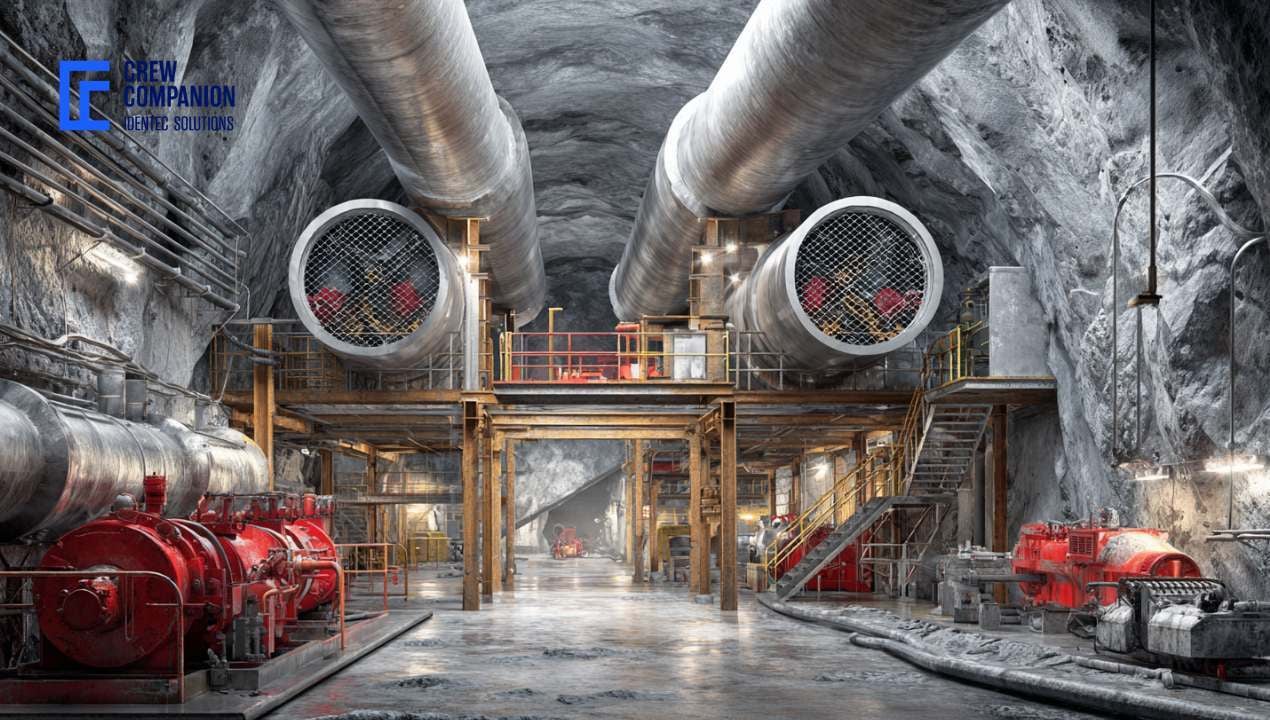
Table of contents:
- Ventilation on Demand: More Than a Fan Control Strategy
- Why Real-Time Localisation Data Is the Foundation of Ventilation on Demand
- Why Zone-Based RTLS Delivers the Best Results
- Connecting Crew Management and Fleet Management to Ventilation Performance
- Building the Connected Mine Through Communications and Digital Infrastructure
- FAQ
- Takeaway
- Glossary
Ventilation on Demand: More Than a Fan Control Strategy
For decades, underground mines have relied on ventilation systems designed to provide airflow across large sections of the operation regardless of whether those areas were occupied. While this approach ensures safety, it often results in substantial energy waste. Ventilation systems are frequently among the largest consumers of electrical power in underground mining operations (see also: underground mine safety).
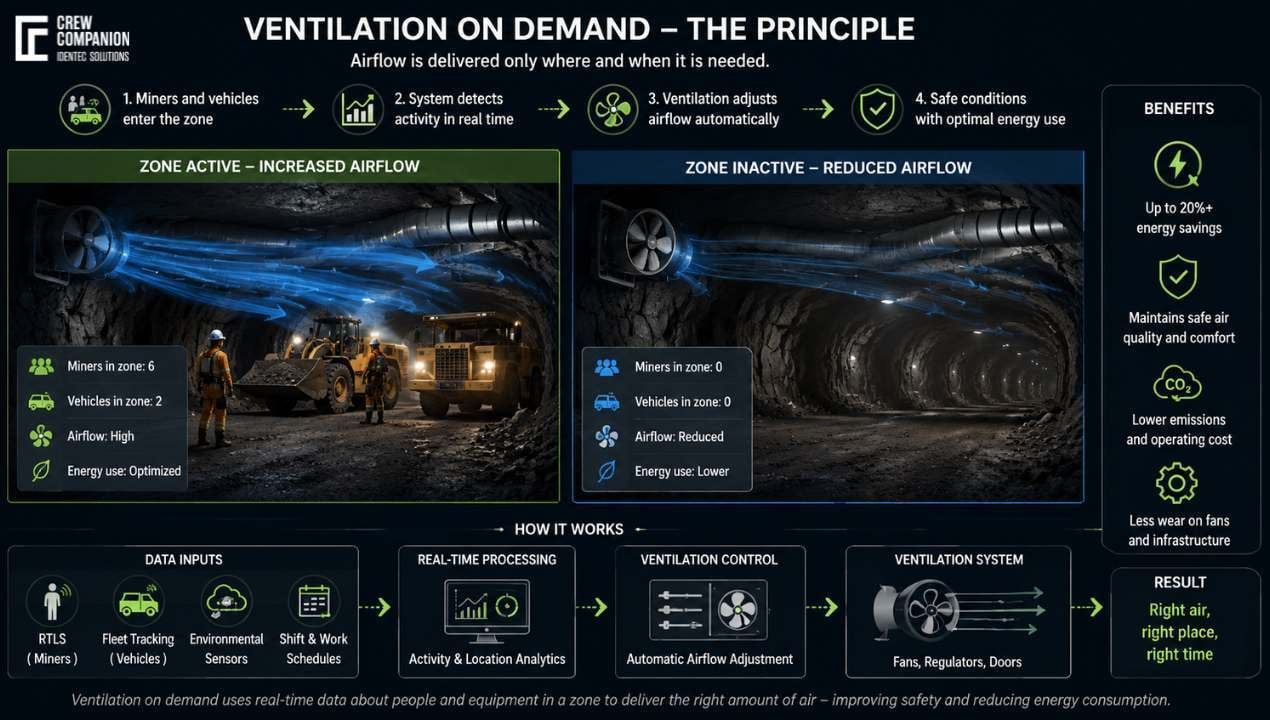
Ventilation on demand (VOD) seeks to change this model. Instead of relying on static assumptions, ventilation on demand adjusts airflow based on actual underground activity. Fresh air is directed to active production areas, development headings, maintenance zones, and haulage routes, while airflow can be reduced in inactive sections.
According to ABB, ventilation systems can account for up to 50% of total energy consumption in underground mines, making ventilation optimisation one of the most impactful opportunities for reducing operational costs. (1)
The concept sounds straightforward. If miners and equipment are present, increase airflow. If a zone is unoccupied, reduce airflow. However, this raises a critical question:How does the ventilation system know where people and equipment are?
This is where operational processes become more important than ventilation hardware.Many organisations initially view ventilation on demand as an engineering project focused on fans, regulators, and variable-frequency drives. In reality, ventilation on demand is fundamentally a data-driven operational strategy. The effectiveness of the system depends on the quality of information available about workforce locations, vehicle movements, production activities, and environmental conditions.
Without reliable operational visibility, even the most advanced ventilation infrastructure can only make assumptions. With accurate real-time information, ventilation becomes responsive, intelligent, and significantly more efficient.

Why Real-Time Localisation Data Is the Foundation of Ventilation on Demand
Every ventilation decision begins with occupancy.Before airflow can be adjusted, mine operators must know whether a particular area is active, how many people are present, and what type of work is being performed. This information is increasingly provided through Real-Time Location Systems (RTLS).
Historically, underground personnel tracking systems were implemented primarily for emergency response. Mines needed to know who was underground, where workers were assigned, and whether everyone had been evacuated during an incident.
Today, localisation data serves a much broader purpose.
Modern RTLS platforms provide continuous visibility into workforce movements across the mine. Personnel can be tracked through RFID tags, cap lamp-integrated transmitters, wearable devices, or hybrid communication systems connected to underground networks.
The value of this information extends far beyond compliance and emergency preparedness. Real-time location data allows operators to understand:
- Which zones are currently occupied
- How many workers are present in each area
- When crews enter or leave a production zone
- Where maintenance activities are occurring
- How workforce distribution changes throughout a shift
These insights become direct inputs for ventilation control strategies. Imagine a development heading that remains unoccupied for several hours. Under a conventional ventilation model, airflow may continue unchanged. Under a ventilation on demand model, airflow can be reduced while still maintaining safety requirements.
When a crew enters the heading, the ventilation system receives occupancy data and automatically increases airflow.
This dynamic approach enables mines to align ventilation resources with actual rather than anticipated demand. The result is improved energy efficiency without compromising worker health or operational performance.
The same localisation infrastructure can simultaneously support emergency response, personnel accountability, productivity analysis, and operational planning, making RTLS one of the most valuable components of a digital mining ecosystem.
Why Zone-Based RTLS Delivers the Best Results
When discussing real-time localisation, many mining professionals immediately focus on positional accuracy. The assumption is often that higher precision automatically leads to better outcomes. For ventilation on demand, however, this assumption is not always correct.
Ventilation systems generally do not require centimetre-level positioning data. They need actionable information about occupancy and activity within operational zones. This distinction is critical.Consider an underground production level. From a ventilation perspective, it is usually more important to know that six workers and two loaders are operating within a stope than to know the exact location of every individual within that stope.
This is why zone-based RTLS approaches often provide the best balance between functionality, reliability, and cost.In a zone-based architecture, the mine is divided into operational areas such as:
- Production stopes
- Development headings
- Workshops
- Refuge chambers
- Haulage levels
- Crusher areas
- Maintenance bays
- Loading stations
The RTLS system determines when personnel or equipment enter or leave these zones.This approach offers several advantages. First, infrastructure requirements are significantly lower than high-precision positioning systems. Fewer readers and location references are required, reducing deployment costs and simplifying maintenance.
Second, reliability improves. Underground mining environments are harsh. Dust, vibration, moisture, blasting activities, and changing mine geometries can affect localisation infrastructure. Zone-based systems are generally more resilient under these conditions (learn more about blasting safety).
Third, scalability becomes easier. As mines expand, additional zones can be integrated without redesigning the entire localisation architecture. Most importantly, zone-based RTLS aligns directly with how ventilation decisions are made. Ventilation control systems typically ask operational questions such as:
- Is this zone occupied?
- How many workers are present?
- What equipment is operating?
- Is production currently active?
Zone-based localisation answers these questions efficiently and reliably.For ventilation on demand, actionable operational intelligence is often more valuable than extreme positioning accuracy.
Connecting Crew Management and Fleet Management to Ventilation Performance
A truly optimised ventilation on demand strategy requires visibility into both people and equipment.Focusing only on workforce locations provides an incomplete picture of underground activity.Crew management data helps operators understand who is working, where work is taking place, and how workforce distribution changes throughout the day.Fleet management data adds another critical dimension.Underground vehicles significantly influence ventilation requirements because they generate heat, dust, and diesel emissions. The ventilation demand associated with a loading operation differs substantially from that of a maintenance activity or inspection task.By integrating crew management and fleet management systems, mines gain a comprehensive operational view.For example, consider a production zone containing:
- Eight miners
- Two load-haul-dump machines
- One underground truck
The ventilation requirements for this zone will differ significantly from those of a zone occupied by a small maintenance team with no mobile equipment.Real-time fleet tracking enables ventilation systems to respond accordingly.As vehicles enter a zone, airflow can increase.As equipment leaves, airflow can gradually decrease.This dynamic relationship between activity and ventilation improves both energy efficiency and environmental control.The benefits extend beyond ventilation.Integrated crew and fleet visibility helps mines:
- Improve shift coordination
- Optimize equipment utilization
- Reduce congestion
- Increase productivity
- Enhance workforce safety
- Improve emergency response readiness
The combination of personnel tracking and vehicle tracking also creates new opportunities for traffic management.Underground mines are becoming increasingly complex environments where workers, mobile equipment, and autonomous systems share the same infrastructure.Visibility into vehicle movements enables operators to identify bottlenecks, reduce unnecessary travel, and minimise interactions between personnel and heavy equipment.As mines pursue greater automation, this level of situational awareness becomes increasingly important.
Building the Connected Mine Through Communications and Digital Infrastructure
None of these capabilities is possible without reliable communication infrastructure.Ventilation on demand depends on continuous information exchange between people, equipment, sensors, and control systems. A modern connected mine typically integrates:
- RTLS infrastructure
- Environmental monitoring systems
- Ventilation controls
- Personnel tracking platforms
- Fleet management solutions
- Communication networks
- Central control room software
These technologies create a shared operational picture that enables automated decision-making. Environmental sensors provide information about airflow, temperature, humidity, gas concentrations, and air quality.
RTLS systems provide occupancy data.Fleet management platforms supply vehicle activity information. Communication networks ensure that data can move between underground assets and surface control systems. When these systems operate together, ventilation becomes proactive rather than reactive.
For example, if a production crew is scheduled to begin work in a development heading at 7:00 a.m., the ventilation system can prepare the area before workers arrive.Similarly, if vehicles leave a zone earlier than expected, airflow can be adjusted automatically.
The next stage of development will involve predictive ventilation strategies.
By combining historical activity data, production schedules, equipment utilisation patterns, and workforce planning information, mines will increasingly be able to forecast ventilation demand before activity occurs. This approach will further reduce energy consumption while maintaining safe and productive working environments.
Ultimately, the future of ventilation on demand is not defined by smarter fans alone. It is defined by smarter operational visibility. The mines that achieve the greatest benefits will be those that connect ventilation systems with workforce tracking, fleet management, environmental monitoring, and communication technologies into a unified operational platform.
FAQ
What is ventilation on demand in mining?
Ventilation on demand is a strategy that supplies airflow to underground mine areas only when and where it is required. By adjusting ventilation based on real-time operational activity, mines can reduce energy consumption while maintaining safe working conditions.
Why is real-time location data important for ventilation on demand?
Ventilation systems need to know where people and equipment are located in order to determine which areas require airflow. Real-time location data provides this visibility and allows ventilation systems to respond dynamically to changing conditions.
Why is zone-based RTLS preferred for ventilation applications?
Zone-based RTLS provides occupancy information at the operational level where ventilation decisions are typically made. It offers lower infrastructure costs, greater reliability, easier scalability, and sufficient accuracy for most ventilation on demand use cases.
Takeaway
Ventilation on demand delivers its greatest value when ventilation decisions are driven by real-time operational data rather than fixed assumptions. By combining localisation technologies, crew management, fleet management, and communication infrastructure, mines can reduce energy consumption while improving operational efficiency. Equally important, the same visibility supports underground mine safety by enhancing emergency preparedness and personnel accountability. It also strengthens traffic management by helping operators monitor vehicle movements, reduce congestion, and improve interactions between workers and mobile equipment in complex underground environments.
Delve deeper into one of our core topics: Mining safety
Glossary
Ventilation is the controlled movement of air through an underground mine to provide workers with sufficient oxygen, dilute and remove hazardous gases, control dust and diesel emissions, regulate temperature, and maintain safe working conditions. A well-designed ventilation system continuously supplies fresh air to active work areas while directing contaminated air away from personnel. Because underground environments constantly change as mining progresses, ventilation must adapt to evolving operational conditions and workforce locations. (3)
References:
(2) Jonathan Rowland: "Turn the Fans Down: Exploring Ventilation on Demand"; Published: April 9, 2026, in: North American Mining; https://northamericanmining.com/index.php/2026/04/09/turn-the-fans-down-exploring-ventilation-on-demand/
(3) CDC/NIOSH, Introduction to Mine Ventilating Principles and Practices
https://stacks.cdc.gov/view/cdc/206398
Note: This article was partly created with the assistance of artificial intelligence to support drafting. The head image was created by AI.