| Written by Mark Buzinkay
Table of contents:
- What Is Zero Entry Mining, and Why Does It Matter?
- Which Technologies and Processes Make Zero Entry Possible?
- How Can Real-Time Localisation Support Zero Entry Mining?
- How Close Is the Mining Industry to Zero Entry Today?
- What Is the Future Roadmap Toward Zero Entry Mining?
- FAQ
- Takeaway
- Glossary
What Is Zero Entry Mining, and Why Does It Matter?
Zero entry mining describes an approach to mineral extraction in which people no longer need to enter active mining areas physically. Instead, autonomous machines, remotely operated equipment, and integrated digital systems carry out production activities. The ultimate objective is a mine where routine human presence is unnecessary, including for activities traditionally performed underground.
The concept goes beyond conventional mine automation. An autonomous haul truck may transport material without a driver, but that does not make the surrounding mine a zero-entry operation. Surveyors, maintenance technicians, geologists and other personnel may still need to enter the area. A genuinely zero-entry mine requires the entire mining process to function without routine human intervention.
This distinction matters because the mining industry has already shown that many individual activities can be automated. The more difficult challenge is connecting those activities into a reliable operating system.
What are the main benefits of zero entry?
Safety is the strongest argument. Underground miners face hazards associated with rockfalls, seismic events, mobile equipment, blasting, dust, heat and potentially dangerous atmospheres. Removing people from these environments eliminates their direct exposure to many of these hazards.
Productivity provides another incentive. Autonomous equipment can potentially operate through shift changes, breaks and periods when personnel would otherwise be prohibited from entering production areas. More consistent machine operation can also improve equipment utilisation and production planning.
The economic implications could extend further. Conventional underground mines require infrastructure designed to protect and accommodate people, including ventilation, cooling, emergency refuges, escape routes and access systems. A mine designed for zero entry might reduce some of these requirements, although machinery, fire protection, emergency access and regulatory obligations would still influence infrastructure design.
Zero entry could also change which mineral deposits are economically accessible. Extremely deep, hot or geotechnically challenging deposits might become more attractive if people no longer need to work near the extraction face.
However, these benefits are not automatic. Autonomous systems introduce costs for communications, robotics, maintenance, cybersecurity, and technical redundancy. Their economic value depends on the mining method, geology and operational requirements.
The Global Mining Guidelines Group (GMG) describes zero entry as a fundamental transformation of mine design and operations, rather than simply another stage of equipment automation.(1)

Which Technologies and Processes Make Zero Entry Possible?
Zero entry depends on integrating multiple technologies and operating processes. Autonomous equipment forms the most visible part of this transformation, but supporting infrastructure and maintenance capabilities are equally important.
Autonomous production and remote operations
Autonomous haulage systems already let trucks navigate designated routes, manage speed, and transport material without onboard drivers. Underground mines use automated load-haul-dump machines, remotely controlled drilling equipment and automated production systems.
These technologies generally operate within defined conditions. Underground machines must operate in narrow tunnels, changing geological environments, dust, poor visibility, and limited satellite navigation. Reliable localisation, onboard sensing and communication networks are therefore essential (see also: Setting up wireless mesh network).
Remote operations centres allow personnel to supervise multiple machines from a central location, sometimes hundreds of kilometres from the mine. Operators can monitor equipment performance, production progress and alarms without travelling underground.
Artificial intelligence, machine vision, LiDAR, radar and other sensors are increasingly used to improve machine perception and decision-making. Nevertheless, most commercially deployed systems still depend on defined operating environments and human supervision.
Digital infrastructure and connected systems
Zero-entry operations require dependable communication between equipment, sensors, control systems and remote personnel.
Underground wireless networks, fibre-optic connections, industrial Wi-Fi, private LTE or 5G and specialised positioning technologies can support different parts of this infrastructure. No single technology necessarily covers every underground requirement.
Digital mine models can combine geological information, equipment positions, production schedules and operational conditions. Such information helps autonomous systems coordinate activities and respond to changing circumstances.
Interoperability is particularly important. Mining fleets commonly include equipment from several manufacturers, each with its own software and control architecture. Without reliable interfaces, automation may remain confined to individual machines or isolated operating zones.
Why is maintenance one of the greatest challenges?
Maintenance is arguably one of the most significant barriers to fully zero-entry mining.
Autonomous machines still experience mechanical failures, tyre damage, sensor contamination, electrical faults and component wear. Underground infrastructure also requires inspection, repair and replacement.
When an autonomous loader becomes immobilised in a production tunnel, somebody may need to enter the area to diagnose and recover it. Similar problems arise when communication equipment fails, ventilation systems require servicing or mining infrastructure must be extended.
Predictive maintenance can reduce these interventions. Sensors monitoring vibration, temperature, hydraulic pressure and component condition can identify deterioration before failure. Robotic inspection systems and remotely operated maintenance equipment may eventually perform some tasks currently requiring technicians.
Automated charging, refuelling, and equipment servicing could further reduce the need for human presence. However, complex repairs, unexpected failures and infrastructure installation remain difficult to automate comprehensively.
This creates an important distinction between a zero-entry production process and an entirely zero-entry operation. A mine might extract and transport material autonomously for extended periods while still requiring occasional human access for maintenance.
Why must mining methods change?
Existing mines were generally designed around human-operated equipment. Tunnels, access routes, workshops and supporting infrastructure reflect those requirements.
A mine designed specifically for autonomous operation could use different layouts, equipment dimensions and extraction methods. However, removing people does not eliminate geotechnical risks or the need to protect equipment and infrastructure.
In his 2025 research, Javier Ruiz-del-Solar argues that current automation is insufficient for fully autonomous mining and proposes collaborative human-machine systems as a practical development path. (2)
How Can Real-Time Localisation Support Zero Entry Mining?
At first glance, personnel localisation may seem unnecessary in a mine designed to operate without people. In practice, the transition toward zero entry makes reliable workforce and asset visibility particularly important.
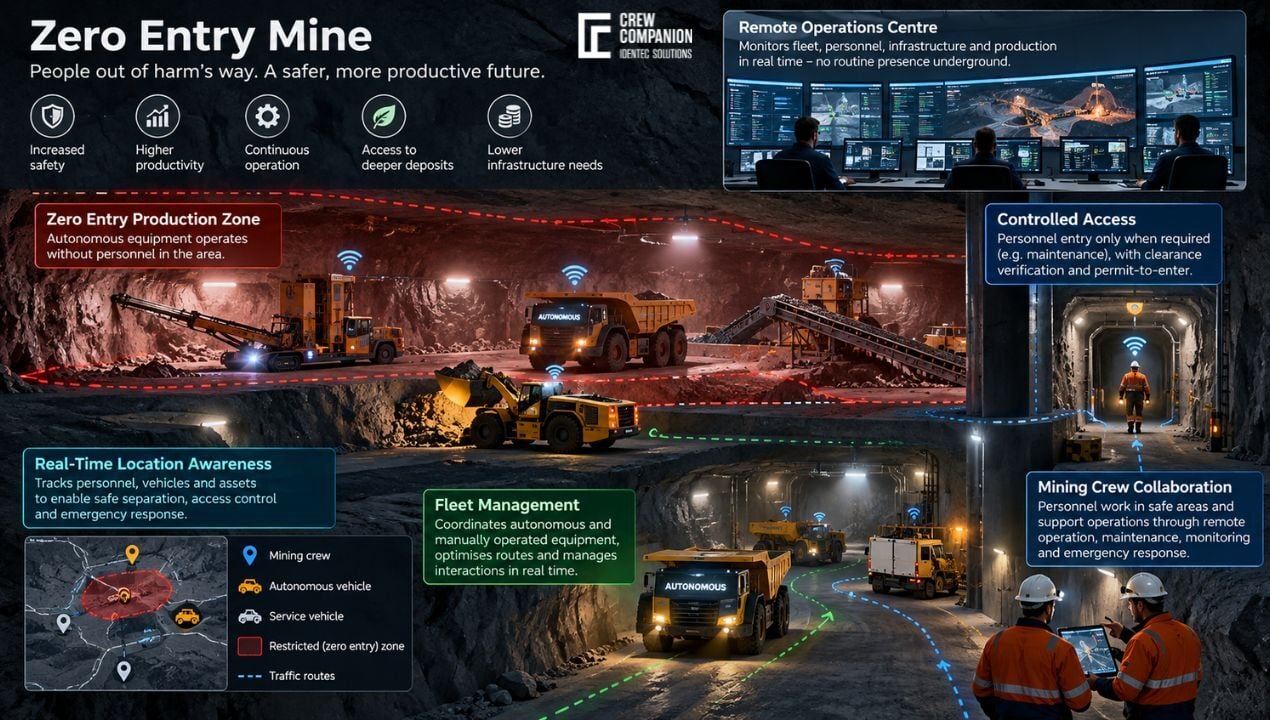
Most mines will not move directly from conventional operations to complete autonomy. Instead, autonomous production zones will gradually expand while people continue working elsewhere underground. These mixed environments require clear separation between personnel and operating machinery.
Personnel accountability and controlled access
Real-time localisation systems can help mine operators determine where personnel are located, which zones they occupy and whether they have entered restricted areas.
Technologies such as active RFID, ultra-wideband positioning, and other wireless tracking approaches can provide location information with varying levels of accuracy. The right technology depends on underground infrastructure, coverage, required precision, and operating conditions.
For example, before autonomous equipment starts operating in a designated production zone, supervisors need assurance that personnel have left the area. A positioning system can contribute to this verification by showing detected personnel and supporting access-control workflows.
However, tracking data alone cannot prove that an area is empty. Additional controls must address missing tags, communication failures, positioning errors, and unregistered visitors. Safety-critical machine functions require appropriately engineered and validated systems.
Supporting maintenance and emergency response
Even highly automated mines may need technicians to enter restricted areas for inspection or repair.
Location-aware workflows can help identify authorised personnel, monitor their presence and confirm that they have left before autonomous operation resumes. This is especially valuable when maintenance takes place near mobile equipment or within normally restricted production zones.
During emergencies, personnel accountability systems can provide information about workers’ last known locations, designated refuge areas and evacuation progress.
Solutions such as Crew Companion from Identec Solutions show how personnel visibility and emergency mustering support underground safety management.
Combining personnel and asset information
Asset localisation adds another operational dimension. Knowing the positions of mobile equipment, service vehicles, and other tracked assets helps coordinate movements and identify potential conflicts.
When operators integrate workforce and equipment information with mine planning, fleet management, and access-control systems, they can develop a more complete picture of underground activity.
This information can support traffic management, restricted-zone monitoring and the coordination of autonomous and manually operated equipment. Nevertheless, personnel positioning systems should complement, rather than replace, dedicated collision-avoidance and machine-safety controls.
The long-term opportunity is an integrated operating environment where autonomous equipment, mine infrastructure, and personnel-accountability systems reliably exchange relevant information.
Wireless mesh networks in mine operations
As we now understand what a wireless mesh network is, how it operates, and how it can be used, it is interesting to ask how they can perform underground in a myriad of shafts and tunnels under rough and difficult conditions to receive and transmit radio frequency signals.
One of the main benefits of a wirelessn ad-hoc mesh network. Re-opening, inspecting, or creating shafts can be hazardous and are rarely covered by a communication channel. Adding new wireless WiFi nodes to enhance the mesh network is relatively fast and cheap.
How Close Is the Mining Industry to Zero Entry Today?
As of October 2026, mining automation has advanced considerably, but fully zero-entry mines are not yet an established commercial operating model. The biggest progress has been in autonomous haulage, underground loading, and remote supervision.
Which mining operations demonstrate progress?
At Roy Hill in Western Australia, Epiroc and Hancock Iron Ore reported in October 2025 that they had converted all 78 haul trucks to driverless capability, with 60 allocated to autonomous operation at that time. The project uses an OEM-agnostic autonomous haulage system, allowing trucks from different manufacturers to operate within the same environment. However, autonomous haulage does not mean that all activities at Roy Hill are performed without personnel.
Underground operations provide equally important examples. At Glencore’s George Fisher Mine in Australia, Sandvik reported ten automated loaders operating in 2025, alongside automated underground trucks. The equipment supports continuous material movement and reduces operator exposure to hazardous working environments.
In March 2026, Sandvik also announced AutoMine orders for five Byrnecut-operated mine sites in Australia and Namibia. These systems enable autonomous loader movements between production and dumping areas, with operators supervising from control rooms.
Sandvik’s May 2026 launch of AutoMine Aura further illustrates this direction, combining three-dimensional perception, navigation, and integration with existing access-control systems.
These deployments demonstrate that individual production activities can operate autonomously at commercial scale. They do not, however, establish that the complete mining process is autonomous.(3)(4)(5)
What do experts say about the feasibility of zero entry?
The industry discussion reveals considerable disagreement about how quickly zero-entry mining can develop.
The GMG Zero Entry Mining initiative, involving representatives from mining companies, universities and technology organisations, argues that a system-wide transformation is necessary. Its work addresses mining methods, economic feasibility, interoperability, brownfield applications and workforce implications.
At the GMG Helsinki Forum in May 2026, Andrew Scott, Geoffrey Liggins and Graeme Mitchell participated in discussions concerning the priorities and operational changes required for zero-entry mining. The programme emphasised redesigning mining processes rather than merely expanding existing automation.
Academic research provides a more cautious perspective. In January 2026, Annika Pekkari and colleagues published a study based on a survey of 44 experts from the European Union and Australia. Although most respondents considered zero-entry mining theoretically achievable, 44% did not believe fully zero-entry underground mines were possible, while 30% expressed the same view concerning open-pit mines.
The researchers also identified an important disagreement about definitions. Some experts consider a mine zero-entry even when maintenance personnel occasionally enter, whereas others require the complete elimination of human entry.
The study suggests that automation will substantially change miners’ responsibilities, but human expertise and physical intervention will remain necessary for the foreseeable future.
The current discussion therefore concerns more than technological readiness. It also involves the practical meaning of zero entry, acceptable operating risks, economic justification and the changing relationship between people and machines. (6)(7)
What Is the Future Roadmap Toward Zero Entry Mining?
The transition toward zero entry is unlikely to follow a uniform schedule. Mines differ substantially in geology, extraction methods, equipment fleets, infrastructure and regulatory requirements. Consequently, adoption will likely occur through several overlapping stages of development.
The first stage involves automating selected production activities. This is already happening through autonomous haulage, remote loading, and automated drilling. Human-machine separation, operational supervision and reliable communications remain central requirements.
The second stage expands zero-entry production zones. More activities can operate without personnel present, supported by integrated fleet management, access control and location-aware operating procedures. Personnel may still enter these areas during planned shutdowns or maintenance activities.
The third stage involves reducing the need for human intervention. Predictive maintenance, robotic inspection, automated servicing and improved equipment recovery capabilities will become increasingly important. Remote operations must also be able to respond to unexpected conditions without requiring immediate physical intervention.
The final stage would involve mines designed around zero-entry principles from the outset. Rather than adapting conventional layouts, operators could develop mining methods, infrastructure and equipment specifically for autonomous production.
How can existing mines adapt?
Brownfield operations face particular challenges because operators generally built infrastructure for human-operated equipment. Mines may need to modernise communication networks, integrate equipment from different manufacturers, introduce digital access-control procedures and progressively automate suitable production areas.
Greenfield projects have greater flexibility. Mine design can consider autonomous traffic routes, equipment servicing, infrastructure requirements and restricted human access from the earliest planning stages.
In both cases, implementation requires more than investment in technology. Operators must establish appropriate safety cases, engage regulators, train personnel, develop new maintenance procedures and demonstrate measurable operational benefits.
The 2024 GMG guideline for autonomous systems highlights the importance of lifecycle costs, change management, operational readiness, testing and continuous performance assessment.
No credible universal date can currently be assigned to the arrival of fully zero-entry mines. Progress will depend on solving practical problems that today’s automated production equipment cannot address.
The most immediate opportunity, therefore, is not necessarily eliminating every underground position. It is to progressively remove personnel from dangerous activities while developing the infrastructure, skills, and operating procedures needed for increasingly autonomous mining.
FAQ
Are there any fully zero-entry mines operating today?
Autonomous equipment and zero-entry production zones already exist. Still, a fully zero-entry mine that performs all routine extraction, maintenance, and support activities without human entry is not an established commercial model. Most advanced operations still require personnel for selected tasks.
What is the difference between zero entry and autonomous mining?
Autonomous mining refers to equipment or processes operating with limited human intervention. Zero entry describes a broader operating concept in which people do not need to enter designated mining areas. Autonomous equipment is an important enabler, but it does not, by itself, achieve zero entry.
Will zero-entry mining eliminate mining jobs?
Zero entry is more likely to transform many mining roles than eliminate the need for human expertise. Remote operators, automation engineers, maintenance specialists and safety professionals will remain important, although the balance between physical and digital work will change.
Takeaway
Zero entry represents a long-term transformation of mining rather than a single technological breakthrough. Autonomous production is advancing, but maintenance, infrastructure and system integration remain significant barriers to fully personnel-free operations. The most practical path is to expand zero-entry zones while gradually redesigning processes and equipment.For underground mine safety, this transition increases the importance of personnel accountability, controlled access and reliable traffic management. Combining real-time workforce and asset localisation with autonomous systems can improve situational awareness, support separation between people and machines, and help mines manage the risks of increasingly automated operations. (read more about miner tracking).

Dive deeper into one of our core topics: Miner safety
Glossary
Interoperability is the ability of different equipment, software platforms, and communication systems to exchange and use information reliably. In mining, it enables autonomous machines, fleet management systems, personnel tracking solutions and safety applications from different manufacturers to work together. This is particularly important in mixed-equipment fleets and brownfield mines, where replacing every system is impractical. Effective interoperability requires compatible interfaces, shared data definitions, secure communication and coordinated operational processes across the mining environment. (8)
References:
(1) https://gmggroup.org/zero-entry-mining-an-exploratory-white-paper/
(2) https://www.mdpi.com/2673-6489/5/2/25
(6) https://gmggroup.org/gmg-helsinki-forum-2026/
(7) https://link.springer.com/article/10.1007/s13563-025-00572-0
(8) https://csrc.nist.gov/glossary/term/Interoperability
Note: This article was updated on the 4th of August 2025. The head image was generated by AI.