| Written by Constance Stickler
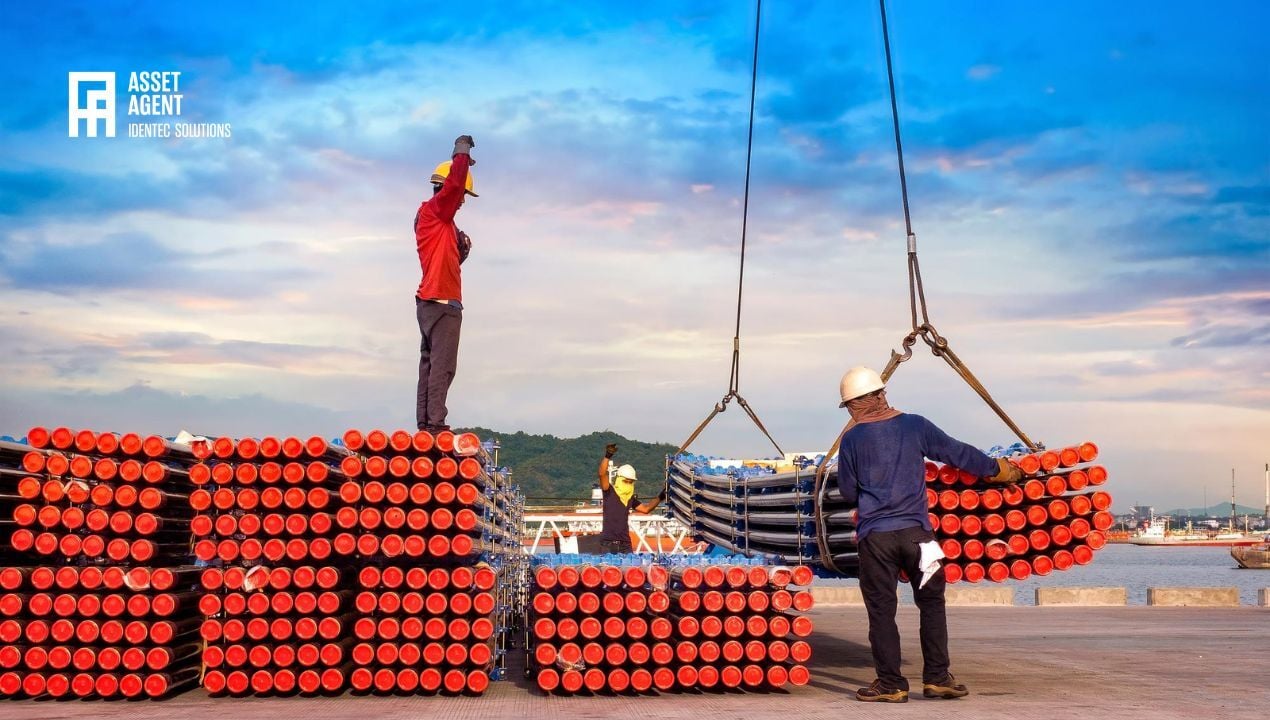
Table of contents:
- The Operational Core of Breakbulk: From Quay to Staging Ground
- How Is Digitalisation Affecting Breakbulk Operations?
- Why Is Control the Real KPI in Breakbulk Operations?
- FAQ
- Takeaway
- Glossary
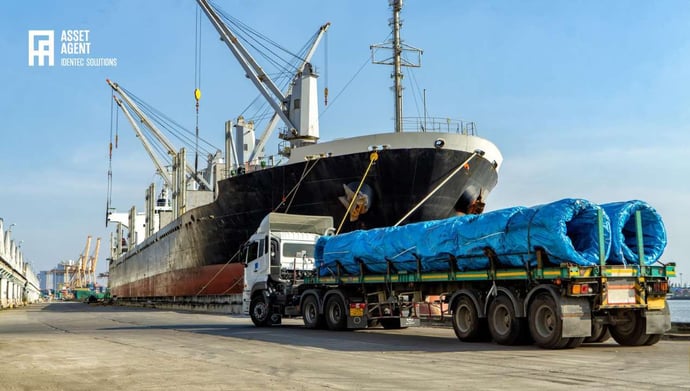
Breakbulk services at the terminal go far beyond simple loading and unloading. They provide a specialised operational framework for goods that, due to their dimensions, shape, or project-specific requirements, cannot be transported by container. This distinction is important because breakbulk cargo requires a fundamentally different operating method. Containers are based on standardisation. Breakbulk, on the other hand, is based on exceptions.
The Operational Core of Breakbulk: From Quay to Staging Ground
Besides goods in crates, sacks, barrels, and boxes, the list of possible breakbulk cargo also includes pipes, steel beams, wind turbine blades, boats, machinery, precast concrete elements, marble blocks, locomotives, aircraft parts, etc. Anything too large, too heavy, or otherwise unsuitable for standardised containers is transported individually. Due to this diversity, breakbulk operations rarely repeat in the same way. Each cargo movement introduces a new set of operational conditions that must be assessed, planned, and executed individually across the terminal:
Vessel-Side Services: Where Breakbulk Operations Begin
At the interface with the ship, most risks, resources, and coordination requirements are concentrated within a very short time.
Unlike the standardised handling processes of container ships, each port call for breakbulk vessels presents a unique operational challenge. Cargo dimensions, weights, lifting equipment, stowage plans, and unloading sequences can vary considerably not only between different ships but also between individual cargo units within the same hold.
Preparations typically begin well before the ship's arrival, in coordination with ship operators, project forwarders, surveyors, and cargo owners. Terminal planners review stowage plans, cargo manifests, lifting requirements, unloading priorities, and equipment needs. Crane capacities must be verified, ground pressure calculations performed, and detailed lifting plans drawn up.
Unloading: Once the ship is alongside, unloading begins in close coordination between ship and shore personnel with the removal of any fastenings, such as lashing straps, sea moorings, welded connections or transport frames.
Equipment: Depending on the cargo characteristics, a combination of mobile harbour cranes, ship cranes, crawler cranes, reach stackers, forklifts, and specialised lifting equipment is used. The selection of equipment is based on factors such as reach, lifting radius, centre of gravity of the load, requirements such as tandem lifting, quay load limits, and weather conditions.
Environment: Weather plays a far greater role than with containerised cargo, which is protected by the container. Large goods, suspended heavy loads, and precision lifting equipment can necessitate temporary work stoppages, even if container handling continues elsewhere in the terminal.
Chronology: The order in which cargo is unloaded is often determined more by downstream logistics requirements than solely by operational efficiency. Project cargo may need to leave the terminal in a specific sequence to support construction schedules at the destination. Similarly, export cargo may need to be loaded according to installation sequence, transport restrictions, or the requirements of the destination.
Documentation: Condition reporting begins on board the vessel when experts inspect the cargo for existing damage. Unlike with containers, this cannot be automated due to the wide variety of cargo types. Photographic documentation and inspection reports are an essential part of the operational process, especially for high-value or project cargo.
Cargo Securing
Load securing and technical handling are among the most demanding aspects of breakbulk cargo handling. Besides the lifting itself, the preparation, stabilisation, protection, and securing of the load before and after the lifting process are crucial in determining whether the operation is carried out safely and without damage.
Standardised lifting points or uniform load characteristics are rare. Each type of load requires different approaches to lifting, bracing, securing, and protecting it. Therefore, the selection and preparation of lifting slings, shackles, spreader beams, lifting beams, chains, and special lifting frames is essential. Incorrect rigging configurations can lead to excessive load, unstable lifting conditions, or equipment overload.
The cargo securing must also be stabilised afterwards, in the staging area, warehouse, transport vehicle, rail wagon or further ship space, to prevent movement during storage or transport. This can involve the use of wooden blocks, substructures, steel beams, chains, straps, welded moorings or specially manufactured securing structures.
Transport Interface Services at the Terminal Gate
The terminal gate is one of the most complex transition points for breakbulk shipments, as they often require customised transport solutions. Oversized, overweight, or irregularly shaped goods may exceed permissible road dimensions, require specialised trailers, or necessitate carefully planned transport routes.
Transport planning begins with measuring the goods. Accurate dimensions, weight data, axle load requirements, and centre of gravity information are essential for selecting suitable transport vehicles and obtaining the necessary permits for road or rail transport. The goods are loaded onto modular trailers, low loaders, self-propelled modular transporters (SPMTs), railcars, or other specialised vehicles, requiring detailed loading plans and close coordination between terminal personnel and transport companies.
An important part of the planning process is also the permitting management in cooperation with road construction authorities, bridge operators, railway infrastructure operators, or other regulatory bodies. This allows the plans to be determined more by the availability of escort vehicles, route restrictions, closure times, or temporary road closures than by terminal opening hours.
What Happens Inside a Breakbulk Warehouse?
A breakbulk warehouse is an operational transhipment centre where freight is prepared, protected, inspected, and managed between transport phases.
Cover: One of their main functions is protection from environmental factors that could cause corrosion, moisture damage, contamination, or depreciation during extended storage periods.
Inspection: Warehouses often also serve as examination facilities. Release for onward transport may depend on the positive outcome of condition assessments, dimensional checks, customs inspections, or quality controls.
Packing: Packaging and repacking activities are also common. Terminals often offer services such as crate packing, shrink wrapping, application of protective covers, corrosion protection treatments, and cargo preservation measures.
Cargo grouping: Another important step is consolidation and deconsolidation. Several units of breakbulk cargo can be combined or, conversely, divided into individual cargo packages.
Preparation: The cargo can also be modified at this point; equipment can be mounted on transport frames, fitted with lifting eyes, assembled into transport configurations, or prepared for specific ship loading requirements.
Warehouse layout: This is often defined by cargo dimensions, lifting requirements, and accessibility. Some large project loads require a lot of storage space despite a relatively small load volume; accessibility takes precedence over storage density.
Open-Air Staging Areas
Open transhipment areas face similar challenges to warehouses. Here, too, the focus is on the requirements for lifting operations and accessibility for specialised equipment, but the dimensions of the cargo are even more immense than those in covered areas. The sometimes enormous weight – some project loads weigh hundreds of tons – often necessitates specially reinforced areas or engineered support systems. Failure to account for these loads can lead to infrastructure damage, operational disruptions, or safety risks.
Positioning: The orientation of the cargo can also be an important factor in its placement. Long goods such as pipes, steel beams, or wind turbine blades may need to be positioned according to future lifting operations or transport requirements. Proper positioning can also be important when components of a single project arrive over a longer period of time, and future installation processes need to be considered.
Environmental impacts: Weather conditions such as rain, snow, wind, sunlight, salt spray, and temperature fluctuations are counteracted with protective covers, corrosion protection measures, drainage systems, or elevated support structures.
Safety: As space utilisation increases, safety management becomes more complex. Large freight units can obstruct visibility, restrict traffic flow, and pose hazards to machine operators. Therefore, effective separation of freight types, clearly defined transport routes, restricted zones, and access controls are essential.

How Is Digitalisation Affecting Breakbulk Operations?
Digitalisation has fundamentally transformed many aspects of terminal operations, enabling automated planning, real-time tracking, and highly standardised workflows. While digital tools are increasingly being used in breakbulk handling, the variability of cargo and its associated processes means it is significantly less digitised than, for example, container handling.
The fundamental challenge is that breakbulk often does not conform to standardised operating models. It frequently consists of individual items with varying dimensions, weights, handling requirements, storage conditions, and transport restrictions. Therefore, many operational decisions still depend on human judgment and cargo-specific planning.
Nevertheless, tools such as digital inspection reports, electronic cargo records, mobile applications, photographic documentation systems, and digital work instructions are being used increasingly. They improve information availability and reduce dependence on paper-based processes, which have traditionally dominated breakbulk handling.
One of the most important aspects is the transparency of the cargo: location, condition, processing status, storage location, and readiness for transport. Especially with project cargo, whose components may arrive from different locations and via various methods over extended periods, this can reduce coordination risks.
Mobile technologies are of great value in this regard:
Improved transparency: Status updates, photos, and measurements can be added directly on-site.
Immediate on-site access: Data can be accessed directly on-site—at the dock, on the premises, in the warehouse, or at the gate—without having to return to an office workstation.
Real-time decision support: The information is therefore available at the moment of action – during lifting, inspections, decisions regarding provisioning or loading of trucks.
Independence from legacy systems: A standalone system can be operated without full integration into terminal operating systems (TOS) or other enterprise platforms. This is particularly valuable where processes are often exception-based and not mainly standardised.
Integration into TOS: These systems can also be integrated if it makes sense from a process perspective.
Improved exception handling: Deviations from the plan are common in breakbulk handling. A mobile system allows users to document, approve, and adjust processes directly on-site. This reduces downtime and misalignments.
Reduced infrastructure dependency: Dedicated workstations, terminals, or office access points are no longer required. This increases reliability in remote areas of the terminal or during peak times.
Greater data accuracy: Data is collected directly at the source (e.g. during inspection or lifting). This reduces transcription errors and subsequent recall-based reports.
Flexible workforce planning: Employees can perform various tasks throughout the terminal area, on the quay, and in the warehouse without being tied to specific workstations or systems. This allows for more flexible workforce deployment.
Faster onboarding and improved usability: Smartphone-based user interfaces are generally more intuitive than traditional terminal systems, thus reducing training requirements for operators and contractors.
Scalability across the entire operation: A mobile system can be deployed at multiple terminals or temporary project locations without requiring significant IT infrastructure.
Why Is Control the Real KPI in Breakbulk Operations?
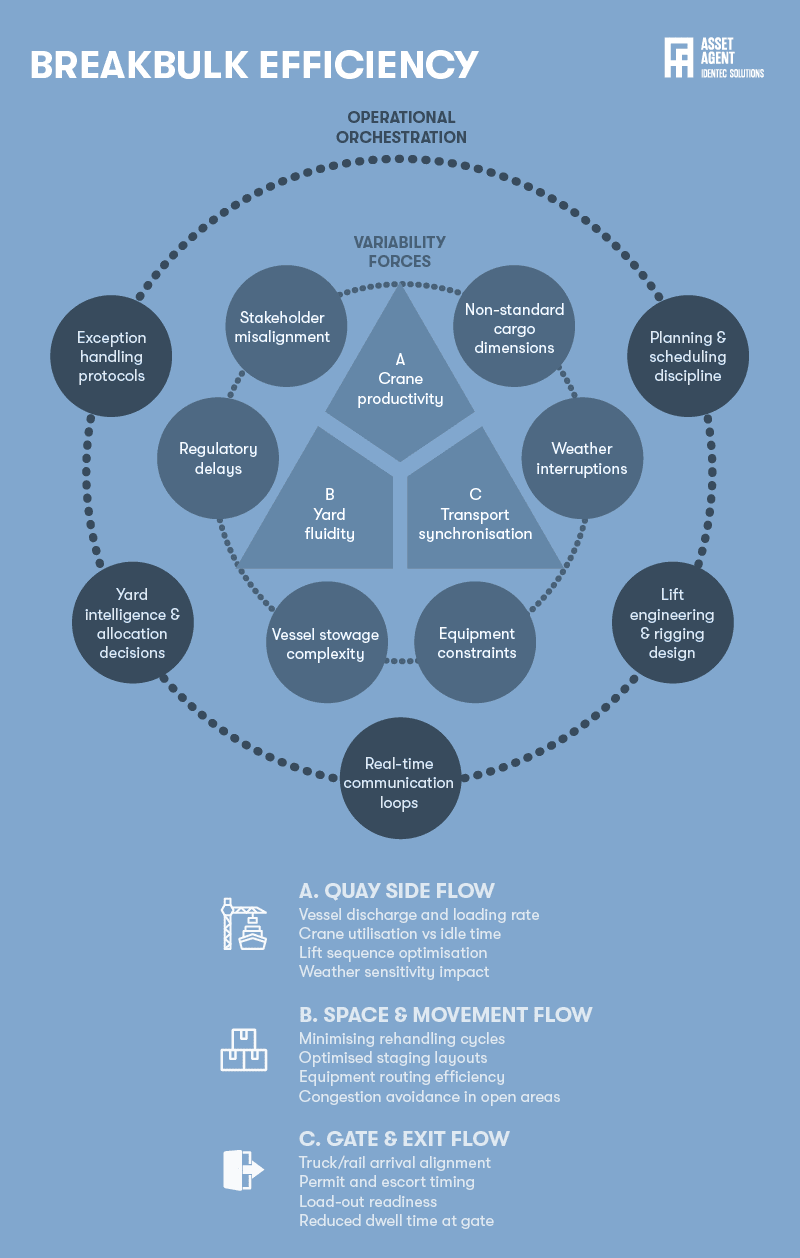
Performance measurement in breakbulk terminal operations is not as straightforward as at container terminals. While throughput, hourly turnover, crane productivity, and storage capacity utilisation are important indicators, they rarely provide a complete picture of operational success in breakbulk services. This is because breakbulk handling is characterised by variability rather than repetition.
While performance in other operations can often be improved by increasing the speed and efficiency of standardised processes, faster turnaround is not always the primary goal at a breakbulk terminal. Maintaining operational control is crucial, and the key performance indicators (KPIs) are therefore more along the lines of:
Cargo transparency: Where is which cargo located and in what condition? Which handling operations have already been completed? What action is next?
Planning and coordination: How well can the terminal coordinate the numerous stakeholders, such as ship operators, stevedores, transport companies, surveyors, project logistics teams, customs authorities and cargo owners, and react to changing circumstances?
Cargo safety: If project components are delivered late, replanning is necessary. However, if they are damaged, this can bring an entire construction project to a standstill. Therefore, preventing cargo damage through proper handling, storage, protection, and monitoring is a fundamental performance objective.
Safety: Impressive productivity figures only count if they do not come at the expense of safe lifting procedures, inadequate planning, or increased risk exposure.
Adherence to deadlines: Meeting project deadlines is paramount; customers often place more value on reliability and transparency regarding the agreed deadline than on minor improvements in the overall turnaround speed.
Traditional KPIs: Indicators such as crane utilisation, idle time, handling rates, equipment availability and labour productivity continue to provide valuable operational insights; however, they should be viewed as supporting indicators rather than the sole measure of success.
The role of breakbulk terminals extends beyond mere cargo handling. They manage a complex network of activities, interfaces, and risks that must remain under control despite constant fluctuations. When transparency is ensured, stakeholders are aligned, cargo integrity is maintained, security risks are managed, and project plans are adhered to, operational success follows naturally.
Therefore, the most important KPI in breakbulk handling is not speed, volume, or capacity utilisation. It is control – the ability to plan, coordinate, and secure complex cargo movements from the arrival of the vessel to final delivery.
FAQ
What does safety management for breakbulk handling look like?
It focuses primarily on controlling the additional risks arising from special cargoes, complex lifting operations, and highly variable working environments. Unlike the repetitive processes at the container terminal, breakbulk cargo requires a separate risk assessment for each individual lifting operation and cargo movement.
Lift planning is central, determining crane configurations, lifting gear, restricted areas, and communication protocols. It is particularly important for heavy or oversized cargoes, as shifting centres of gravity during lifting can lead to instability.
Another core aspect is personnel coordination. Stevedores, crane operators, riggers, surveyors, and supervisors must operate within tightly controlled communication structures, especially when working under suspended loads or in congested staging areas.
The often highly complex lifting operations place increased importance on environmental conditions. Wind speed, visibility conditions and ground conditions can directly affect lifting safety and may necessitate a temporary interruption of work.
Takeaway
Breakbulk handling is not defined by throughput or repetition, but by controlled complexity across the entire terminal environment. Every service level, from vessel handling and cargo security to staging, storage, and onward transport interfaces, is part of an operating system designed to manage non-standard cargo.
In this context, efficiency is achieved primarily by reducing uncertainty, avoiding unnecessary handling, and ensuring that all parties involved work with consistent information and clear parameters.
The most effective breakbulk terminals are therefore those that manage variability and ensure that even the most complex projects or heavy-lift shipments are handled safely, predictably, and in the correct sequence from vessel arrival to final delivery.

Glossary
Crane capacity is the maximum weight a crane can safely lift, move, and place, usually stated in tons and often reduced as the load moves farther from the crane’s centre. At breakbulk terminals, capacity matters because cargo pieces can be heavy, irregular, and lifted with beams, slings, or hooks rather than standardised spreaders. Operators must consider not just the rated lift, but also radius, wind, cargo balance, and the combined weight of rigging and attachments. Matching crane capacity to cargo type is key for safe, efficient handling and to avoid delays or damage. (3)
A stowage plan is the loading blueprint for where each cargo piece will be placed on the vessel or in the terminal flow. It shows the order of handling, exact positions, weight distribution, access for cranes and forklifts, and how cargo will be separated, supported, and secured. For breakbulk, the plan is especially important because cargo items differ in size, shape, weight, and lifting points. A good stowage plan reduces rehandling, protects cargo, keeps the ship stable, and shortens berth time. (4)
References:
(1) Break bulk and cargo management
(2) https://www.maersk.com/logistics-explained/transportation-and-freight/2024/09/18/break-bulk-cargo
(3) Branch, Alan E. (2007): Elements of Shipping. Routledge.
(4) House, David. (2020): Cargo Work: For Maritime Operations. 8th ed., Elsevier.
Note: This article was partly created with the assistance of artificial intelligence to support drafting.

Author
Conny Stickler, Marketing Manager Logistics
Constance Stickler holds a master's degree in political science, German language and history. She spent most of her professional career as a project and marketing manager in different industries. Her passion is usability, and she's captivated by the potential of today's digital tools. They seem to unlock endless possibilities, each one more intriguing than the last. Constance writes about automation, sustainability and safety in maritime logistics.