| Written by Constance Stickler
Table of contents:
- East Africa’s Fresh Export Opportunity
- What Are the Key Export Commodities Driving the Cold Chain Shipments in East Africa?
- The East African Cold Chain Infrastructure
- Major Export Corridors in East Africa
- Challenges in Maintaining a Reliable Cold Chain
- Technology Transforming Cold Chain Exports
- What Is the Role of Container Terminals in Cold Chain Shipments?
- FAQ
- Takeaway
- Glossary
East Africa’s Fresh Export Opportunity
Consumers worldwide increasingly expect year-round availability of fruits, vegetables, seafood, and flowers, while retailers and food service establishments seek reliable suppliers who can guarantee consistent quality over long distances. This opens up new opportunities for export regions.
East Africa is one such region with significant potential. Countries like Kenya, Tanzania, Uganda, Ethiopia, and Rwanda benefit from favourable climatic conditions, diverse growing areas, and year-round agricultural production. Many areas boast fertile soils, regular rainfall, and moderate temperatures, allowing farmers to cultivate crops continuously rather than only during short seasons. This natural advantage makes the region particularly attractive for the production of exportable horticultural products such as avocados, green beans, mangoes, and cut flowers.
Agriculture plays a central role in many East African economies, employing a large portion of the workforce and contributing significantly to export earnings. In recent years, governments and private investors have increasingly focused on high-value horticulture as a path to economic growth. Compared to staple foods, fresh fruits, vegetables, and flowers command significantly higher export prices per tonne. However, these products are also considerably more sensitive to delays and temperature fluctuations after harvesting.
From harvest onwards, precise temperature control is essential to maintain freshness, appearance, and shelf life (see also: Cold chain temperature control). Pre-cooling systems in packhouses, refrigerated transport, temperature-controlled storage, and modern handling of refrigerated containers in ports all play a crucial role in protecting perishable goods. Without the seamless interaction of these systems, the region's agricultural advantages cannot be fully translated into export success.
Exports of perishable goods from East Africa are primarily concentrated in three major international markets. Europe remains the most established market, with strong demand for fresh vegetables, fruits, and flowers. Its geographical proximity compared to competing suppliers in Latin America or Asia offers exporters a valuable logistical advantage for time-sensitive products. The Middle East has also become an increasingly important market, driven by rapid urban population growth and a heavy reliance on food imports. At the same time, Asian markets are gradually expanding their imports of high-quality fresh produce, thus opening up additional opportunities for East African producers seeking to diversify their trade routes.

What Are the Key Export Commodities Driving the Cold Chain Shipments in East Africa?
East Africa's growing importance in global agricultural trade is closely linked to a group of high-value commodities that depend heavily on reliable, temperature-controlled logistics. With increasing exports, these commodities are not only driving agricultural growth but also shaping investments in cold storage facilities, refrigerated transport, and temperature monitoring systems across the region.
Fresh Fruits
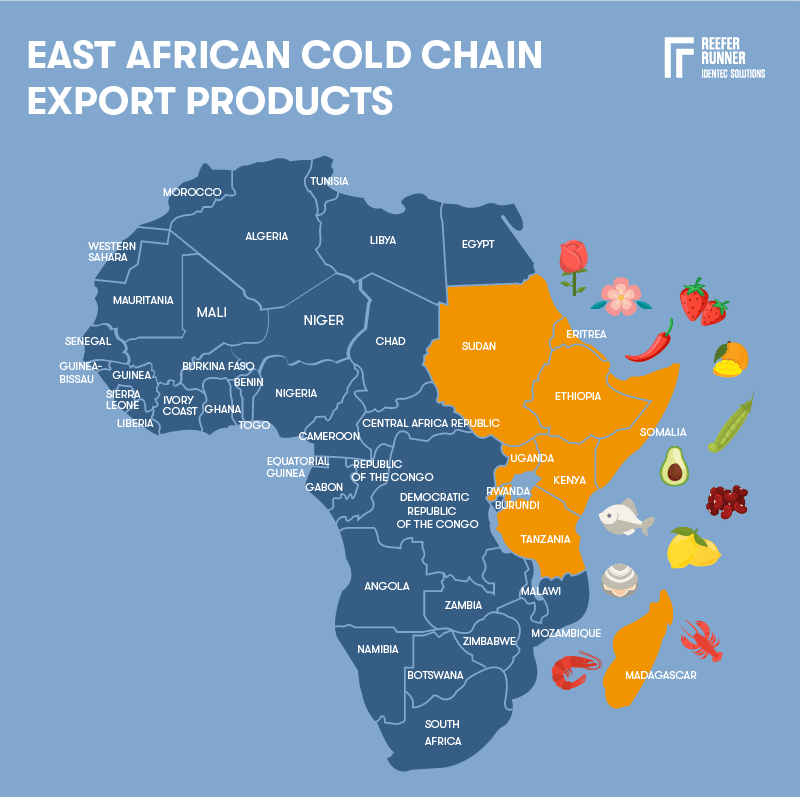
Among the most important export products are fresh fruits, especially avocados, particularly from Kenya. Over the past decade, the country has become one of the world's leading suppliers of the Hass variety for European and Middle Eastern markets. Mangos and pineapples are increasingly cultivated in Tanzania and Uganda for markets seeking alternatives during the off-seasons of other regions. Madagascar especially is known for its Lychees.
Vegetables
High-quality horticultural crops such as green beans, sugar snap peas and speciality vegetables are grown on a large scale for international markets, in smaller scales for example also in Rwanda and Burundi.
Flowers and Horticulture
Flower cultivation is one of East Africa's most successful export sectors. Countries like Kenya and Ethiopia have become world-leading exporters of cut flowers, especially roses. Flower farms at high altitudes benefit from favourable growing conditions, producing high-quality blooms that are in high demand on international markets.
Many of these fresh flowers are still shipped by air freight to ensure rapid delivery to wholesale markets and distribution centres in Europe. Although the vast majority of flower exports still move by air freight, improvements in cold chain infrastructure are gradually enabling limited volumes to be transported in refrigerated containers.
Fish and Seafood
The fisheries around Lake Victoria supply export markets with species such as Nile perch and tilapia, which are processed and shipped to international customers. Madagascar exports (besides vanilla, for which it is mainly known) prawns, crabs and lobsters.
For many producers and exporters in East Africa, these commodities form the backbone of regional demand for cold chain logistics. As global markets continue to seek reliable suppliers of fresh, high-quality perishable goods, the growth of these export sectors will continue to attract investment.
The East African Cold Chain Infrastructure
The success of the entire cold chain process depends heavily on the infrastructure that maintains product quality after harvest. Cold chain systems connect farms, processing plants, transport networks, and export centres, ensuring that temperature-sensitive goods remain under controlled conditions throughout their journey. Paul Matthew, Global Cold Chain Alliance (GCCA) Director for Africa, stated during a visit to Kenya in 2024, “There is exciting and robust momentum in the expansion and development of East Africa’s cold chain. Significant investment is coming into the industry, and the results are very impressive: efficient new facilities, modern technologies, a strong range of services available to meet customers’ needs, and serious future plans.” (1)
Packhouses and Pre-Cooling Facilities
The cold chain begins immediately after harvesting. As soon as fruits, vegetables, or flowers leave the field, they must be transported to packhouses as quickly as possible, where they are sorted, graded, packaged, and chilled before entering the transport network. Removing the field heat is particularly important, as it slows down biological processes such as respiration and ripening. This is the only way to extend shelf life and ensure that the products survive long-distance transport without losing their freshness.
In the main horticultural regions, modern packhouses with refrigeration systems are becoming increasingly common; many farms now use integrated facilities with sorting lines, packaging lines, and pre-cooling units. These investments help exporters meet the stringent quality standards of international buyers.
However, access to such facilities remains unevenly distributed across the region. Smallholder farmers, who produce a significant share of agricultural output, often rely on communal packhouses or cooperatives to access the cold chain.
Cold Storage and Distribution Hubs
After pre-cooling and packaging, the goods are then moved to cold storage facilities, where they are consolidated and prepared for shipment. These facilities are crucial for managing peak harvests and coordinating logistics. Particularly near major production centres, the number of temperature-controlled warehouses is increasing. These facilities often offer refrigerated or deep-freeze storage for a wide range of goods, from fresh fruits and vegetables to seafood and processed foods.
Consolidating products from different farms into larger shipments increases logistical efficiency and makes it possible to meet the volume requirements of international customers.
Despite these improvements, refrigeration capacity remains limited in many parts of East Africa. Expanding cold storage networks, therefore, remains a key priority for governments and private investors seeking to strengthen the region's export infrastructure.
Reefer Transport
Refrigerated trucks play a central role in transporting goods from inland areas to ports. Delays caused by traffic jams, poor road conditions, or border crossings can extend transport times and pose risks to perishable goods. Therefore, logistics providers are increasingly investing in modern refrigerated fleets and route planning technologies to improve reliability.
Ports
From ports on the East African coast, such as Mombasa (Kenya), Dar es Salaam (Tanzania), and Djibouti, ships then travel to Europe, the Middle East, and Asia. A sufficient power supply is essential at these ports to maintain the numerous reefers (learn more about reefer operations).
Major Export Corridors in East Africa
Export corridors connect agricultural production areas with international shipping hubs. Since many growing regions are located inland or in landlocked countries, the reliability of these corridors is crucial.
Kenya’s Export Corridor
One of the most established corridors is located in Kenya. Kenyan horticultural production is concentrated in fertile highland regions such as the Mount Kenya region, Naivasha, and the Murang'a district. These areas produce large quantities of vegetables, fruits, and flowers for international markets, which are transported by refrigerated trucks to major ports, such as Mombasa, the region's main maritime export hub.
Tanzania’s Emerging Export Routes
Agricultural regions such as Arusha and the Kilimanjaro region produce fruit and vegetables, which are transported via expanding cold chain logistics networks to export hubs in the port of Dar es Salaam, one of the largest ports on the East African coast. Improvements to the port infrastructure and refrigerated container capacity have strengthened its ability to handle the growing volume of refrigerated container shipments.
Uganda’s Land-Linked Supply Chains
Uganda is a landlocked country, so its export supply chains are heavily dependent on cross-border transport routes that connect domestic production areas with ports in neighbouring countries. Agricultural products from the region around the capital, Kampala, and fish from Lake Victoria are transported through Kenya to Mombasa.
Regional Integration and Cross-Border Logistics
East African export corridors rely on regional cooperation and integrated logistics networks. Infrastructure initiatives and trade agreements within the East African Community help improve the efficiency of cross-border transport and reduce delays for exporters.
Efforts to simplify customs procedures, expand the road network, and enhance logistics infrastructure are gradually strengthening the reliability of these corridors. For temperature-sensitive goods, reducing transit times and minimising border delays can significantly lower the risk of temperature excursions and product spoilage.
These logistics routes are the lifelines connecting the region's agriculture and fisheries to global markets, enabling exporters to compete in the rapidly growing international trade of fresh and temperature-controlled products.
Challenges in Maintaining a Reliable Cold Chain
Although East Africa has made significant progress in expanding its cold chain capacity, maintaining a consistently reliable, temperature-controlled logistics network remains a challenge. The region's agricultural potential is considerable, but various structural and operational barriers continue to hinder the transport of perishable goods from farms to international markets.
Infrastructure Gaps
One of the biggest challenges is the unequal availability of cold chain infrastructure in the region. While export-oriented agricultural zones are increasingly investing in packhouses, cold storage facilities, and refrigerated transport, many rural production areas still lack sufficient cooling capacity.
If pre-cooling and refrigerated storage are only accessible to a limited extent, this can lead to bottlenecks immediately after harvest, and the quality of the products can be compromised even before they enter the actual export logistics chain.
One of the most critical factors in the cold chain is a reliable power supply. Cold storage facilities, packhouses, refrigerated warehouses, trucks, and container terminals—every single step requires electricity to maintain optimal conditions. In parts of East Africa, where power outages are frequent, operators often rely on emergency generators to keep refrigeration systems running. While this approach allows operations to continue, it increases operating costs and adds complexity for logistics providers.
Transport Delays and Handling Risks
Many agricultural regions are connected to ports via long road corridors, and delays on these routes pose significant risks to perishable goods. These delays are due to the often poor condition of roads in rural areas and traffic congestion near urban centres. Waiting times also occur at customs stations that handle shipments from inland countries. Furthermore, improper handling during loading and unloading compromises the integrity of the cold chain.
Temperature Monitoring and Visibility
Another challenge is the limited transparency of temperature conditions along the supply chain, which are still mostly monitored manually or only at specific checkpoints. This makes it difficult to detect problems early in the event of deviations.
Cost Barriers for Small Exporters
For smaller exporters, requirements such as specialised packaging and monitoring systems pose a significant hurdle. Many smallholder farmers, therefore, rely on cooperatives, shared packing facilities, or external logistics providers. While this fills gaps in the infrastructure, it also entails coordination efforts.
Improving access to affordable cold chain services is therefore a key priority, enabling more producers to participate in the international export market.
Technology Transforming Cold Chain Exports
With the continued growth of East Africa's fresh produce export sector, technology is becoming increasingly important. From digital monitoring systems to data-driven logistics platforms, new technologies are helping exporters, logistics providers, and terminal operators control temperature in complex international supply chains. These innovations are particularly important for regions with inadequate infrastructure and long transport routes.
IoT Temperature Monitoring
These systems use networked sensors in refrigerated containers, warehouses, or transport vehicles to continuously monitor temperature and other environmental conditions. The data is sent to digital platforms, providing valuable real-time insights into the condition of the goods during transport. If deviations occur, such as in temperature or humidity, alarms are generated so that corrective action can be taken before product integrity begins to suffer.
Data-Driven Cold Chain Management
Historical data from IoT temperature monitoring enables a new level of cold chain management. Analysing this data allows for the identification of patterns, such as recurring delays on specific transport routes or locations with frequent temperature fluctuations. This enables route optimisation, improved handling procedures, and modifications to warehousing practices to minimise risks.
Furthermore, data-driven insights help optimise harvesting and shipping plans. By aligning production volumes with available logistics capacities, companies can reduce bottlenecks in packhouses and export centres, thus ensuring more efficient transport of perishable goods through the cold chain.
Automation and Digital Platforms
Automation and digital logistics platforms are increasingly transforming the coordination of cold chains. Digital systems integrate information from various stakeholders in the supply chain, including farmers, exporters, transport companies, port operators, and shipping lines.
This flow of information enables more effective shipment coordination. Exporters can track goods movements in real time, logistics providers can optimise transport plans, and terminal operators can prepare more efficiently for incoming refrigerated containers.
Digital documents are another important development, allowing for faster customs clearance and passage through the gates of container terminals.
What Is the Role of Container Terminals in Cold Chain Shipments?
Container terminals are the final stage of the cold chain export process on land. They therefore require specialised infrastructure, operational procedures, and monitoring systems specifically designed for refrigerated containers.
Reefer Plug Capacity and Monitoring
The key requirement for the successful handling of temperature-controlled goods is sufficient power connection capacity, as reefers need a continuous power supply to operate their refrigeration units. Major export ports such as those in Mombasa and Dar es Salaam have gradually increased the number of plugs.
However, an adequate power supply alone does not guarantee success: The condition of the refrigerated containers must be actively monitored. Temperature and other parameter settings, alarm states, and operating status must be checked regularly. Many terminals still perform manual checks—this poses significant risks, as problems can naturally occur between inspection intervals and may be overlooked without digital systems.
Efficient Reefer Handling Procedures
Handling the containers requires specific operational procedures to minimise the time they have to operate without a power supply. This necessitates efficient warehouse planning to make delivery and collection as simple and time-saving as possible.
Furthermore, it is important to avoid peak loads when large quantities of refrigerated containers arrive simultaneously. Such peak loads drive up the port's energy costs and, in the case of vulnerable networks, can lead to problems and outages. With so-called "peak shaving," the containers are connected sequentially according to urgency (varying sensitivity of the goods, current temperature) to balance the load.
Coordination Between Shipping Lines and Terminals
The success of a cold chain depends significantly on close cooperation between terminal operators, shipping companies, and logistics providers. Temperature specifications and special handling requirements must be clearly defined and adhered to, while the spaces in the terminal yard and on the vessel must be available on time.
Especially during peak harvest seasons and other peak periods, ensuring an adequate power supply is often a challenge. If all plugs at the rack are occupied, ports also utilise gensets located in dedicated yard slots. It is important to ensure that remote monitoring is available for the reefers parked there. Modern systems feature hardware that can be permanently mounted to the rack (e.g., bolted down) or directly to the refrigerated reefer (using magnets, for example).
With the continued growth of East Africa's agricultural exports, container terminals will play an increasingly vital role in protecting the integrity of temperature-sensitive shipments. By combining a reliable power supply infrastructure, specialised handling procedures and effective operational coordination, terminals help ensure that perishable goods leave the region in optimal condition for long-distance transport to international markets.
FAQ
What is the economic impact of missing refrigerated transport on farmers and food prices?
An estimated 14 per cent of all food produced for human consumption is lost before it reaches the consumer. One of the main reasons for this is the lack of an effective cold chain. This could save up to 144 million tons of food annually if the infrastructure were as well-equipped as in industrialised countries.
Especially in developing countries, food losses reduce the income of 470 million smallholder farmers by about 15 per cent. Investments in sustainable cold chains would be crucial in helping these farming families escape poverty. (2)
The economic consequences extend beyond agriculture and farmers. When large quantities of perishable food are lost before reaching consumers, the supply of fresh produce decreases. In many developing countries, this scarcity contributes to higher retail prices. Studies suggest that post-harvest losses of fruits and vegetables can reach 40–50% in regions lacking cold chain infrastructure. (3)
Takeaway
East Africa possesses the natural resources and agricultural potential to play a significant role in the global trade of perishable goods. Exports already reach Europe, Asia, and the Middle East.
However, to prevent food losses and increase exports, investment in refrigeration infrastructure is essential. Equally important is the use of digital technologies such as IoT sensors for temperature monitoring and logistics platforms to ensure reliability and transparency.
Further challenges include infrastructure improvements in rural areas, ensuring a secure electricity supply, and facilitating access to cold chain services for smaller producers. Continued cooperation between governments, logistics providers, exporters, and port operators is therefore crucial.
By expanding cold chain capacity and improving operational coordination, East Africa can reduce food losses, safeguard product quality, and further establish itself as a reliable supplier of temperature-sensitive goods to global markets.

Delve deeper into one of our core topics: Refrigerated containers
Glossary
Horticulture is the intensive cultivation, production, and science of high-value garden crops, including fruits, vegetables, nuts, flowers, ornamentals, and landscape plants. Unlike broad-field agriculture focused on staple grains or livestock, horticulture emphasises small-scale, specialised management techniques such as propagation, breeding, irrigation precision, pest control, and postharvest handling to maximise quality, yield, and aesthetic value. It spans pomology (fruits/nuts), olericulture (vegetables), floriculture (flowers), and arboriculture (trees). (4)
A packhouse is a dedicated facility where freshly harvested produce is received, sorted, graded, washed, sometimes pre‑cooled, packed, and prepared for cold storage or refrigerated transport. It is the first organised node after the farm and crucial for preserving quality and shelf life: rapid removal of field heat, hygienic handling, and standardised packaging reduce mechanical damage, microbial growth, and temperature abuse before the product enters long-haul cold logistics. (5)
Reference:
(1) https://www.gcca.org/magazine-article/robust-momentum-in-east-africa/
(4) George, R.A.T.; Edwardson, J.R. (1993). Horticulture. Longman Scientific & Technical.
(5) Kitinoja, Lisa; Thompson, James F. (2016). Prevention of Postharvest Food Losses: Fruits, Vegetables and Root Crops. FAO.
Note: This article was partly created with the assistance of artificial intelligence to support drafting.

Author
Conny Stickler, Marketing Manager Logistics
Constance Stickler holds a master's degree in political science, German language and history. She spent most of her professional career as a project and marketing manager in different industries. Her passion is usability, and she's captivated by the potential of today's digital tools. They seem to unlock endless possibilities, each one more intriguing than the last. Constance writes about automation, sustainability and safety in maritime logistics.