| Written by Constance Stickler
Table of contents:
- The TOS as the Digital Backbone and Integration Hub
- What Is a Container Terminal Operating System?
- The Evolution of TOS: From Legacy Systems to Digital Ecosystems
- Market Overview: Leading TOS Platforms and Technical Comparison
- Who Works with a TOS?
- TOS Architecture and Integration Capabilities
- User Profiles and System Interaction – Highlighting IT Responsibilities
- Reefer Runner Integration Into TOS
- Terminal Tracker Integration Into TOS
- FAQ
- Takeaway
- Glossary
The TOS as the Digital Backbone and Integration Hub
Today, the efficiency of container terminals no longer depends solely on cranes, trucks, and storage space—it's about data, connectivity, and seamless system integration. At the heart of this is the terminal operating system. It acts not only as the operational "brain" but also as the digital backbone and integration centre, connecting assets, personnel, and business systems.
The TOS consolidates extensive operational data streams—from vessel stowage schedules and gate arrivals to asset status and refrigerated container monitoring. Combined with IoT platforms such as Reefer Runner and Terminal Tracker, the TOS becomes a real-time control centre. Terminals can use it to monitor critical assets, perform security checks, optimise resource allocation, and respond immediately to exceptions.
The system's architecture, scalability, and integration capabilities are crucial for successful deployment, enabling it to adequately respond to challenges such as unprecedented cargo volumes, multi-terminal operations, and increasing automation. A TOS must manage high-frequency data, support APIs and middleware for third-party systems, and provide reliable dashboards for planners, operations, and management—all while adhering to strict cybersecurity standards.
Like other platforms, they are evolving toward cloud-native, AI-driven, and predictive architectures that enable IT teams to orchestrate terminal operations more intelligently, resiliently, and efficiently. Understanding how a TOS integrates into the digital landscape is essential to ensuring that technology investments translate into measurable operational performance, security, and sustainability.
In short, the TOS is the central nervous system of a connected, data-driven terminal, and a strategic enabler of digital transformation.
What Is a Container Terminal Operating System?
The TOS is the central digital backbone of a terminal, coordinating data, workflows, and networked systems in real time. It serves as an integration hub connecting vessels, yard equipment, gate systems, reefer monitoring platforms, and enterprise applications into a single, cohesive ecosystem.
At its core, a TOS offers a modular architecture that separates key functions while ensuring seamless data exchange throughout the system. Modules typically include vessel planning, yard management, gate operations, intermodal coordination, equipment planning, and reporting. Each module communicates via standardised interfaces, or APIs, allowing IT teams to integrate third-party solutions.
Modern TOS platforms also feature real-time data processing capabilities. Sensors on cranes, straddle carriers, reach stackers, and reefer terminals continuously transmit telemetry data and status updates. All this information is consolidated into dashboards and workflows, enabling predictive analytics, automated alerts, and proactive decision-making. For IT departments, this means managing large volumes of data, ensuring reliability, and maintaining security and access control across all connected systems.
The Evolution of TOS: From Legacy Systems to Digital Ecosystems
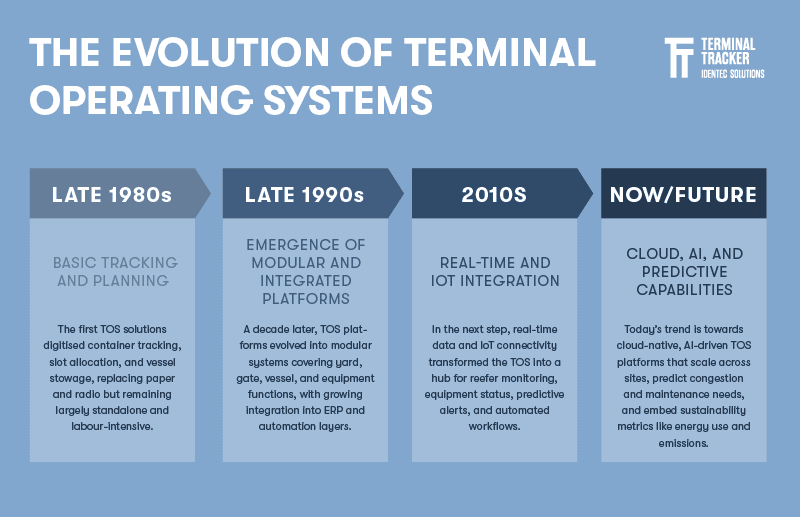
The evolution of TOS reflects the comprehensive digital transformation that container terminals have undergone in recent decades. Since their beginnings, TOS platforms have evolved from simple record-keeping tools to sophisticated, integrated IT ecosystems that support all operational and strategic decisions.
Early Systems: Basic Tracking and Planning
Until the late 1980s, terminals used paper-based records, spreadsheets, and radio communications to manage container movements. The first generation of TOS digitised this process, enabling basic container tracking, slot allocation, and vessel stowage planning. While these systems reduced manual errors and improved transparency, they were largely standalone, required significant human intervention, and could not be integrated with other operational or enterprise systems.
Emergence of Modular and Integrated Platforms
In the late 1990s and 2000s, terminals faced growing container volumes and more complex operations. TOS platforms evolved into modular architectures that separated warehouse management, gate operations, vessel planning, equipment scheduling, and KPI reporting. During this time, integration capabilities also evolved, enabling TOS platforms to communicate with automation systems, ERP platforms, and early telemetry devices. IT teams are increasingly focused on data standardisation, API interfaces, and reliability to enable seamless communication between terminal functions.
Real-time and IoT Integration
The last decade saw the most transformative phase. Modern systems now support real-time monitoring and integration with IoT (Internet of Things) devices. For example, refrigerated containers transmit live temperature and performance data, while equipment provides status, location, and results before safety checks go live. The TOS consolidates these data streams, enabling predictive alerts, automated workflows, and real-time dashboards. This requires robust data acquisition pipelines, event-driven architectures, and secure API management for processing high-frequency and large-scale telemetry data.
Cloud, AI, and Predictive Capabilities
The trend is toward more cloud-native implementations, AI-powered analytics, and predictive operations. Cloud architecture enables seamless terminal scaling, multi-site integration, and reduced on-premises infrastructure overhead. AI and machine learning enable predictive warehouse planning, congestion avoidance, and proactive maintenance planning. Sustainability features, including energy monitoring and carbon footprint tracking for equipment and reefer containers, are increasingly being integrated into systems. IT teams must ensure the security, resilience, and compliance of these systems while providing planners and management with actionable insights.
From paper and spreadsheets to AI-powered digital ecosystems, TOS platforms have evolved into the essential operational foundation of terminals. Nowadays, the container terminal operating systems market size is valued at USD 4.5 trillion in 2024 and is forecast to grow at a CAGR of 8.5% from 2026 to 2033, reaching USD 8.9 trillion by 2033. (1)
Market Overview: Leading TOS Platforms and Technical Comparison
Selecting a TOS is primarily about operational capabilities, but also about architecture, scalability, integration capabilities, and long-term maintainability. The leading TOS platforms differ in their technical design, deployment options, and integration capabilities.
Navis N4 (Kaleris)
Navis N4 is known for its modular, scalable architecture. It supports the operation of large, multi-terminal terminals and features sophisticated APIs for integrating third-party systems, automation layers, and IoT devices. IT teams appreciate its support for processing large amounts of data, role-based access control, and redundancy configurations. Cloud and on-premises deployment options offer flexibility for terminals with diverse IT infrastructures. Robust security protocols and audit logging also make Navis N4 suitable for terminals with strict regulatory requirements.
RBS TOS+
RBS TOS+ is a cloud-native, modern TOS for small to medium-sized terminals or those seeking rapid deployment. Its lightweight architecture enables IT teams to efficiently manage integrations and supports API-based connections to IoT devices, enterprise systems, and automation layers. Security and access control are integrated, and the system's SaaS model reduces infrastructure overhead while supporting scalability and remote monitoring.
Tideworks Technology
Tideworks TOS is known for its flexible integration framework and strong intermodal support. IT teams appreciate its modular design, which allows for the selective deployment of gate, yard, or scheduling modules. Tideworks supports real-time data feeds from sensors, IoT devices, and enterprise systems. Its API-first approach simplifies integration with 3rd party platforms. While Tideworks doesn't offer the same level of automation as Navis N4, it excels in environments with legacy systems or highly customised workflows.
CyberLogitec OPUS Terminal
OPUS Terminal is particularly well-established in terminals in the Asia-Pacific region and is valued for its centralised architecture and integrated dashboards. IT departments benefit from its unified data model, which consolidates device telemetry, vessel planning, and shipyard operations. It offers API endpoints for real-time integrations, enabling seamless connections with IoT devices, predictive analytics tools, and cloud services. OPUS also offers extensive logging and monitoring capabilities, helping IT maintain operational security and compliance.
Who Works with a TOS?
The TOS is the central platform that connects all departments of a container terminal—from the quay cranes to the finance departments. Each department relies on it to a different extent:
Operations uses the TOS for berth planning, bin allocation, and gate processing to ensure efficient container flow.
Facility control and maintenance use it to assign shipments to cranes and carriers while coordinating preventative maintenance.
Reefer management integrates tools like Reefer Runner to monitor plugins, setpoints, and alarms in real time.
Security and compliance benefit from integrations like Terminal Tracker to capture pre-commissioning safety checks and track incidents.
The finance and billing department leverages timestamps and reefer plugins data from the TOS for accurate invoicing and demurrage processing.
Customer service and sales teams access real-time container status and performance reports from the TOS to serve customers and negotiate contracts.
System administrators maintain the TOS environment, manage user access rights, and ensure stable day-to-day operations.
Integration specialists connect the TOS with external systems – from IoT solutions and ERP platforms to customs and shipping portals.
Network and cybersecurity teams secure data flows, protect against threats, and ensure compliance with cybersecurity standards.
IT leadership (CIOs, IT managers, and digitalisation officers) sets the strategic direction and oversees upgrades, cloud adoption, and the long-term integration roadmap.
TOS Architecture and Integration Capabilities
Terminal operating systems are not monolithic software but integration hubs that connect a diverse digital ecosystem. Understanding how the TOS architecture supports these integrations is critical for assessing scalability, resilience, and futureproofing.
Modular and Layered Design
Most TOS platforms today are based on a modular architecture that separates core functions (ship planning, yard management, gate operations) from specialised modules and external systems. This layered structure allows terminals to initially deploy essential functions and then extend them with advanced features such as automation support, IoT integration, or predictive analytics without compromising the operational core.
Integration with IoT Solutions
IoT-driven solutions enable unprecedented transparency. For example, the reefer monitoring tool Reefer Runner integrates with the TOS to feed real-time information on temperature status, alarms, and power connections directly into the operational dashboard. Terminal Tracker's capabilities enable error-free localisation of individual containers and CHE (container handling equipment) at any time.
Connection to ERP and Financial Systems
To optimise financial and administrative processes, TOS is also linked to enterprise resource planning (ERP) systems. This ensures that recorded container movements, storage times, and reefer plug-ins flow seamlessly into billing, procurement, and financial reporting systems. The integration reduces reconciliation errors, simplifies compliance audits, and supports real-time financial transparency.
Automation Layer Interfaces
As automation advances, the TOS is also expected to be able to connect to systems such as interfaces provided by vehicle manufacturers. This allows movement instructions to be sent to automated cranes, transport vehicles, and stacking systems and, in return, to receive telemetry data and status updates.
APIs and Openness
Application programming interfaces (APIs) are the standard for extending TOS functionality. Open APIs enable rapid integration with shipping portals, customs systems, trucking platforms, or advanced analytics tools. The quality and openness of a TOS's API framework are crucial factors: they determine how easily new digital initiatives—from blockchain pilot projects to AI-driven yard optimisation—can be tested and scaled.
The integration capabilities of a TOS determine its long-term value. A closed, rigid system ties terminals to outdated processes, while an open, modular TOS enables continuous innovation.
User Profiles and System Interaction – Highlighting IT Responsibilities
Terminal operating systems support a wide range of user profiles, from ship planners and crane operators to finance and customer service teams. IT departments, in particular, are required to understand exactly how their own teams interact with the TOS and what their responsibilities are. These responsibilities ensure not only smooth day-to-day operations but also long-term stability, security, and adaptability.
System Administration
System administrators are the guardians of the TOS environment. They handle user management, role-based access controls, database integrity, and system performance monitoring. Their work ensures that planners, operators, and managers throughout the terminal can rely on stable and uninterrupted system access.
Integration Management
Integration specialists ensure seamless communication between the TOS and ERP systems, IoT solutions, automation control layers, and external stakeholders, such as customs authorities and shipping companies. Their focus is on ensuring data consistency and real-time synchronisation between the TOS and the wider IT ecosystem.
Network and Cybersecurity
The increasing openness of platforms for cloud use, APIs, and connectivity to IoT devices brings with it enormous security challenges. Network and cybersecurity teams develop and implement security measures to protect critical data flows, prevent attacks, and ensure compliance with international standards such as ISO/IEC 27001. They also play a central role in developing and testing failover mechanisms to ensure resilience.
IT Monitoring and Incident Response
TOS must be continuously monitored to detect anomalies early and minimise downtime. Dedicated teams use dashboards, log analytics, and alert systems to track performance and security indicators. In the event of a disruption—be it a hardware failure, network outage, or cyberattack—they coordinate with operations to ensure rapid recovery and business continuity.
IT Leadership
IT executives and department heads shape the future of the TOS. They make decisions about cloud adoption, hybrid deployments, modular expansions, and long-term vendor partnerships. Their task is to align TOS functions with the terminal's business objectives and ensure that the system remains both an operational backbone and a driver of innovation.
Reefer Runner Integration Into TOS
Reefer container monitoring has evolved from manual checks to a fully digital process. For IT managers, integrating Reefer Runner into the terminal operating system not only provides additional functionality but also real-time visibility, data consistency, and process automation across the entire terminal.
Integration Architecture
Reefer Runner typically connects to the TOS via APIs (Application Programming Interfaces), exchanging data between Reefer Runner and the TOS. Telemetry data from each reefer container—plug status, setpoints, and alarms—is collected via the Reefer Runner tags and transmitted to Reefer Runner. The integration synchronizes these data points with the TOS in near real time, allowing warehouse planners, operations teams, and customer service departments to work from the same data.
Data Flow and Synchronisation
From an IT perspective, the - is ensuring reliable and consistent data transfer. For example:
- When a reefer container is plugged in, Reefer Runner logs the action and sends the timestamp to the TOS.
- When an alarm is triggered, Reefer Runner notifies the TOS, which can escalate the incident via operational workflows.
When planners in the TOS assign a reefer container transport, Reefer Runner receives relevant updates to ensure contextual accuracy in its monitoring dashboard.
Scalability and Load Management
Container terminals with thousands of reefer container slots require scalable integration architectures. Well-designed interfaces on both sides, Reefer Runner and the TOS, ensure the system can handle spikes in telemetry data (high throughput) with minimal latency.
Security Considerations
State-of-the-art security measures are required to protect Reefer Runner and the TOS against cybersecurity threats. Reducing the attack surface relies on encryption, strong authentication, and a robust on-premise infrastructure that can withstand scaling demands. Additional safeguards, such as network segmentation, DMZ placement, and intrusion detection, ensure data integrity, stable performance, and long-term resilience.
Reefer Runner uses encryption in communication between the tag and reader, as well as TLS between the reader and the server. It also provides the technical capabilities to implement interfaces in accordance with local security requirements.
Operational Benefits
For IT managers, the added value of the integration is evident in how Reefer Runner enhances the TOS ecosystem:
- Billing automation: Precise timestamps for plug-in and unplug-in transactions flow into the TOS, reducing disputes and manual corrections.
- Alarm response: Real-time alerts enable proactive intervention, reduce freight claims, and increase customer confidence.
- Energy monitoring: Electricity consumption data supports sustainability reports and energy cost management and its incorporation into company metrics.
- Data consolidation: Reefer container telemetry becomes part of the TOS data pool, enabling predictive analytics and integration into BI dashboards.
Terminal Tracker Integration Into TOS
Operations in modern container terminals are becoming increasingly digitalised, and systems like Terminal Tracker play a central role in this. For IT managers, integrating Terminal Tracker into the terminal operating system not only enables data capture but also directly embeds critical process information from security checks and compliance workflows into the terminal's digital backbone.
Integration Architecture
Depending on the deployment model, Terminal Tracker can be integrated into the TOS via APIs. Specific information captured by Terminal Tracker, such as for example pull-park events and driver log-on events are pushed to the TOS. This ensures that critical information is visible in the same operational environment where planning and scheduling decisions are made.
Functions and Data Flow
From an IT perspective, the integration ensures that critical information provided by Terminal Tracker is also available in the TOS:
The Position Detection System (PDS) related information ensures that the locations of container handling equipment and containers are known at all times, thus maintaining yard accuracy (see more about container handling terminal operations).
The "Container Control" function ensures that containers can only be placed in the slot designated for them by the TOS, as the twistlocks cannot be released at other locations.
Pre-Operational Safety Checks (POSC): The results of driver or operator checks (e.g., tire check, fluid level, braking systems) are logged in the Terminal Tracker and transmitted to the TOS. If a check fails, the device is automatically marked as unavailable, preventing it from being used in the TOS.
Scalability and Performance
Large terminals with hundreds of devices and multiple operator shifts generate large data throughputs. Well-designed interfaces ensure that the integration can handle, for example, concurrent driver log-on events during shift changes without bottlenecks. This is best achieved through well-thought-through software architectures, where data is queued and processed without interrupting real-time device dispatch.
Security and Compliance
Because Terminal Tracker handles sensitive employee data and compliance records, IT management must enforce strict data management. This includes role-based access to security records and compliance with GDPR or local data protection regulations. APIs connecting Terminal Tracker to the TOS must be secured and must comply with local security requirements. Network segmentation is equally important to ensure that security-critical devices are protected.
Operational Benefits of Integration
Depending on the implemented modules, the following elements are integrated:
- Capture and recording of lift and drop events for CHEs, as well as pull and park events for trucks.
- Capture and recording of container weights for CHEs.
- Capture of truck positions for use in job promotion on the CHE operators' screens (the closest is served first).
- Capture and notification of task step completion based on processed TOS job data.
- Use of TOS job data to control which locations a CHE may drop a container.
- Operators are automatically logged in and out of the TOS via card.
The current TOS interfaces are via an XML over TCP solution similar to Navis SPARCS RDT (and ECN4 compatible) messaging.
With proper integration, Terminal Tracker improves the TOS ecosystem in several ways. Some examples are:
- Container misplacement, which would require labour-intensive and time-consuming remediation, is prevented.
- Automatic device blocking: Unsafe or unchecked machines are immediately marked as unavailable in the TOS, reducing the risk of accidents.
- Unnoticed and unreported collisions are registered and transmitted via shock sensors, helping to prevent subsequent issues.
- Transponders attached to external trucks allow them to be integrated into the port's internal system, offering the same benefits as internal trucks.
An overview of all Terminal Tracker modules and functions can be found here.
FAQ
What Should IT Leaders Consider When Choosing a Container Terminal Operating System?
In addition to covering core functionalities such as vessel planning, yard management, and gate operations, there are other important aspects for selecting the right TOS:
Integration Capabilities
The TOS should seamlessly connect to IoT devices, automation systems, and enterprise platforms such as ERP, customs, or port community systems. Reliable APIs, real-time data acquisition, and event-driven processing are essential for a smooth data flow.
Scalability and Deployment
The TOS should be able to easily handle fluctuating container volumes, multi-terminal operations, and future expansion. Cloud-native or hybrid deployment options should also be considered, as should modular architectures and the ability to add new modules or integrations without disruption to operations.
Data Architecture and Reliability
The system's message queues, data validation, latency, and failover mechanisms must be evaluated, especially when processing high-frequency telemetry data from sensors and devices.
Cybersecurity and Compliance
TOS is connected to internal and external systems. Therefore, strong role-based access controls, encryption, audit logging, and monitoring tools are essential to protect sensitive data and ensure regulatory compliance.
Futureproofing
Consider the provider's roadmap for AI-powered analytics, predictive maintenance, energy-efficiency monitoring, and integration with new IoT devices or automation technologies.
Selecting the right TOS is not just a software decision; it's a strategic integration that impacts all aspects of the port. Its architecture, connectivity, and resiliency determine how effectively the terminal can leverage real-time data, predictive insights, and automation to drive operational efficiency and digital transformation.
Takeaway
Today's container terminal operating systems are much more than just software; they are the digital backbone of the port, determining whether a terminal can cope with today's scale and the uncertainties of tomorrow. Its role as an integration hub makes it indispensable: from real-time IoT feeds from reefer containers and handling equipment to seamless connections with ERP, customs, and automation layers. For IT managers, questions about architecture, scalability, security, and resilience are strategic decisions that shape competitiveness. A well-chosen, futureproof TOS enables terminals to transform complexity into flow, ensuring operational efficiency, digital innovation, and long-term sustainability.

Delve deeper into one of our core topics: Smart Port
Glossary
Cloud-native means that the system uses cloud infrastructures and paradigms from the ground up and is not simply adopted from local on-premises systems. Key features include modular microservices, containerisation, dynamic scaling, continuous delivery, and infrastructure as code. For terminal IT teams, cloud-native helps them respond quickly to changes, deploy new modules or integrations with minimal disruption, and flexibly adapt compute and storage capacity to fluctuating requirements. (2)
In a hybrid deployment of a container terminal operating system, parts of the system run on-premises (locally or in a private cloud), while other modules or services run in the public cloud. For example, central container handling, warehouse operations, or gate control can be hosted on-premises for low latency and better control, while data analytics, reporting, backups, or non-critical modules run in the cloud. This setup enables IT to maintain reliability and data sovereignty locally while leveraging the scalability, elasticity, and innovation of the cloud. Hybrid deployments also help manage legacy systems and regulatory or connectivity restrictions. (3)
References:
(1) https://www.linkedin.com/pulse/terminal-operating-systems-tos-market-outlook-trends-epfic/
(2) Tom Laszewski, Kamal Arora, Erik Farr & Piyum Zonooz (2018). Cloud Native Architectures: Design high-availability and cost-effective applications for the cloud. Packt.
(3) Buckwell, Mark; Van Daele, Stefaan; Horst, Carsten (2024). Security Architecture for Hybrid Cloud: A Practical Method for Designing Security Using Zero Trust Principles. O'Reilly Media.
Note: This article was partly created with the assistance of artificial intelligence to support drafting.

Author
Conny Stickler, Marketing Manager Logistics
Constance Stickler holds a master's degree in political science, German language and history. She spent most of her professional career as a project and marketing manager in different industries. Her passion is usability, and she's captivated by the potential of today's digital tools. They seem to unlock endless possibilities, each one more intriguing than the last. Constance writes about automation, sustainability and safety in maritime logistics.