| Written by Mark Buzinkay
Table of contents:
- Defensive design: Building safety before mistakes happen
- Defensive design beyond equipment: Creating resilient offshore processes
- Defensive design during emergencies: Designing for human behaviour under stress
- Creating a defensive design culture offshore
- The future of defensive design: Connected, intelligent and predictive offshore safety
- FAQs
- Takeaway
- Glossary
Defensive design: Building safety before mistakes happen
Offshore installations are among the most demanding workplaces in the world. Personnel routinely operate heavy machinery, work at height, handle hazardous energy sources, and perform maintenance in confined spaces while facing changing weather conditions, long shifts, fatigue, and complex operational procedures. In these environments, even a seemingly minor mistake can escalate into a serious incident.For decades, industrial safety programmes concentrated primarily on training workers to avoid mistakes. While competence and experience remain essential, modern safety engineering recognises a fundamental reality: human error can never be completely eliminated. People become distracted, tired, stressed, overloaded with information, or forced to make rapid decisions under pressure. Defensive design therefore starts from a different premise—not “How do we make people perfect?” but rather, “How do we design systems that remain safe when people are not?”
This philosophy is closely linked to Human Factors Engineering, which considers how people interact with equipment, procedures, work environments, and organisations. Instead of viewing mistakes as individual failures, human factors examines how workplace design influences behaviour and decision-making. According to the UK’s Health and Safety Executive (HSE), effective system design must account for foreseeable operating conditions, maintenance activities, emergencies, and the interaction between people and technology. (1)
In practice, defensive design means incorporating barriers that either prevent an error from occurring or minimise its consequences should one occur. These barriers may be physical, procedural, or digital.Physical examples include:
- Mechanical interlocks prevent equipment from operating under unsafe conditions.
- Electrical connectors are designed so that incompatible systems cannot be connected together.
- Colour-coded valves, pipelines, and emergency equipment.
- Guardrails and machine guarding that physically prevent access to hazardous areas.
- Distinctive control handles with different shapes and tactile feedback allow operators to identify controls without relying solely on vision.
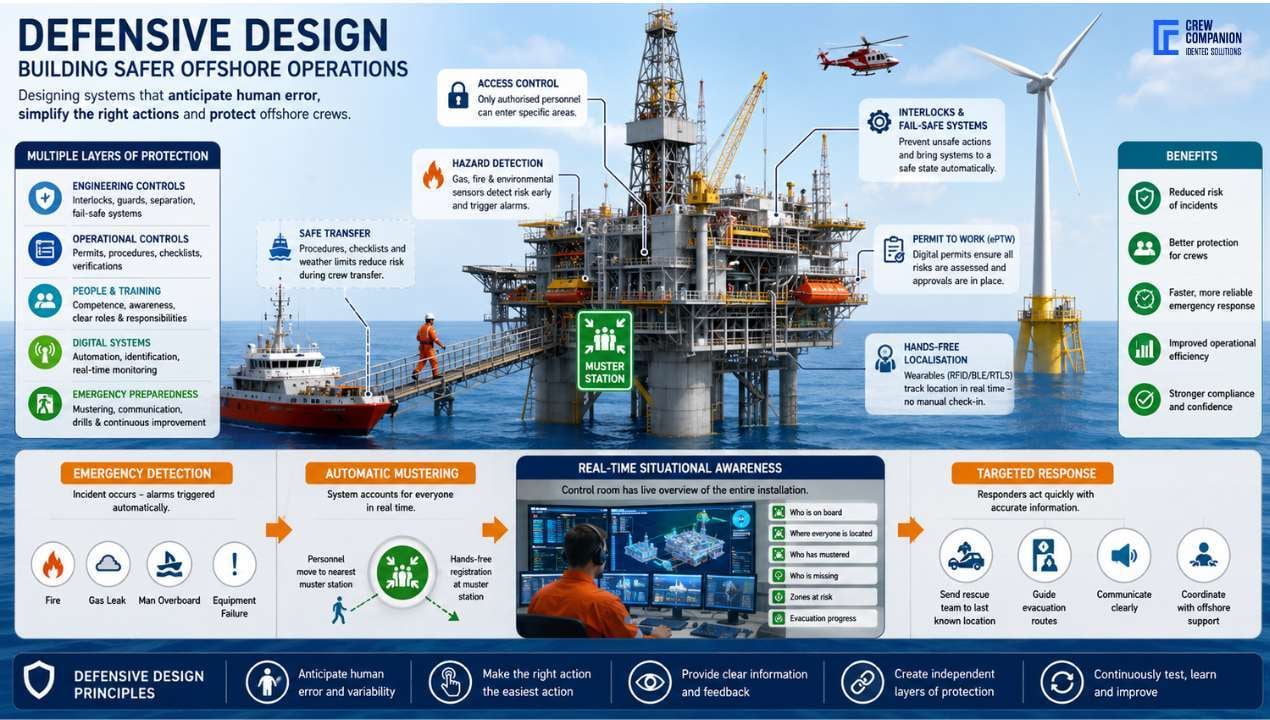
Many offshore systems already employ these concepts. Blowout preventers, emergency shutdown systems (ESDs), gas detection systems, fire suppression systems, and escape route layouts all represent forms of defensive design. They are engineered to continue protecting personnel even when another component or process fails.
The concept also extends into software. Before executing high-risk actions, operators may be required to confirm critical commands, obtain supervisory approval, or complete electronic checklists. Rather than unnecessarily slowing operations, these confirmation steps intentionally interrupt automatic behaviour, giving personnel an opportunity to detect errors before they become incidents.A useful way to understand defensive design is through James Reason’s Swiss Cheese Model, one of the most influential concepts in safety engineering. Rather than relying on a single safeguard, organisations implement multiple independent layers of protection. Every layer has weaknesses—or “holes”—but an accident only occurs when weaknesses in several layers align simultaneously. Consequently, improving safety means strengthening every defensive layer rather than expecting flawless human performance. (3)
For offshore operators, these protective layers typically include:
- Engineering controls
- Operating procedures
- Competency and training
- Maintenance programmes
- Safety management systems
- Offshore emergency response plans
- Digital monitoring technologies
Each layer compensates for the inevitable imperfections in another.
The offshore environment makes this multi-layered approach particularly important. Personnel rotations, contractor management, simultaneous operations (SIMOPS), adverse weather, helicopter transfers, vessel movements, and hazardous process equipment create an operating environment where risks constantly evolve throughout the day. Defensive design acknowledges that these changing conditions cannot always be managed through procedures alone.Instead, offshore safety increasingly depends upon systems that actively help workers make the correct decisions, prevent incorrect actions, and automatically identify emerging risks before they escalate.
Ultimately, the strongest safety systems are those that require the least reliance on perfect human behaviour. By embedding safety directly into equipment, workflows, and operational infrastructure, defensive design transforms safety from something people must continuously remember into something the workplace itself actively supports. Task begins with a Job Safety Analysis (JSA), which identifies hazards and outlines mitigation strategies.

Defensive design beyond equipment: Creating resilient offshore processes
While equipment often receives the greatest attention, defensive design extends far beyond physical hardware. Many offshore incidents do not originate from mechanical failures but from breakdowns in communication, coordination, planning, or execution. Consequently, resilient organisations design not only safer equipment but also safer processes.
Every offshore task follows a sequence of decisions and actions. Personnel obtain work permits, isolate hazardous energy, perform inspections, conduct maintenance, hand over responsibilities between shifts, and coordinate with multiple teams working simultaneously. Each step presents opportunities for misunderstandings, omissions, or incorrect assumptions.
Traditional procedures frequently rely on workers to remember each required action, accurately record information on paper, and verbally communicate critical updates. Under ideal conditions, these methods may perform adequately. However, offshore work rarely occurs under ideal conditions. Time pressure, weather changes, fatigue, contractor turnover, equipment alarms, and multiple concurrent activities all increase cognitive workload, making human error more likely.
Defensive process design addresses this challenge by making safe actions easier and unsafe actions more difficult.
One example is the Permit-to-Work (PTW) system. Rather than allowing hazardous work to begin immediately, PTW procedures require risk assessments, hazard identification, isolation verification, and formal authorisation before activities commence. Electronic Permit-to-Work (ePTW) systems further strengthen this process by automatically validating required approvals, linking permits to isolation records, tracking permit status in real time, and preventing work from progressing until mandatory steps are complete.Similarly, Lockout/Tagout (LOTO) procedures apply defensive design principles by ensuring hazardous energy sources cannot be inadvertently restored while maintenance is underway. Physical locks, tags, and verification procedures create multiple independent barriers against accidental energisation.
Another critical offshore activity is the shift handover. Complex installations such as a offshore rig operate continuously, meaning essential operational knowledge must be transferred reliably between outgoing and incoming crews. Poor handovers have contributed to numerous industrial incidents because incomplete information can lead to duplicate work, missed hazards, or incorrect equipment status.
Defensive design improves handovers through structured digital checklists, standardised reporting formats, mandatory acknowledgement of critical information, and integrated operational dashboards that provide incoming personnel with a consistent, real-time overview of plant conditions.
Simultaneous Operations (SIMOPS) present another significant challenge. Multiple maintenance teams, contractors, lifting operations, vessel movements, and production activities may occur concurrently within the same installation. Defensive process design ensures that these activities are coordinated rather than managed independently. Digital planning systems, work area zoning, conflict detection, and automatic notifications help reduce the likelihood of incompatible activities occurring simultaneously.
Increasingly, digital technologies are becoming an integral component of defensive design rather than an optional enhancement. Electronic identification, RFID, Bluetooth Low Energy (BLE), Real-Time Location Systems (RTLS), wearable devices, and geofencing enable safety systems to automatically verify personnel locations, authorisations, and movement without requiring continuous manual input.This represents a fundamental shift in safety philosophy. Rather than expecting workers to repeatedly confirm their location, the equipment they are using, or which permits apply to them, connected systems can automatically validate much of this information. Access control systems can prevent unauthorised entry into hazardous areas. Digital personnel tracking can identify individuals entering restricted zones. Electronic Persons on Board (ePOB) systems maintain continuously updated personnel records. Every automated verification removes another opportunity for human error.
Importantly, the objective is not to collect more operational data simply because technology makes it possible. The purpose is to eliminate unnecessary human actions that introduce risk. Every manual registration, handwritten checklist, radio call, badge scan, or paper record represents another point where mistakes may occur.
Defensive design, therefore, asks a simple but powerful question: Can this task be designed so that the safest action happens automatically? This principle becomes even more valuable during emergencies, when stress, uncertainty, and rapidly changing conditions significantly reduce people’s ability to follow complex procedures consistently. It is in these moments that defensive design demonstrates its greatest value—not by expecting better human performance, but by reducing the need for it. (4) (read more about emergency response solutions)
Defensive design during emergencies: Designing for human behaviour under stress
Emergency situations represent the ultimate test of any offshore safety system. During routine operations, personnel have time to think, verify information, consult procedures, and communicate with colleagues. In contrast, emergencies such as fires, gas leaks, explosions, structural failures, helicopter incidents, or man-overboard events require immediate action under intense psychological pressure. It is precisely during these situations that defensive design delivers its greatest value.
Emergency response procedures often assume that people will follow training exactly as practised. However, decades of research in psychology, aviation, and industrial safety show that human behaviour changes significantly under stress. Heart rate increases, attention narrows, memory performance declines, and decision-making becomes less analytical. Individuals may overlook obvious hazards, forget routine procedures, or simply follow the actions of those around them.
These reactions are not signs of poor training—they are natural human responses to danger.For offshore operators, this reality has important implications. Safety systems must be designed not only for normal working conditions but also for situations where people are frightened, distracted, fatigued, or injured. Defensive design, therefore, aims to reduce the number of decisions that personnel must make during an emergency while ensuring that critical information remains immediately available to emergency coordinators.
One area where this principle becomes particularly important is mustering.
Why traditional mustering is vulnerable to human error
The objective of mustering is straightforward: account for every person on board and verify that everyone has reached the appropriate muster station safely. Achieving this quickly and accurately allows emergency teams to identify missing personnel, initiate rescue operations, and make informed evacuation decisions.
Historically, many installations have relied on manual or semi-manual mustering procedures. Personnel travel to a designated muster station, where supervisors perform headcounts, compare names against personnel lists, verify attendance, and report results to the control room via radio or telephone.Although these methods have been used successfully for many years, they also depend heavily on flawless human performance.Potential sources of error include:
- Personnel reporting to the wrong muster station.
- Missing or outdated Persons on Board (POB) lists.
- Manual counting errors during stressful situations.
- Delays caused by large groups arriving simultaneously.
- Radio congestion slows communication between muster stations and the control room.
- Difficulty identifying personnel who remain inside hazardous areas.
- Time-consuming searches for contractors or visitors unfamiliar with emergency procedures.
Every manual action introduces another opportunity for mistakes. A single missed name or an incorrect headcount can delay rescue operations or cause emergency teams to search areas that have already been evacuated.Defensive design addresses these weaknesses by removing unnecessary manual processes wherever possible.
Hands-free systems: Removing human actions from emergency response
One of the clearest examples of defensive design offshore is the introduction of hands-free personnel identification and localisation systems.Rather than requiring workers to scan identification cards, tap access readers, sign attendance lists, or manually report their location, these systems automatically detect personnel as they move throughout the installation. Depending on the application, technologies such as active RFID, Bluetooth® Low Energy (BLE), Ultra-Wideband (UWB), or hybrid Real-Time Location Systems (RTLS) continuously update personnel locations without requiring any user interaction.
This design philosophy is remarkably simple:The safest emergency action should also be the easiest one.
If personnel only need to proceed to the nearest designated muster station, the technology performs the remaining tasks automatically. Instead of requiring workers to:
- remember to scan a badge,
- queue at a reader,
- sign a register,
- present identification,
- or verbally confirm their arrival,
the system records their presence in the background.
By eliminating these manual steps, defensive design reduces cognitive workload precisely when human performance is most vulnerable.
Improving situational awareness for emergency coordinators
Defensive design benefits not only offshore crews but also the emergency response team responsible for coordinating the incident. Modern emergency management platforms integrate personnel localisation, electronic Persons on Board (ePOB), access control, and alarm systems into a single operational dashboard. Rather than waiting for updates from multiple muster stations, incident commanders receive continuous, real-time information about personnel movement across the installation. For example, the control room can immediately determine:
- how many people have reached each muster station,
- who is still travelling toward a safe area,
- who remains inside hazardous zones,
- whether anyone has entered a restricted area after an alarm,
- where contractors or visitors were last detected,
- and whether evacuation routes remain viable.
This level of situational awareness fundamentally changes emergency management. Instead of making decisions based on delayed reports or assumptions, coordinators can allocate rescue teams, communicate with emergency services, and plan evacuations using accurate, continuously updated information. Equally important, automatic location information reduces communication overload. During major incidents, radio traffic can quickly become congested as multiple teams simultaneously report personnel status, equipment conditions, and operational updates. If personnel accountability is already being maintained automatically, valuable communication capacity remains available for higher-priority emergency coordination.
Designing emergency systems around predictable human behaviour
Defensive design recognises that people under stress are likely to:
- seek familiar routes,
- follow colleagues,
- overlook signage,
- forget procedural details,
- experience reduced concentration,
- and make rapid decisions based on incomplete information.
Rather than expecting emergency procedures to overcome these human limitations, defensive design adapts the system itself.Examples include:
- clearly marked and illuminated escape routes,
- intuitive wayfinding and colour-coded muster areas,
- automatically unlocked emergency exits,
- emergency lighting that continues operating during power failures,
- redundant communication systems,
- audible and visual alarms,
- simplified emergency instructions,
- and hands-free personnel accountability.
Each feature removes unnecessary complexity from the emergency response process.Importantly, defensive design also considers the reliability of the safety technology itself. Personnel localisation systems, emergency communications, and access control infrastructure require regular maintenance, battery monitoring, functional testing, and redundancy to ensure they remain available when needed most. A safety system that fails during an emergency becomes a new source of operational risk.
Defensive design as an integrated emergency management strategy
The greatest value emerges when individual safety technologies work together as part of an integrated emergency management system rather than as isolated solutions.
For example, an offshore installation may combine:
- Electronic Permit-to-Work (ePTW),
- electronic Persons on Board (ePOB),
- access control,
- hands-free personnel localisation,
- automatic mustering,
- gas detection,
- emergency shutdown systems,
- CCTV,
- digital communication platforms,
- and central command software.
When these systems share information, emergency coordinators gain a comprehensive understanding of both the incident and the personnel affected. They know not only who is present but also where they are, what work they were performing, which permits were active, and whether anyone remains inside hazardous areas.
This integrated approach reflects the true purpose of defensive design: creating multiple, interconnected layers of protection that continue to function even when individuals make mistakes or when rapidly changing conditions increase uncertainty.
Ultimately, successful emergency management does not depend on expecting perfect human behaviour. It depends on designing systems that anticipate predictable human limitations and actively compensate for them. In high-risk offshore environments, the best emergency response is one that eliminates unnecessary decisions, automates critical tasks, and provides responders with the information they need before they even ask for it.
Creating a defensive design culture offshore
Defensive design is often associated with engineered safety features such as machine guarding, emergency shutdown systems, or automatic fire suppression. While these technologies are essential, they represent only part of the overall picture. Offshore safety cannot rely solely on well-designed equipment. It also depends on an organisational culture that continuously identifies weaknesses, learns from experience, and improves both technology and operational processes.
In other words, defensive design is not a one-time engineering project—it is an ongoing way of operating.
Every offshore installation changes over time. Equipment ages, software is updated, maintenance activities introduce temporary modifications, contractors rotate in and out, production requirements evolve, and new technologies become available. Unless defensive measures are reviewed regularly, they gradually become less effective or may no longer address the risks they were originally intended to mitigate.
For this reason, leading offshore operators treat defensive design as part of their broader safety management system rather than as an isolated engineering discipline.
Learning from incidents before they become accidents
One of the most valuable sources of information is the analysis of near misses.
A near miss is an event that could have resulted in injury, environmental damage, or equipment failure but did not because another protective barrier prevented escalation. These events provide organisations with an opportunity to strengthen their defensive layers before a more serious incident occurs.Instead of asking:“Who made the mistake?”
Organisations adopting defensive design ask:
- Why was the mistake possible?
- Which barriers failed to prevent it?
- Which warning signs were overlooked?
- Could equipment or procedures be redesigned?
- Could automation remove this risk altogether?
This shift in perspective encourages continuous improvement rather than assigning blame. Workers become more willing to report hazards because investigations focus on improving the system instead of identifying individuals responsible for errors.
For example, if maintenance personnel repeatedly isolate the wrong valve, the solution may not be additional training alone. It could involve clearer labelling, improved colour coding, revised piping layouts, digital work instructions, or electronic verification before isolation begins.
Similarly, if emergency drills reveal delays in mustering, organisations should evaluate whether personnel are following unnecessarily complicated procedures rather than simply expecting faster responses during the next exercise.
Preventive maintenance is defensive design
Even the most advanced safety systems become ineffective if they are not properly maintained. Emergency lighting, gas detectors, access control systems, localisation infrastructure, communication networks, wearable tags, alarm systems, and emergency shutdown equipment all require regular inspection and testing. Batteries degrade, sensors drift out of calibration, software versions become outdated, and hardware eventually reaches the end of its service life.
Defensive design, therefore, includes comprehensive maintenance programmes to ensure safety systems remain fully operational long before an emergency occurs.
Examples include:
- Functional testing of emergency shutdown systems.
- Calibration of gas detection sensors.
- Inspection of emergency escape lighting.
- Battery replacement for wearable localisation devices.
- Verification of wireless communication coverage.
- Testing backup power supplies.
- Routine inspection of emergency exits and escape routes.
- Validation of personnel databases used by Electronic Persons on Board (ePOB) systems.
Modern offshore installations increasingly automate many of these activities. System health dashboards can continuously monitor battery levels, communication quality, sensor status, and network availability, allowing maintenance teams to identify potential failures before they affect operational safety. This predictive approach represents another form of defensive design: identifying weaknesses before they become hazards.
Training people to work with defensive systems
Technology alone cannot guarantee safe behaviour. Personnel must understand both how defensive systems operate and why they exist. Training should therefore extend beyond explaining procedures. It should help workers understand the reasoning behind engineering controls, automation, and digital safety systems.For example, offshore crews should recognise why:
- access restrictions prevent unauthorised entry into hazardous areas,
- permit approvals cannot be bypassed,
- localisation tags should always be worn correctly,
- emergency drills must follow realistic scenarios,
- automatic mustering systems still require orderly movement to designated assembly areas,
- and safety-critical alarms should never be ignored or routinely overridden.
When personnel understand the purpose of these measures, they are far more likely to trust and use them correctly. Regular emergency exercises are particularly valuable because they validate both technology and human performance simultaneously. Drills reveal whether localisation systems accurately identify personnel, whether communication procedures function as expected, whether evacuation routes remain suitable, and whether emergency teams receive the information required to coordinate an effective response.
Every exercise should therefore be viewed as an opportunity to refine defensive design rather than merely confirm regulatory compliance.
Building multiple layers of protection
One of the defining characteristics of mature offshore safety programmes is that they rarely rely on a single protective measure. Instead, organisations combine multiple independent safeguards.For example, preventing unauthorised entry into a hazardous process area may involve:
- physical barriers,
- access control systems,
- electronic identification,
- warning signage,
- Permit-to-Work authorisation,
- geofencing,
- real-time personnel localisation,
- CCTV monitoring,
- and supervisor oversight.
If one layer fails, several others remain available to prevent escalation. The same philosophy applies during emergency management. Personnel localisation complements Electronic Persons on Board (ePOB), which supports automatic mustering, thereby improving emergency command software and rescue coordination. Each system strengthens the effectiveness of the others.
This layered approach creates resilience by ensuring that no single mistake, equipment failure, or communication breakdown is likely to result in a catastrophic outcome.Ultimately, organisations that embrace defensive design recognise that safety is not achieved by eliminating every possible error. Instead, it is achieved by creating workplaces where mistakes are anticipated, their consequences are limited, and recovery remains possible even under the most demanding conditions. (5)
The future of defensive design: Connected, intelligent and predictive offshore safety
Offshore safety continues to evolve alongside digital transformation. While traditional defensive design focused primarily on physical barriers and procedural controls, the next generation of offshore safety systems will increasingly combine engineering, automation, artificial intelligence (AI), and real-time operational data into a unified safety ecosystem.Rather than reacting to incidents after they occur, future defensive design will increasingly aim to predict unsafe conditions before they develop.
Artificial intelligence can already analyse data from sensors, maintenance records, environmental monitoring systems, CCTV, wearable devices, and operational software to identify patterns that may indicate increasing risk. Instead of waiting for equipment failure or unsafe behaviour, intelligent systems can warn operators about deteriorating conditions while corrective action is still possible.
Another important development is the growing use of digital twins. A digital twin creates a virtual representation of an offshore installation that continuously receives live operational data. Combined with personnel localisation and asset monitoring, digital twins provide emergency coordinators with a comprehensive overview of both infrastructure and workforce status, improving planning, maintenance, and emergency preparedness.
Computer vision and video analytics are also becoming valuable components of defensive design. Cameras equipped with AI can automatically detect whether personnel are wearing the required personal protective equipment (PPE), identify unauthorised access to hazardous areas, recognise smoke or fire during its earliest stages, and monitor work activities for potential safety violations. These systems support supervisors by identifying risks that may otherwise remain unnoticed.Wearable technologies will continue to expand their role beyond simple identification. Future devices may monitor physiological indicators such as fatigue, heat stress, heart rate, or exposure to hazardous gases while simultaneously providing hands-free localisation and emergency communication. This additional context enables supervisors to make better-informed operational decisions and respond more quickly when abnormal conditions arise.
At the same time, autonomous inspection robots, aerial drones, and remotely operated vehicles (ROVs) will increasingly perform routine inspections in hazardous environments, reducing personnel exposure to unnecessary risks. By removing workers from dangerous tasks altogether, these technologies represent perhaps the most effective form of defensive design.Despite these technological advances, the fundamental objective remains unchanged. Defensive design is not about replacing people—it is about supporting them. Successful offshore safety systems combine engineering, operational procedures, maintenance, training, and intelligent technologies to reduce the likelihood of human error and minimise its consequences when mistakes inevitably occur.
As offshore energy production becomes more complex, interconnected, and increasingly automated, defensive design will continue to evolve from individual safety features into a comprehensive operational philosophy. Future installations will rely on integrated systems that anticipate risk, simplify emergency response, and provide continuous situational awareness for both frontline personnel and control room operators. The safest offshore installations will not necessarily be those with the greatest number of technologies, but those where engineering, digital systems, and human-centred design work together seamlessly. In that environment, defensive design becomes more than a collection of protective measures—it becomes the foundation of resilient, efficient, and sustainable offshore operations.
FAQ
What is defensive design in offshore operations?
Defensive design is an engineering and operational philosophy that anticipates human error and incorporates safeguards that prevent mistakes or minimise their consequences. Offshore examples include mechanical interlocks, Electronic Permit-to-Work systems, access control, automatic mustering, and hands-free personnel localisation.
Why are hands-free safety systems considered defensive design?
Hands-free systems eliminate manual tasks that are prone to human error. Instead of requiring personnel to scan badges, sign attendance lists, or manually report their location, wearable identification technologies automatically verify personnel presence and movement, reducing workload and improving reliability during routine operations and emergencies.
How does defensive design improve emergency management?
Defensive design enhances emergency response by automating personnel accountability, improving situational awareness, reducing communication delays, and providing incident commanders with real-time information about personnel locations. This allows emergency teams to make faster, better-informed decisions while reducing dependence on manual headcounts and verbal reporting.
Takeaway
Defensive design transforms offshore safety by anticipating human error rather than expecting perfect human performance. Through thoughtful engineering, resilient operational processes, hands-free localisation, automated mustering, and integrated emergency management, organisations create multiple layers of protection that improve both safety and operational efficiency. Although underground mining presents different operational challenges, the same defensive design principles—particularly real-time personnel awareness, automated emergency response, and traffic management—help protect workers, reduce human error, and improve decision-making in high-risk environments.
Delve into one of our core topics: Emergency Response Management
Glossary
An error-resilient system is designed to continue operating safely even when people make mistakes, equipment fails, or unexpected situations occur. Rather than relying on flawless human performance, error-resilient systems incorporate multiple layers of protection, redundancy, automatic detection, and recovery mechanisms that prevent minor errors from escalating into serious incidents. In safety-critical industries, error resilience is a fundamental principle of human-centred system design and operational risk management. (6)
References:
(1) UK Health and Safety Executive – Human Factors: Design
https://www.hse.gov.uk/humanfactors/topics/design.htm (HSE)
(2) UK Health and Safety Executive – Introduction to Human Factors
https://www.hse.gov.uk/humanfactors/introduction.htm (HSE)
(3) https://safeche.engin.umich.edu/tutorials/swiss-cheese-model/
(4) ABS Guidance Notes on Human Factors Engineering for Offshore Installations
https://ww2.eagle.org/content/dam/eagle/rules-and-guides/current/other/208_humanfactorsengineeringoffshoreinstallations/HFE_Offshore_GN_e.pdf (ww2.eagle.org)
(5) International Association of Oil & Gas Producers (IOGP), Process Safety – Recommended Practice and Human Performance Resources
https://www.iogp.org
(6) Reason, J. (1997). Managing the Risks of Organizational Accidents. Ashgate Publishing. This seminal work introduces the Swiss Cheese Model and explains how resilient systems reduce the consequences of inevitable human error through multiple defensive layers.
Note: This article was partly created with the assistance of artificial intelligence to support drafting. The images was generated by AI.