| Written by Constance Stickler

Table of contents:
- Temperature Control: The Foundation of Every Cold Chain
- Why Does Cold Chain Temperature Control Begin Before Monitoring?
- Cold Chain Temperature Control Processes
- The different ways to monitor cold chain temperatures
- Compliance and Traceability
- How Can You Choose the Right Approach for Your Cold Chain?
- FAQ
- Takeaway
- Glossary
Temperature Control: The Foundation of Every Cold Chain
A cold chain is only as reliable as its ability to keep products within the required temperature range. Whether fresh food, pharmaceuticals, speciality chemicals, or other temperature-sensitive goods – even brief deviations from recommended conditions can impair product quality, shorten shelf life, or compromise product safety. This challenge is becoming increasingly complex as external conditions place additional pressure on temperature-controlled processes. Recent heat waves have demonstrated how higher ambient temperatures can increase the strain on refrigeration systems. They must work harder to maintain stable conditions, and energy consumption along the cold chain rises. (1)
Maintaining the correct temperature is challenging, especially since shipments pass through several stages before reaching their destination. Warehouses, distribution centres, ports, vehicles, and final delivery locations all offer opportunities for temperature fluctuations. Loading delays, frequent door openings, refrigeration failures, insufficient air circulation, or incorrect temperature settings can all compromise the integrity of the shipment.
The consequences extend beyond spoiled products. Temperature deviations can lead to rejected deliveries, violations of legal regulations, insurance claims, financial losses, and reputational damage. In highly regulated sectors such as the food and pharmaceutical industries, companies must also prove that products remained within the prescribed temperature limits during storage and transport.
Why Does Cold Chain Temperature Control Begin Before Monitoring?
Temperature monitoring is an essential part of any cold chain, but it should never be the first line of defence. Its primary purpose is to verify that products remain within the required temperature range and to alert those responsible if something is wrong. However, modern, optimised cold chain processes focus on preventing temperature deviations in the first place.
Preparation in reefer logistics begins with pre-cooling. This is necessary because refrigerated vehicles and containers are designed to maintain temperature, not to cool goods. If products are loaded when too warm, this can lead to longer recovery times and increase the risk of quality loss.
The equipment also needs to be carefully prepared. Cold storage rooms, refrigerated vehicles, and refrigerated containers should be preconditioned to the correct temperature, while pre-departure checks help to verify the proper functioning of refrigeration units, sensors, and door seals.
A key condition for adequate cooling is proper air circulation, which is why correct positioning of the goods is essential. Blocked air ducts or an overloaded vehicle can cause temperature fluctuations, even with the refrigeration system operating correctly.
Another element is clearly defined operational procedures, which aim to:
- Minimise door opening times during loading and unloading
- Reduce unnecessary handling
- Plan efficient transport routes
- Prepare for contingency measures in case of delays
In short: Monitoring technologies can detect temperature deviations, but they cannot prevent inadequate preparation. A well-managed cold chain combines proven operating procedures with effective monitoring. This way, technology ensures that good performance is confirmed, rather than compensating for avoidable errors.
The trend towards semi-automation is the next step in the evolution of HSE at container terminals and depots. It offers a middle ground between full automation and traditional human-operated systems. Here, machines perform repetitive or dangerous tasks while human workers continue to monitor operations and make complex, high-risk decisions. This hybrid approach is designed to increase efficiency and create safer, healthier and more environmentally friendly working environments.
The interaction between man and machine reduces the physical demands of the job and, thus, injuries caused by manual handling and heavy machinery. Workers can avoid the dangerous proximity of containers, cranes and other equipment, which significantly reduces the risk of accidents. Remote control and digital reefer monitoring allow workers to carry out many tasks from the safety of a control room.
Significant improvements can also be made in terms of safety. Machines are simply better suited to completing repetitive tasks with consistent precision. This significantly reduces the scope for human error due to fatigue or distractions, for example. The semi-automatic systems can also quickly identify hazards such as equipment malfunctions or operational inefficiencies, thus achieving faster response times and reducing risks.
From an environmental perspective, energy consumption is optimised, emissions are reduced, and waste is minimised. Semi-automation reduces idle time and improves fuel efficiency, contributing to optimised resource management. This not only supports environmental regulations but also helps to save unnecessary costs.
Cold Chain Temperature Control Processes
Maintaining the correct temperature extends to every stage of the cold chain – from storage immediately after production or harvesting, through transport, to delivery at the destination. Every stage and every handover carries the risk of deviations if procedures are not consistently followed.
Incoming goods
Products should be verified upon receipt to ensure they are within the specified temperature range before being accepted into storage. Employees must employ appropriate inventory turnover procedures, such as the FEFO (First Expired, First Out) principle, minimise door openings, and ensure adequate air circulation around the stored goods.
Loading
The products should be loaded as quickly as possible to minimise their exposure to the often much warmer ambient temperature. When positioning them, care must be taken to ensure that the cooling air can circulate freely, as otherwise localised warm or cold zones, as well as condensation and humidity, can occur. With ethylene-sensitive fruits, inadequate ventilation can allow ripening gases to accumulate and accelerate quality deterioration.
Transportation
During shipment, drivers and staff must follow predefined procedures for delays, equipment failures, or unexpected temperature deviations to ensure corrective action can be taken before product quality is compromised.
Handovers and transfers
During transshipments, products can be exposed to ambient temperatures, for example, while waiting at loading docks, during customs inspections, or during transport between cold storage facilities. Clear handover procedures, efficient coordination, and short transhipment times are therefore essential.
Retail and shelf life
The cold chain doesn't end when products reach their final destination. Maintaining the correct storage temperature is crucial in supermarkets, pharmacies, and other retail environments. Even with proper transport, inadequate temperature control during storage or display can accelerate spoilage, reduce efficacy, or increase food waste. This underscores the importance of maintaining temperature specifications until the point of sale or use.
These operational processes are most effective when supported by clear responsibilities, employee training, and standard operating procedures (SOPs). While robust processes help prevent many temperature-related issues, companies also need reliable monitoring technologies to ensure temperature compliance and to detect unavoidable problems.
The different ways to monitor cold chain temperatures
In addition to effective processes, monitoring technologies are needed that can detect errors, inconsistencies, and gaps in the individual process steps. The right solution depends on factors such as product value, legal requirements, transport duration, and the respective risk level. Some methods simply record temperatures for later analysis, while others provide real-time data and alerts that enable immediate intervention.
Manual temperature checks
The simplest monitoring method is manual temperature measurement using handheld or infrared thermometers, or reading displays on-site and documenting the results on paper or in a digital system. This approach is cost-effective and easy to implement, making it suitable for routine inspections in warehouses or smaller cold chain operations. However, manual checks only provide a snapshot and are highly dependent on operator accuracy, meaning temperature variations between checks can go unnoticed.
Temperature data loggers
These loggers automatically record measurements at predefined intervals during storage or transport. Available as disposable and reusable devices, they create a detailed temperature history that can be analysed after a shipment is completed. Their biggest limitation is that the data is often only accessible after the device has been removed. While this makes them ideal for verification and quality assurance, they are less effective at preventing temperature deviations as they occur.
Time-temperature and freezing indicators
Time-temperature indicators (TTIs) and freezing indicators visually indicate that a product has been exposed to temperatures outside its acceptable range. They are commonly used for pharmaceuticals, vaccines, and certain foods where even a single freezing or overheating event can compromise quality. These indicators are inexpensive and easy to interpret; however, they do not indicate the time or duration of an aberration and do not provide continuous temperature records.
Wireless sensors
These sensors use technologies such as Bluetooth, RFID, or LoRaWAN to transmit temperature data without the need to manually remove individual devices. They are commonly used in warehouses, distribution centres, and transportation, enabling more frequent data collection while reducing manual effort. However, depending on the communication technology, range and infrastructure requirements may limit their use in certain environments.
Real-time IoT monitoring
IoT-based monitoring systems combine networked sensors with mobile or satellite communication, enabling continuous visibility along the entire cold chain. Operators can access live temperature data via (cloud) platforms, receive automatic alerts when predefined thresholds are exceeded, and react before minor deviations lead to significant product losses. In addition to temperature, many systems also record location, humidity, door openings, and other environmental conditions, thus supporting both operational decision-making and regulatory compliance. Another advantage is that some modern solutions of this kind also enable remote reefer management (for example, changing setpoints) and monitoring the power supply.
Refrigerated container telematics
Modern refrigerated containers and vehicles increasingly offer direct access to refrigeration unit data via integrated telematics systems. In addition to supply and return air temperatures, these systems can report information such as setpoint, humidity, defrost cycles, operating status, and equipment alarms.
Typically, multiple monitoring technologies are used throughout the cold chain. Manual inspections are used for routine operational checks, while data loggers provide reliable documentation for quality assurance. Wireless sensors and IoT solutions offer increasing transparency and automation, while integrated refrigeration telematics provides detailed information about the performance of refrigeration systems.
The choice of monitoring technology is influenced not only by operational requirements but also by customer expectations, such as visibility, and by legal regulations. Regardless of the chosen solution, demonstrating that products have remained within their specified temperature range is becoming increasingly important.
Compliance and Traceability
Companies must be able to demonstrate that their products remained within the required temperature range throughout storage and transport. Reliable records provide the necessary evidence to satisfy customers, support quality management systems, and comply with industry regulations.
Modern monitoring solutions automatically generate detailed temperature histories that can be stored electronically and accessed as needed. In addition to temperature readings, these systems record information such as the date and time of measurements, alarm events, device status, and corrective actions taken in response to temperature deviations. This creates comprehensive documentation that enables companies to investigate incidents, verify product integrity, and identify areas for improvement.
Documentation is particularly important in highly regulated industries such as food, pharmaceuticals, and healthcare. Standards and guidelines, including HACCP (Hazard Analysis and Critical Control Points), GDP (Good Distribution Practice), and national food safety regulations, require companies to maintain appropriate records and demonstrate the correct handling of temperature-sensitive products. Accurate documentation also supports insurance claims, customer audits, and regulatory inspections by providing objective evidence of adherence to temperature requirements.
Supported by robust processes and appropriate monitoring technologies, compliance and traceability enable companies to protect product quality, strengthen customer trust, and continuously improve the reliability of their cold chain processes.
How Can You Choose the Right Approach for Your Cold Chain?
Selecting the most suitable solution for cold chain temperature control depends on the products being transported (product sensitivity), the level of risk (journey duration, ambient conditions), and the operational requirements (infrastructure) of the supply chain. Cost is naturally an important factor, but choosing the cheapest option can prove costly if it leads to product losses, complaints, or compliance issues.
In practice, a combination of processes and technologies is used instead of relying on a single solution. A typical approach includes, for example, pre-cooling equipment, adherence to standard operating procedures, real-time IoT monitoring during transport, and detailed temperature recording to ensure compliance and traceability. This multi-layered strategy reduces risk while providing the necessary transparency to respond quickly to any issues.
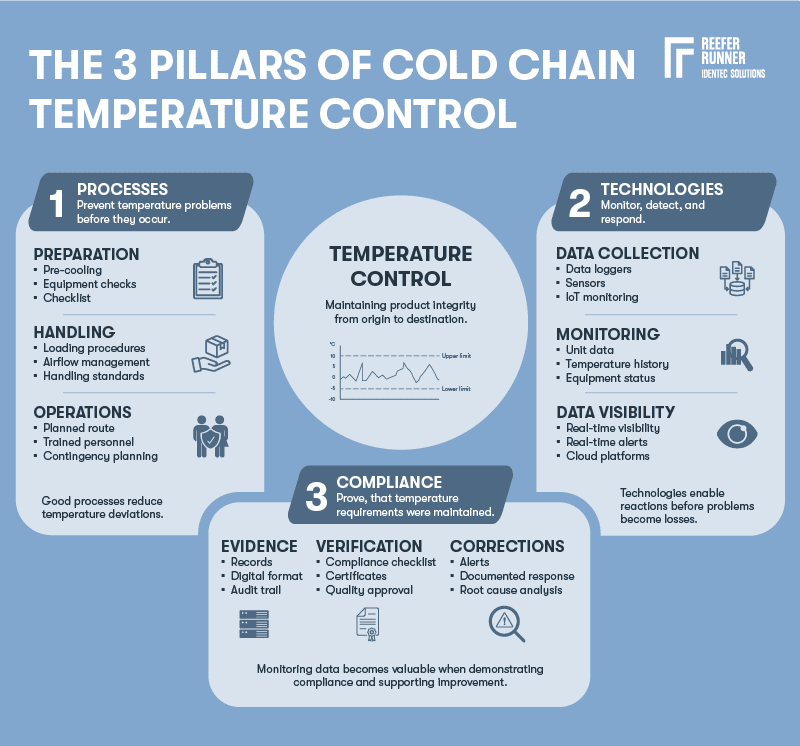
Ultimately, effective temperature control in the cold chain rests on three complementary pillars: robust operational processes, appropriate monitoring technologies, and reliable documentation. When these elements work together, companies can ensure product quality, meet regulatory requirements, and strengthen trust throughout the supply chain.
FAQ
How Is Cold Chain Equipment Prepared Before Operation Begins?
Before the cargo is loaded or stored, it must be ensured that the equipment meets the required conditions.
Reefer containers: Pre-trip inspection (PTI)
The inspection typically includes checking the refrigeration system, control settings, sensors, alarms, power supply, and the overall condition of the equipment to ensure the container can maintain the required temperature throughout transport.
Refrigerated vehicles: Pre-departure preparation and inspection
Preparation includes checking the refrigeration system, temperature settings, door seals, insulation, power and/or fuel supply, and ensuring the cargo space has been pre-cooled before loading.
Cold storage facilities: Preparation and verification
This includes checking the refrigeration systems, validating temperature sensors, verifying alarm functions, and ensuring the storage areas are operating within the specified temperature range. Temperature mapping is particularly important for identifying areas with temperature variations.
Takeaway
Effective temperature control in the cold chain is not achieved through a single technology or isolated process. It is the result of the interplay of multiple elements that protect products throughout their entire transport.
Consistent processes for storage, transport, handover, and delivery are essential along the entire supply chain to ensure product integrity.
Monitoring technologies provide the necessary transparency to verify conditions and respond to any issues. From manual checks and data loggers to wireless sensors, IoT platforms, and refrigerated container telematics, each solution offers specific benefits depending on the level of risk, required transparency, and operating environment.
Finally, compliance and traceability transform temperature data into valuable evidence. Accurate records enable companies to demonstrate proper product handling, investigate incidents, and continuously improve the performance of their cold chain.
When the three pillars—processes, technologies, and compliance—work together, companies can reduce losses, ensure product quality, and build trust throughout the entire supply chain.
Delve deeper into one of our core topics: Refrigerated containers
Glossary
FEFO means first expired, first out. In the cold chain, it is a stock-rotation rule that says products with the earliest expiry date should be shipped, used, or sold first, regardless of when they arrived. That matters for chilled and frozen foods, medicines, and other perishables because shelf life can be lost quickly if older batches stay in storage too long. FEFO helps reduce waste, protect product quality, and improve food safety and compliance in warehouses, depots, and distribution centres. (2)
Ripening gas in the cold chain usually means ethylene, a natural gas produced by fruits that accelerates ripening. In refrigerated transport, ethylene can be useful for controlled ripening, but unwanted exposure can make produce soften, discolor, or spoil too early. Cold chain operators therefore manage temperature, ventilation, and sometimes ethylene removal or absorption to keep sensitive fruit from ripening too fast. The term is most often used for climacteric fruits such as bananas, avocados, apples, and tomatoes. (3)
Sources:
(1) https://www.dairyreporter.com/Article/2026/07/21/pressures-on-cold-chain-storage-in-a-heatwave/
(2) Shapiro, Roy D.; Heskett, James L. (1985): Logistics Strategy: Cases and Concepts. West Publishing.
(3) Thompson, J. F.; Mitchell, F. G.; Kasmire, R. F.; Crisosto, C. H. (2002): Commercial Cooling of Fruits, Vegetables, and Flowers. University of California, Division of Agriculture and Natural Resources.
Note: This article was partly created with the assistance of artificial intelligence to support drafting.

Author
Conny Stickler, Marketing Manager Logistics
Constance Stickler holds a master's degree in political science, German language and history. She spent most of her professional career as a project and marketing manager in different industries. Her passion is usability, and she's captivated by the potential of today's digital tools. They seem to unlock endless possibilities, each one more intriguing than the last. Constance writes about automation, sustainability and safety in maritime logistics.