| Written by Constance Stickler
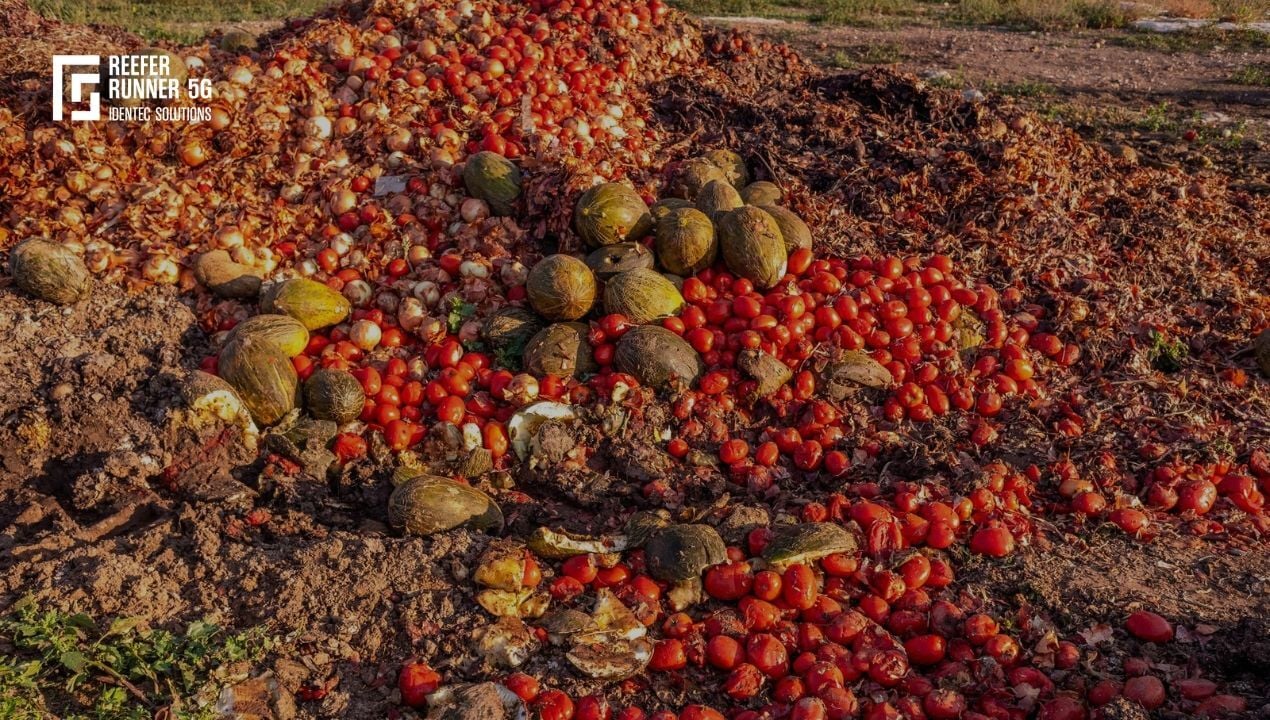
Table of contents:
- Why does temperature control alone not guarantee food quality?
- How can continuous reefer monitoring prevent food loss?
- What happens when a reefer is unplugged?
- Why do connected monitoring and temperature guidance matter throughout the cold chain?
- FAQ
- Takeaway
- Glossary
When people think of food wastage, they usually picture items discarded in supermarket bins or household trash cans. Indeed, this type of food waste accounts for 19% of the food available to consumers. However, a significant risk to these goods arises much earlier—while they are still moving through the supply chain. More than 13% of food is lost during transit, as it travels from farms through processing plants, warehouses, ports, and distribution centres to its final destination. (1) This lost food could help end global hunger. However, if we continue as we have been, the quantities will double by 2050. (2)
As they make their way to their destination, perishable goods depend above all on one thing: the right conditions at the right time. Refrigerated trucks and containers play a crucial role in this. Risks such as temperature fluctuations, power interruptions, or a lack of information—which would otherwise hinder the assessment of how urgently countermeasures are needed—can now be managed effectively.
Why does temperature control alone not guarantee food quality?
A refrigerated container may be connected to a power supply, set to the correct target temperature, and show readings within the permitted range. Yet, questions still remain for logistics teams:
-
Did the cargo stay within the required temperature range the entire time?
-
Were any power supply interruptions kept within an acceptable duration?
-
And if something did go wrong, how long did it take for the issue to be noticed and resolved?
These questions are crucial. While a reefer is designed to maintain specific conditions, the technology alone cannot guarantee that every step of the cold chain proceeds as planned: power connections may remain disconnected for longer than intended, doors might be opened more frequently than anticipated, or information may not always reach the people who need it.
Moreover, temperature is only one part of the overall picture. The quality of the goods depends on their condition at the time of loading, transport duration, humidity levels, and other factors. The greatest risk often lies in time gaps: the interval between the occurrence of a problem and its discovery, between discovery and intervention—or between a recorded temperature reading and the correct interpretation of what that value signifies.
To avoid food losses, you need reliable information, an understanding of the cargo's specific requirements, and the ability to intervene before a manageable problem becomes an irreversible loss.
How can continuous reefer monitoring prevent food loss?
At a terminal with hundreds or thousands of reefer containers—each holding goods that require specific conditions—manually checking every single container is simply no longer feasible. It's also not advisable, as serious issues could arise between inspections and go unnoticed.
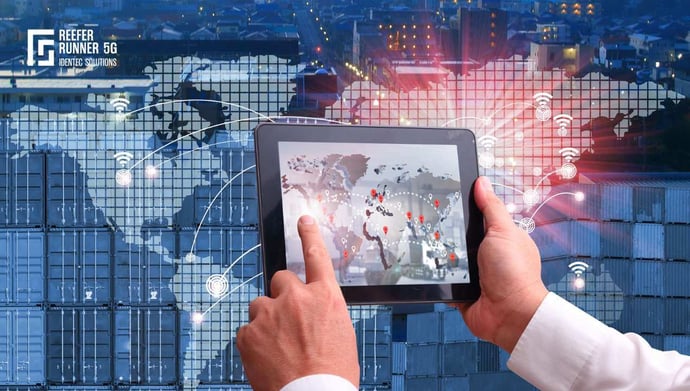
Through continuous monitoring, logistics teams can access all relevant data remotely via centralised dashboards. This includes not only parameters such as temperature or humidity levels, but also power status and alarms. The latter, in particular, contribute significantly to the success of the cold chain, as they make it possible to identify issues at an early stage and take appropriate action. Based on the data collected, the responsible team can determine the level of urgency and the measures to implement.
Such systems are also of immense value outside of large terminals—for instance, in inland shipping, where the very small crews on board may lack specialised expertise in refrigeration. Mobile systems provide critical, real-time information, allowing onshore support staff to prepare for necessary interventions well in advance or to issue specific instructions to the crew on the vessel.
In the cold chain, the time factor is crucial. The sooner a deviation is detected, the more quickly the associated risk can be assessed and the next steps determined. It is therefore advantageous for a system to provide not only alarms but also warnings—alerts that are triggered as values approach critical thresholds.
A centralised overview eases staff workload. Instead of repeatedly checking every reefer unit, staff can focus on those that truly require attention. This is particularly relevant in situations where teams are small.
Another advantage of these systems is the comprehensive documentation of data and events. This supports compliance standards, and if an incident occurs, the sequence of events and the subsequent response are precisely recorded. These records are useful not only for addressing the immediate situation but also for the future; for instance, they can help identify recurring technical faults or facilitate the optimisation of operational processes.
For monitoring to be successful, it requires reliable data transmission, sensibly configured alarm settings, and clearly defined responsibilities for responding to alerts. When these elements are in place, temperature and power-status data are transformed into operational visibility.
What happens when a reefer is unplugged?
A rise in temperature does not necessarily occur the moment the power supply is cut off. Heat transfer is slowed by the insulation, and the cargo itself can store a significant amount of thermal energy. Nevertheless, refrigerated containers (reefers) must not be left unattended indefinitely.
Conditions change when power is disconnected; the rate of change depends on several factors, such as the type and quantity of the cargo, its temperature at the time of disconnection, the ambient temperature, the container's insulation, and the duration of the power interruption.
The challenge for logistics teams lies in effectively managing this period without an external power supply: for instance, frozen goods behave differently than chilled fresh produce, and containers in cooler environments warm up less rapidly than those exposed to direct, intense sunlight on a hot day.
Understanding cargo requirements is the first step. The set point—the target temperature for the refrigeration system—serves as an important reference point. However, it does not indicate how long a specific shipment can safely remain without a power supply.
In this context, practical guidelines for temperature management are particularly valuable. An app-based tool can help personnel understand relevant set points and the factors that influence temperature behaviour when the refrigeration system is not running. Since there is no universal rule of thumb that applies to all containers, specific knowledge is essential for making informed decisions about priorities and handling. Based on key parameters—such as the type and mass of the cargo, the type of reefer unit, and weather data (daytime and night-time temperatures, as well as whether conditions are sunny or cloudy)—the tool can provide an estimate of how long the required temperature levels can be maintained without external power.
Why do connected monitoring and temperature guidance matter throughout the cold chain?
Reefers do not remain connected to an external power supply at every point in their journey. During handling, transfers or temporary storage, power interruptions may be planned or unexpected. Logistics teams therefore need different kinds of information to manage both situations.
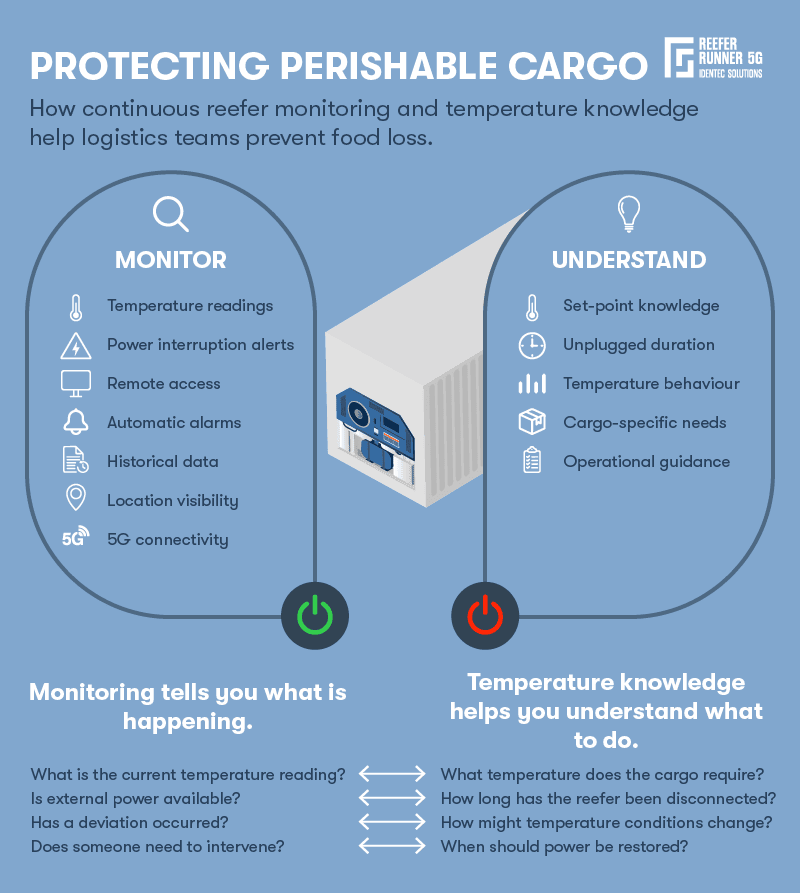
Continuous monitoring gives teams insight into a refrigerated container's condition and power status. This data helps identify issues early, allowing timely intervention.
But what happens when a reefer is temporarily disconnected from its power source—whether planned or unplanned? In such cases, personnel must be aware of the cargo’s temperature requirements and be able to estimate how long the goods can maintain the necessary temperature under the given conditions. Specialised tools can support operational decision-making: they help staff estimate how long the required temperature conditions can be maintained without an external power supply—enabling targeted planning for subsequent handling and reconnection (see also: Cold chain operations).
Both approaches complement each other. Ultimately, protecting perishable goods requires more than just maintaining refrigeration. It is about having the right information for every situation: insight into the actual operating conditions of connected refrigerated containers, as well as a solid understanding of how temperatures evolve when those containers are disconnected from a power source. This combination helps logistics teams make more informed decisions, reduce avoidable risks, and safeguard cargo throughout every stage of its transport.
FAQ
What is the difference between food loss and food waste?
Both terms refer to food that does not reach its intended human consumption. However, they occur at different stages of the supply chain.
Food loss occurs during production, post-harvest handling, processing, storage, or transportation. It is often the result of inadequate infrastructure, improper handling, transport delays, or unsuitable temperature conditions.
Food waste occurs at the retail, food service, or consumer level. Examples include supermarkets discarding unsold products, restaurants throwing away prepared meals, or households disposing of food that has passed its expiration or "use-by" date (see also: Food waste reduction technologies)
Takeaway
Preventing food loss starts long before the supermarket shelf or the consumer’s home; it starts at the very beginning of the cold chain—where perishable goods are stored, handled, or transported.
Continuous monitoring provides logistics teams with an overview of current temperatures and other key parameters. A solid understanding of target values and temperature behaviour enables them to make better-informed decisions—especially when containers must temporarily operate without an external power source. These approaches help teams identify risks early, prioritise necessary actions, and manage cargo more securely.
Delve deeper into one of our core topics: Cold Chain Monitoring
Glossary
Chilled fresh produce is unprocessed fruit or vegetables carried above freezing to slow respiration, ripening, and decay. In reefers, temperatures vary by commodity: leafy vegetables and many berries are commonly held near 0–2 °C, while tropical items such as bananas, avocados, and tomatoes need warmer settings—often 7–18 °C—to avoid chilling injury. High relative humidity, typically about 85–95%, limits moisture loss. Produce should be pre-cooled before loading, and the reefer must maintain the agreed pulp temperature and airflow throughout transport. (3)
Frozen food means food kept in a solid-frozen state throughout the cold chain, normally at −18 °C (0 °F) or colder. Typical cargoes include meat, seafood, vegetables, prepared meals, and ice cream; ice cream may be carried at about −25 °C. The reefer should maintain the cargo’s temperature rather than freeze warm product, so the container is pre-cooled and cargo is loaded already frozen. Brief, controlled rises may be tolerated under some rules, but repeated thawing and refreezing damage quality and safety. (4)
References:
(1) https://www.unep.org/en/what-we-do/food-systems/food-loss-and-waste
(2) https://www.wri.org/insights/reducing-food-loss-and-food-waste
(3) Wills, Ron B. H.; Golding, John B. (2016): Postharvest: An Introduction to the Physiology and Handling of Fruit and Vegetables. CABI.
(4) Gaur, P. K. (2017): Refrigerated Cargoes. Witherby Publishing.
Note: This article was partly created with the assistance of artificial intelligence to support drafting.

Author
Conny Stickler, Marketing Manager Logistics
Constance Stickler holds a master's degree in political science, German language and history. She spent most of her professional career as a project and marketing manager in different industries. Her passion is usability, and she's captivated by the potential of today's digital tools. They seem to unlock endless possibilities, each one more intriguing than the last. Constance writes about automation, sustainability and safety in maritime logistics.
Related Articles
Related Product