| Written by Constance Stickler
Table of contents:
- Why Does the Cold Chain Matter So Much for Food Waste?
- Where Does Food Waste Risk Increase Between the Farm and the Warehouse?
- Periodic vs. Continuous Temperature Monitoring
- Which Food Waste Reduction Technologies Can Help Protect the Cold Chain?
- What Should a Producer, Warehouse or Logistics Company Look for in a Monitoring System?
- FAQ
- Takeaway
- Glossary
Why Does the Cold Chain Matter So Much for Food Waste?
According to the UN, “Globally, around 13.2 percent of food produced is lost between harvest and retail.” (1)
Fresh food doesn't wait. Time starts ticking the moment a crop leaves the field, milk leaves the farm, meat leaves the processing line, or fish comes out of the water. From that moment on, temperature is one of the most important factors determining how long food remains fresh, safe, and marketable.
An effective cold chain slows down processes that shorten shelf life. It helps slow down the growth of microorganisms, delay ripening, reduce enzyme activity and oxidation, and preserve nutrients.
But what if the refrigeration doesn't work as intended? A refrigerated truck might experience a power outage. A refrigeration unit in a warehouse might fail. A door might be left open too long. A shipment might sit on a vehicle for hours due to an unexpected delay. Sometimes the problem is even simpler: the wrong temperature is being entered as set point.
A temperature issue doesn't necessarily render a pallet of food unusable immediately. More often, it shortens the product's remaining shelf life. An hour here, two hours there. By the time the food reaches the next stage of the supply chain, it may not have enough shelf life to be sold before it spoils.
That's why temperature control is about more than just refrigeration equipment. It's about continuity. A cold chain shouldn't only be cold when it's being checked. It must maintain the required conditions throughout the entire transport process.
Where Does Food Waste Risk Increase Between the Farm and the Warehouse?
The cold chain doesn't only break when a refrigeration unit fails. Food can also lose quality during various stages of the process: harvesting, loading, waiting time, transport, unloading, and storage. Every point of contact carries the risk of temperature control being compromised.
Harvesting and pre-cooling
The products must be cooled as quickly as possible after harvesting. If this takes too long, the product will have a shorter shelf life than intended.
Loading
The doors open. Forklifts drive in and out. Pallets wait at the loading dock. Especially with tight schedules or when multiple loads are competing for the same loading dock, loading can sometimes take longer.
Transportation
Refrigeration units may fail. Power outages may occur. Traffic may extend a two-hour journey to four hours. A driver may have to make an unscheduled stop. Doors may open repeatedly.
Unloading
Again, the doors remain open longer; the forklift unloads the cargo. It is inspected and moved to the warehouse.
The warehouse
Refrigeration units or power outages may occur here as well. Air circulation may be disrupted, or the storage area may be overloaded.
The weak points are not immediately obvious: an open door, a delayed truck, a faulty sensor, an overlooked alarm.
What is particularly problematic is that the cold chain crosses organisational boundaries. The farmer controls the first storage stage. A logistics provider operates the vehicle. A warehouse manages the next transfer. Each party may have its own systems, procedures, and records. Yet, the food passes through all these stages as a single, uninterrupted journey.
Checking temperature only at individual milestones can therefore create a false sense of security. A delivery may leave the farm at the correct temperature and arrive at the warehouse at the correct temperature, even though it has already suffered a temperature excursion along the way, causing food waste.
Periodic vs. Continuous Temperature Monitoring
In principle, monitoring seems simple: check the temperature, note it down, done. Until something goes wrong between checks.
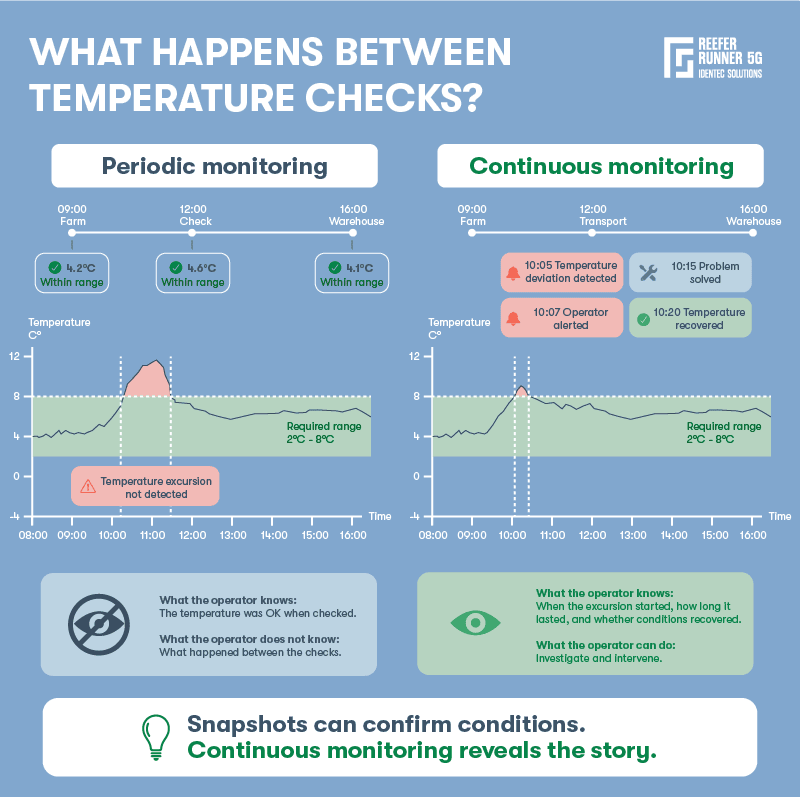
Imagine a refrigerated truck leaving a farm at 4.2°C. The temperature seems fine. Hours later, the cargo arrives at the warehouse and is checked again. 4.1°C is shown - everything seems fine. In theory, the cold chain appears intact.
But perhaps the refrigeration unit was off for an extended period in the meantime. Perhaps the vehicle was stuck in traffic on a hot afternoon. Perhaps the doors were opened several times during a stop. The temperature rose and then gradually returned to normal after the refrigeration system restarted.
The last measurement may seem reassuring, but it is incomplete. Periodic measurements provide snapshots rather than a continuous picture. If a deviation occurs and then disappears between two checks, no one may notice. By the next measurement, the refrigeration system may be functioning normally again, and the traces of the incident may have vanished.
This leads to two problems: First, the opportunity to intervene may have already passed. If a cooling problem is discovered while the shipment is still in transit, this offers the operator options for action.
Second, uncertainty can lead to waste. If no one knows when a temperature deviation occurred, how long it lasted, or which goods were affected, operators must proceed with caution. A large shipment may have to be quarantined or disposed of simply because there isn't enough information to make a more informed decision.
Continuous monitoring changes this. Now, the temperature can be tracked seamlessly throughout transport or storage. As soon as conditions deviate from a defined range, the system can issue a warning while the problem is still developing.
Depending on the situation, intervention might mean checking the refrigeration system, contacting the driver, rerouting the vehicle, or moving the goods into functioning cold storage. Problems can be resolved before the entire cargo loses its valuable shelf life.
Not every incident has a happy ending, but the response begins earlier. Temperature fluctuations aren't necessarily an event that instantly turns food from "good" to "spoiled." Duration, severity, product characteristics, and previous temperature history all play a role. Continuous recording provides this history.
Continuous recording offers another advantage: it can uncover patterns. Perhaps a particular vehicle experiences recurring problems on longer journeys. Perhaps temperature fluctuations repeatedly occur in a specific cold storage room. Perhaps charging processes cause predictable temperature deviations.
In this way, monitoring becomes more than just a warning system; it becomes a source of operational insights.
Which Food Waste Reduction Technologies Can Help Protect the Cold Chain?
The technology itself is no longer the biggest challenge. Sensors have become smaller, connectivity is easier, and cloud platforms can process massive amounts of data. The real question is how these technologies work together—and whether they help ensure that temperature problems are detected and addressed early, before food waste occurs.
At the heart of it all is the temperature sensor.
It measures the actual conditions in the food's environment. Its placement is crucial: A sensor measuring the air near a cooling vent may provide different results than a sensor located elsewhere in the vehicle or storage area.
Then comes connectivity.
While a sensor that stores data until it is downloaded later can provide a useful record, it cannot warn anyone of an imminent problem. Networked sensors can transmit readings during the transport or storage of food, allowing those responsible to monitor conditions remotely.
This is where IoT technologies like BLE (Bluetooth Low Energy) or 5G come into play. The sensor becomes part of a larger system and is no longer an isolated measuring device.
Add to this the alerts.
This is perhaps the most important function of all. A temperature deviation hidden in a database is passive. An alert that reaches the person responsible for the vehicle, warehouse, or shipment, however, can very well prompt action.
Good systems distinguish between information and action. Operators don't need a notification for every minimal temperature change. They need meaningful alerts when conditions indicate a need for action.
Location adds another layer.
It's helpful to know that a shipment experienced a temperature deviation. It's even more helpful to know that this occurred on a specific trip, at a specific location, and during a specific phase of transport. The combination of temperature and location data helps operators identify problem areas and determine the responsible contacts.
The same principle applies to warehouse monitoring.
Temperature data can be assigned to specific warehouse areas, rooms, or facilities. Over time, a picture emerges of how reliably each area functions. A recurring fluctuation is no longer an isolated mystery, but rather points to a maintenance or operational issue.
Cloud-based platforms aggregate these data streams.
Instead of checking individual devices, operators can monitor multiple vehicles, storage locations, or shipments through a single interface. Historical data remains available for investigations, reporting, and trend analysis. This is particularly valuable when multiple parties share responsibility for the same cold chain.
The next step is data analysis.
Repeated temperature deviations can reveal patterns that are difficult to detect manually. A particular vehicle might perform worse on longer routes. Temperature fluctuations might occur regularly in a specific storage area. A loading process might repeatedly expose goods to uncontrolled temperatures.
The technology can uncover the pattern.
However, resolving the issue still requires human intervention.
That's why the most effective cold chain solutions combine various technologies instead of relying on a single sensor. Temperature tells us what happened. Connectivity tells us when it happened. Location tells us where. Operational data helps explain the reasons.
Putting these elements together makes the cold chain much easier to understand.
What Should a Producer, Warehouse or Logistics Company Look for in a Monitoring System?
The first question should be: What do we need to know, and how quickly?
For most cold chain processes, continuous measurement is the starting point (see: cold chain solutions). Food waste reduction technologies should monitor temperature continuously and trigger meaningful alerts when defined thresholds or conditions indicate a problem. These alarms must reach the responsible person quickly. Too many notifications lead to alarm fatigue; too few can cause real problems to go unnoticed.
Connectivity is crucial, especially for mobile equipment. The system should continue to collect data even during temporary communication outages and transmit the stored information once the connection is restored.
Location data provides valuable information during transport. Knowing that a temperature deviation has occurred is helpful; knowing where it occurred helps operators identify the cause and respond more effectively.
Also, ensure that historical data is readily available. Temperature records should remain accessible for incident investigation, shipment evaluation, and identifying recurring issues.
Finally, consider integration and scalability. Temperature data is significantly more useful when it can be linked to information about vehicles, deliveries, storage areas, or other operational processes.
The best monitoring system isn't necessarily the one with the most comprehensive feature set. It's the one that answers four practical questions:
What is happening? Where is it happening? Who needs to be informed? And what are the next steps?
If the system can reliably answer these questions, temperature monitoring becomes a tool for protecting food—not just for recording temperature.
FAQ
Which pre-cooling method is best suited for farms?
The goal is to remove field heat quickly before the products are stored or transported. There is no one-size-fits-all solution. The best pre-cooling method depends on the harvest, the required cooling rate, the existing infrastructure, and the budget.
Room cooling is often the easiest entry point for farms, as it utilises existing cold storage facilities (refrigerated rooms) and requires little additional equipment. It is relatively inexpensive but also slow and therefore less suitable for highly perishable products.
Forced-air cooling - fans forcing cold air through produce containers - is more effective when faster cooling is required. It can often be integrated into an existing cold storage facility and cools products many times faster than conventional space cooling. Therefore, it is a viable option for many farms and packing houses without the need for a completely separate refrigeration system.
Hydrocooling, where chilled water flows over or around produce, is even faster and can reduce moisture loss but requires suitable products, clean water, and water-resistant packaging. Vacuum cooling is extremely fast but requires specialised equipment - vacuum chambers, where the pressure is reduced - and is therefore more suitable for larger, well-equipped cold chain operations.
For farms with limited electricity or refrigeration infrastructure, evaporative cooling can be a cost-effective alternative, especially in dry climates. It cannot replace refrigeration in every situation, but it can provide valuable cooling before products enter the wider cold chain.
Takeaway
A cold chain is only as reliable as its weakest link. A cooling system failure, delayed vehicles, or extended loading times can shorten the shelf life of temperature-sensitive food products—sometimes without leaving any visible trace.
Periodic temperature checks cannot capture all events between measurements. Continuous monitoring, however, can (see also: reefer tracking). By combining temperature sensors with reliable connectivity, alerts, and location data, farmers, logistics companies, and warehouse teams can detect deviations in real time. This allows them to intervene before a problem leads to significant losses.
Furthermore, a complete history is available: when the deviation began, how long it lasted, and whether conditions returned to normal. Over time, these records can uncover recurring problems and contribute to process and facility improvements.
Food waste reduction technologies won't prevent every incident in the cold chain. Nor will every temperature deviation lead to food waste.
But greater transparency means better decisions.
Delve deeper into one of our core topics: Cold Chain Monitoring
Glossary
Enzymes are natural proteins that speed up specific chemical reactions without being used up themselves. In food, they may come from the raw material, microorganisms, or added processing ingredients. Enzymes help bread dough develop, tenderise meat, clarify juices and wine, coagulate milk for cheese, and break down starches into sugars. They also influence ripening, softening, flavour, texture, and unwanted browning in fruits and vegetables. Food processors control enzyme activity through temperature, pH, time, and inhibitors; refrigeration generally slows enzymatic reactions but does not necessarily stop them completely. (2)
Microorganisms are microscopic living organisms, including bacteria, yeasts, moulds, and some parasites. In food, they can have beneficial or harmful effects. Useful microorganisms carry out fermentation, producing foods such as yoghurt, cheese, bread, pickles, beer, and wine while changing flavour, texture, and acidity. Other microorganisms cause spoilage, leading to unpleasant smells, flavours, discolouration, slime, or gas. Pathogenic microorganisms are particularly important because they can cause foodborne illness without necessarily changing the food’s appearance. Food preservation and cold-chain control aim to encourage desirable microbes when appropriate and limit harmful or spoilage organisms. (3)
References:
(1) https://www.un.org/en/observances/end-food-waste-day
(2) Kuddus, Mohammed (ed.; 2018): Enzymes in Food Technology: Improvements and Innovations. Springer.
(3) Lawley, Richard; Curtis, Laura; Davis, Judy (2008): The Food Safety Hazard Guidebook. Royal Society of Chemistry.
Note: This article was partly created with the assistance of artificial intelligence to support drafting.

Author
Conny Stickler, Marketing Manager Logistics
Constance Stickler holds a master's degree in political science, German language and history. She spent most of her professional career as a project and marketing manager in different industries. Her passion is usability, and she's captivated by the potential of today's digital tools. They seem to unlock endless possibilities, each one more intriguing than the last. Constance writes about automation, sustainability and safety in maritime logistics.