| Written by Mark Buzinkay

Table of contents:
- POB on offshore installations in the past: manual control and procedural discipline
- POB on offshore installations today: integrated systems and real-time awareness
- Technologies enabling POB on offshore installations: from access control to RTLS
- FAQs
- Takeaway
- Glossary
POB on offshore installations in the past: manual control and procedural discipline
Before “POB monitoring” was a digital system, it was largely an administrative discipline: a mix of paper, radio calls, and procedural checks designed to answer one question at any moment—exactly who is on an offshore installation, and where should they be in an emergency? On offshore installations, that question has always been more than headcount. It affects emergency response, evacuation planning, medical readiness, bed management, catering, work permits, and—crucially—legal compliance around mustering and accounting for personnel.
Historically, the backbone of POB (personnel on board) control was the manual POB list maintained by the Offshore Installation Manager (OIM) team, the radio operator, or an admin function (often the marine/aviation coordinator, depending on the asset). People arriving by helicopter or vessel were checked in against a passenger manifest and then added to the onboard list; those departing were removed. Changeovers were a high-risk moment for accuracy because many people moved in a narrow time window, sometimes in poor weather, with last-minute swaps and “no-shows.” Aviation and marine manifests helped, but they were still only as good as the last update and the discipline of matching “planned” versus “actual” movements. Modern readers are used to real-time dashboards; in the past, “real time” often meant “as of the last radio call or clipboard update.”
Why it mattered was most visible during mustering. In an alarm event—fire, gas release, or loss of containment—muster stations needed a reliable way to confirm who was safe, who was missing, and where to send search-and-rescue teams. UK offshore regulation and guidance have long emphasised that dutyholders must have effective arrangements to assign people to muster points and account for them, including keeping up-to-date muster lists (or an equally effective alternative). That requirement drove a lot of the historical process design: lists displayed or available at muster locations, routines for verifying counts, and clear responsibility for reconciling discrepancies. (1)
What made POB tricky in practice was the gap between “administrative truth” and “physical reality.” People borrowed cabins, worked night shifts, visited other areas, transferred between connected assets, or went temporarily “off list” during boat transfers, crane transfers, or unplanned movements. Even simple issues—two people sharing the same name, nicknames versus passport names, contractors switching companies mid-campaign—could introduce errors. The higher the operational tempo, the more reconciliation was required. That reconciliation often relied on human checks: supervisors confirming their teams, catering cross-checking meal counts, medics cross-checking clinic visits, and control room staff chasing anomalies by radio.
Another challenge was that personnel accounting had to align with emergency command and control. Emergency response guidance for offshore installations frames mustering not just as a roll call but as an information flow to the command centre: names of missing persons, last known work areas, and potential reasons for absence (injured, trapped, off-station). In the paper era, that meant runners carrying lists, radio operators collecting reports, and decision-makers working with partial information until counts stabilised. (2)
Finally, POB in the past was tightly linked to transport logistics—especially helicopters. Aviation operations typically require a manifest for each flight, and operators use those manifests to manage capacity and ensure the destination asset stays within POB limits. But manifests were still “point in time” documents; if someone was bumped from a flight, swapped late, or diverted due to weather, the offshore POB record had to be manually corrected. That dependency on accurate manifests, plus the realities of offshore weather and dynamic planning, is a big reason early POB processes were so procedure-heavy. (3)

POB on offshore installations today: integrated systems and real-time awareness
Today, POB (personnel on board) monitoring on offshore installations has evolved from a primarily administrative task into a digitally supported, safety-critical capability that underpins daily operations and emergency management in the offshore energy industry. While the core objective has not changed—knowing exactly who is on the installation at any given time—the way this information is captured, validated, and used has shifted significantly, driven by regulation, operational complexity, and expectations around real-time situational awareness.
Modern POB is typically accomplished through integrated digital systems rather than standalone lists. Arrival and departure events are still initiated by transport—helicopter or vessel—but are now captured electronically and synchronised with central POB databases. Passenger manifests are generated digitally, validated against training and medical records, and transferred directly into offshore POB systems. Once personnel arrive on an offshore installation, their status is automatically or semi-automatically updated, reducing manual data entry and reconciliation. In many cases, POB systems are linked to accommodation management, catering, work permits, and safety management systems, turning POB into a shared operational “source of truth” rather than a document owned by a single role.The importance of POB today extends beyond emergency mustering. On offshore installations, POB data supports regulatory compliance, particularly under safety case regimes that require operators to demonstrate effective control of personnel in both normal and abnormal situations. It also directly affects logistics planning, helicopter capacity management, bed space utilisation, and fatigue control. In an industry facing cost pressure and tighter margins, accurate POB data enables better campaign planning, reduced offshore wait times, and more efficient crew rotations—all without compromising safety.Emergency response remains the most critical driver.
Modern offshore emergency management expects POB information to be available instantly in the control room and, where applicable, in onshore emergency response centres. During drills and real incidents, muster status is no longer just a headcount; it is a live dataset that can show who has mustered, who is unaccounted for, and which work areas or zones may still be occupied. This expectation has fundamentally changed how POB systems are designed: availability, redundancy, and data integrity are now treated with the same seriousness as other safety-critical systems.
What makes POB monitoring today challenging is not a lack of technology, but the complexity of offshore operations themselves. Offshore installations increasingly operate as part of connected ecosystems, with walk-to-work vessels, accommodation units, normally unattended installations, and construction or commissioning campaigns involving large numbers of transient personnel. People may move between assets multiple times per day, sometimes without aviation or marine transport, and POB systems must accurately reflect these movements. The line between “on the installation,” “in transit,” and “temporarily off the asset” has become more nuanced, and misalignment between systems can still create uncertainty if interfaces are poorly designed.
Another challenge lies in balancing automation with operational reality. While today’s systems aim to minimise manual updates, there are still scenarios that require human intervention, such as last-minute crew changes, weather-related diversions, emergency evacuations, or technical outages. Offshore energy operators, therefore, focus heavily on defining clear procedures for exceptions and degraded modes, ensuring that POB control remains effective even when automated data flows are disrupted. Cybersecurity and system resilience have also become part of the conversation, as POB data is now digital, networked, and often accessible from onshore locations.
Finally, today’s POB systems must support a diverse workforce and regulatory landscape. Contractors from multiple companies, each with their own competence systems and identifiers, need to be represented consistently. At the same time, offshore operators must comply with data protection and privacy requirements while still ensuring that sufficient information is available for safety and emergency response. This tension—between visibility, accountability, and data protection—is one of the defining characteristics of modern POB management on offshore installations.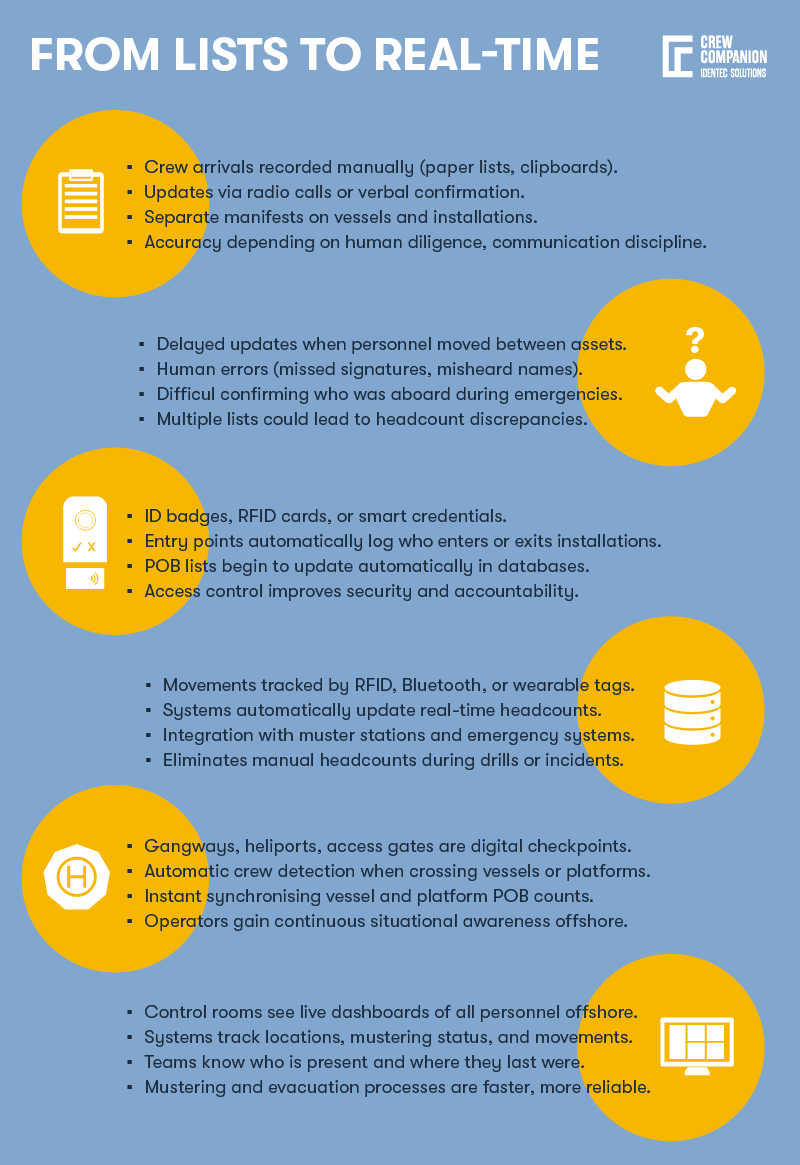
Technologies enabling POB on offshore installations: from access control to RTLS
Today, POB (personnel on board) monitoring on offshore installations is supported by a combination of digital platforms and sensing technologies that reduce manual intervention, improve accuracy, and provide near–real-time visibility into personnel status. Rather than relying on a single technology, most offshore energy operators deploy layered systems in which transport data, access control (see also: access monitoring), and location-awareness technologies work together to maintain a reliable picture of who is on board, where they are, and whether they can be accounted for during an emergency.
At the core of modern POB lies a digital POB management system. This acts as the authoritative database for personnel status and is typically hosted on the offshore installation with synchronisation to onshore systems. These platforms ingest data from helicopter and vessel manifests and automatically update POB when personnel arrive or depart. Integration with competence and medical systems ensures that only authorised personnel are checked in, and that expired certificates or restrictions are flagged before travel. Compared to historical paper-based approaches, this automation significantly reduces transcription errors and delays, while also creating a full audit trail that supports regulatory compliance and post-incident review.
To move beyond “point-in-time” accuracy, offshore installations increasingly rely on electronic access control systems. Personnel are issued RFID badges, smart cards, or similar credentials for use at gangways, heli-reception points, and key access doors. Each access event updates the POB system automatically, confirming physical presence on the installation. In practice, this creates a continuous feedback loop between administrative records and real movements, narrowing the gap that historically existed between planned and actual POB. During normal operations, access control data also supports zone management and worksite coordination by showing which areas are currently occupied.For higher-resolution visibility, many offshore energy assets deploy real-time location systems (RTLS). These systems use active RFID, ultra-wideband, or similar technologies to detect personnel tags within defined zones or muster areas. From a POB perspective, RTLS enables automated mustering: instead of relying on roll calls or manual counts, the system can confirm which individuals are physically present at a muster station within seconds of an alarm. This capability is particularly valuable on large or complex offshore installations, where evacuation and search-and-rescue decisions must be made quickly and with confidence. RTLS data is often presented visually in control rooms, supporting faster interpretation under stress.
Another important technology layer is system integration and visualisation. Modern POB solutions are rarely standalone; they are connected to emergency management systems, control room displays, and onshore emergency response centres. This ensures that the same POB picture is available to offshore and onshore decision-makers, supporting coordinated response during major incidents. Redundancy and fail-safe design are critical here: offshore POB technologies are engineered to continue operating during power loss, network disruption, or partial evacuation, reflecting their role as safety-critical systems.Automation, however, does not eliminate complexity. Offshore installations increasingly host mixed populations—core crew, project teams, short-term contractors, and visitors—often moving between assets such as walk-to-work vessels, floating accommodation, and normally unattended installations. POB technologies must therefore handle frequent transitions between “onboard,” “in transit,” and “temporarily off installation” states. This is typically achieved through rules engines within POB software that interpret events from multiple sources rather than relying on a single trigger. Getting these rules right is one of the main technical challenges, as overly rigid logic can produce false discrepancies, while overly permissive logic can erode trust in the system.
Finally, modern POB technologies must address cybersecurity, data protection, and human factors. As personnel data is now digital and networked, systems must be secured against unauthorised access while remaining usable under emergency conditions. At the same time, offshore operators recognise that technology only supports POB if the workforce understands and trusts it. Clear procedures, regular drills, and transparent feedback are essential to ensure that automated POB systems are treated as authoritative, not bypassed or second-guessed.
FAQ
What does POB monitoring mean on offshore installations?
POB monitoring refers to the continuous process of knowing exactly which personnel are present on an offshore installation, including their arrival, departure, and status during normal operations and emergencies. It supports safety, regulatory compliance, logistics planning, and effective emergency response by ensuring personnel can be quickly accounted for at any time.
Why is accurate POB information so critical offshore?
On offshore installations, POB data is directly linked to emergency management. In the event of a fire, gas release, or evacuation, operators must know who is on board, who has mustered, and who may be missing. Beyond emergencies, accurate POB also affects helicopter capacity, accommodation limits, catering, and fatigue management.
How is POB monitoring different today compared to the past?
Today, POB monitoring is largely digital and automated, integrating transport manifests, access control, and sometimes real-time location systems. Unlike manual lists used in the past, modern systems provide near–real-time visibility, reduce human error, and allow offshore and onshore teams to share the same operational picture for offshore installations.
Takeaway
Effective POB monitoring is a cornerstone of oil rig security on offshore installations. Knowing exactly who is on board, where they are, and whether they are authorised to be there strengthens both safety and security by reducing blind spots and limiting unauthorised access. Modern digital POB systems support faster emergency response, tighter access control, and improved situational awareness, helping operators protect personnel, assets, and operations in an increasingly complex offshore environment (see also: Oil rig security).

Delve deeper into one of our core topics: Personnel on board
Glossary
Cybersecurity refers to the practice of protecting digital systems, networks, and data from unauthorised access, disruption, or damage. It encompasses technical measures, processes, and governance to safeguard information confidentiality, integrity, and availability. In industrial environments such as offshore installations, cybersecurity is especially critical because digital systems directly support safety, operations, and emergency response, making them potential targets for both accidental failures and malicious attacks. (4)
References
(1) https://www.hse.gov.uk/foi/internalops/hid_circs/enforcement/spcenf155.htm
(3) https://www.iogp.org/bookstore/product/offshore-helicopter-recommended-practices/(4) ISO/IEC 27001:2022 – Information security, cybersecurity and privacy protection – Information security management systems – Requirements. International Organization for Standardization.
Note: This article was partly created with the assistance of artificial intelligence to support drafting. The head image was generated by AI.