| Written by Constance Stickler
Table of contents:
- The New Reality: Terminals Run on Data, Not Just Equipment
- What Does Vehicle Telematics Really Mean in a Container Terminal?
- The Machine Intelligence Layer
- Why Should the Head of IT Care about Vehicle Telematics?
- Integration with the TOS
- KPIs That Actually Matter to IT
- What Happens If You Don’t Invest?
- FAQ
- Takeaway
- Glossary
The New Reality: Terminals Run on Data, Not Just Equipment
For a long time, container terminals were optimised using physical equipment such as cranes, terminal trucks, reach stackers, RTGs, and other container-handling equipment. These machines did the work, and early systems recorded the results.
Today, terminals operate amidst electrification, automation, labour shortages, sustainability goals, and rising customer expectations. Equipment fleets are more diverse and interconnected than ever before. A modern container terminal is no longer just a crane or an RTG—it's a data source.
For IT managers in ports, this development is shifting the focus; telematics are becoming a pivotal piece of infrastructure. And the sales figures show that too. According to dataintelo, "the global port vehicle telematics market size reached USD 2.67 billion in 2024. The market is expected to grow at a robust CAGR of 13.1% during the forecast period, attaining a value of USD 7.60 billion by 2033." (1)
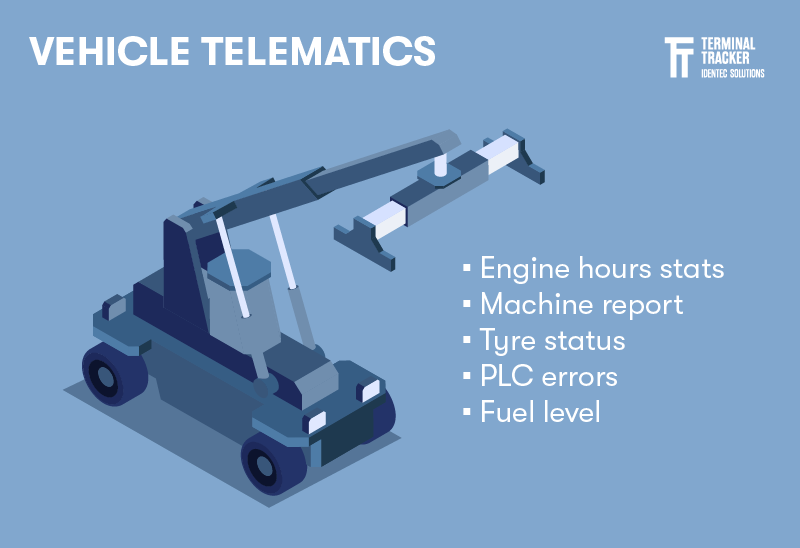
Modern telematics systems offer comprehensive insights into all mobile assets on the terminal premises: real-time location analysis, geofencing, usage analysis, idle time measurement, route habits, and availability status. This creates a dynamic digital representation of the vehicle fleet. And it goes even deeper: through integration with onboard systems, access to engine parameters, fuel or energy consumption, battery status, error codes, operating hours, load cycles, and usage patterns is possible.
Terminals no longer simply monitor a vehicle's location; they now understand its behaviour. This distinction is of enormous importance for IT.Another aspect is the increasing electrification of CHE (Container Handling Equipment) – this creates a new dependency: transparency into energy consumption (see also: CHE operator in container terminal operations). Only structured telematics data allows for the recording of key aspects: state-of-charge trends, charging behaviour, energy consumption per trip, peak load patterns, and battery ageing over time.If this data is stored only in isolated OEM systems, it fails to reach its full potential. However, if it is integrated into a unified telematics layer, it can be used for planning, maintenance, and sustainability reporting.
The complexity of reality highlights the need for data aggregation, as terminals often operate mixed vehicle fleets:
-
Different OEMs
-
Different device generations
-
Different communication protocols
-
Different maintenance cycles
The inconvenient truth is: if telematics is implemented merely as an add-on system, only data is collected. However, when integrated into the infrastructure, valuable insights are generated. This difference determines whether your terminal merely digitises processes or truly becomes data-driven.
What Does Vehicle Telematics Really Mean in a Container Terminal?
To put it simply: If in your terminal it merely means that points on a map are moving, you're not fully utilising the technology's potential. GPS tracking is not telematics. It's a starting point, not the system itself. The commonly available overview of real-time locations, utilisation rates, route tracking, and other data answers operational questions such as:
Where is the nearest available terminal tractor?
Which straddle carriers are underutilised?
How much idle time is there per shift? Useful – yes. Sufficient – no.Telematics introduces data such as fuel or energy consumption, hydraulic pressure, temperature readings, etc. This shifts the focus to:
-
Is the machine operating efficiently?
-
Is its condition deteriorating?
-
Is it being operated correctly?
-
Is maintenance overdue based on actual usage rather than static intervals?
This is a completely new level of transparency.
The Machine Intelligence Layer
Vehicle telematics is based on onboard units in mobile devices. These devices communicate with machine systems (often via the CAN bus) and act as edge processors. They securely collect, process, and transmit data to a central platform.Key components typically include:
-
Onboard Device Layer: Hardware installed in RTGs, reach stackers, terminal tractors, or empty container handling equipment. It is responsible for data collection and local processing.
-
Communication Layer: Wi-Fi, LTE, or private 5G networks that reliably transmit data across the terminal premises.
-
Central Platform Layer: A telematics platform that aggregates, normalises, and structures machine data from various OEM fleets.
-
Integration Layer: APIs that feed data into the terminal operating system (TOS), maintenance management systems (CMMS), business intelligence tools, or data lakes.
A key insight is that you no longer need to rely on manual reports or manufacturer-specific service portals; instead, you can gain standardised, fleet-wide transparency into the actual performance of the equipment.
This is essential for a modern maintenance approach. Traditionally, maintenance followed rules such as "maintenance every x hours," "inspection after y days," and "replace components according to schedule." However, this model ignores the actual usage of the machines. Telematics infrastructure shifts the focus to condition-based monitoring:
-
Are the engines running continuously under high load?
-
Is a battery deteriorating faster than expected?
-
Are the hydraulic pressures deviating from the target values?
-
Are certain machines generating recurring error codes?
Continuously recording machine parameters and correlating them with operational events enables the following:
-
Identifying systemic inefficiencies
-
Detecting underperforming systems
-
Quantifying operator influence
-
Measuring energy consumption per movement
-
Validating planning assumptions
-
Supporting predictive analytics models
Telematics is thus becoming the fundamental data source for optimisation, automation preparation, and AI-supported decision-making. For IT managers, this means that if machine data is not integrated into their core infrastructure, other systems will be built around it—often inconsistently, sometimes insecurely, and rarely scalable.
Why Should the Head of IT Care about Vehicle Telematics?
To be perfectly clear: A mobile asset intelligence layer is a critical system decision where IT must take the lead—otherwise, it will be responsible for fixing the problems. The onboard devices in RTGs, reach stackers, and empty container stackers become infrastructure endpoints that connect to:
-
Wi-Fi on company premises
-
LTE or private 5G networks
-
Cloud environments
-
Local servers
-
APIs accessible to other systems
This has direct implications for endpoint security, device authentication, data encryption standards, firewall rules, and the monitoring and response to security incidents. Therefore, it is essential that the IT department assumes architectural oversight to prevent uncontrolled attack surfaces in critical operational infrastructure.
Integration with the TOS
Planning and execution converge at the port's Terminal Operating System (TOS). For this system to work with real-time machine data, such as real-time equipment status updates, automated availability confirmations, and dynamic performance validations, structured, stable, and controlled APIs are essential. Otherwise, data redundancy, latency issues, and a loss of trust in the system data are likely.Therefore, aspects such as data ownership, API standards, update frequencies, event handling logic, and troubleshooting processes must be precisely defined. Telematics without integration discipline will otherwise lead to inaccurate and therefore irrelevant information.
Cloud vs. On-Premise
This is a strategic decision that raises the following questions:
- Where will the data be stored?
- Who controls access?
- How does this align with the company's cloud policy?
- What impact will latency have on operational systems?
In many cases, hybrid architectures emerge, where latency-critical data is processed locally while historical analytics reside in the cloud.
Data Governance and Standardisation
Mixed vehicle fleets are the rule, not the exception, which can lead to differences in data structures, parameter naming conventions, update frequencies, and diagnostic depth. Therefore, a data abstraction layer must be implemented to standardise parameter definitions, event categories, performance indicators, and fault classification. Only clean, structured, and consistent data enables analysis, AI modelling, and cross-site benchmarking.
KPIs That Actually Matter to IT
Operations will focus on moves per hour, idle reduction, fuel savings, and asset utilisation.Those matter. But for a Head of IT, a different layer of KPIs determines whether vehicle telematics truly supports the digital strategy.
System Reliability
If telematics data feeds the TOS, reliability becomes mission-critical.
-
Key indicators include:
-
Platform uptime
-
Data latency between machine and TOS
-
Event delivery success rate
-
API response stability
If data arrives late or inconsistently, dispatch decisions degrade. Trust in automation declines quickly.Reliability is not an operational metric. It is an infrastructure metric.
Connectivity Health
Vehicle telematics depends on continuous communication across the yard.IT-relevant KPIs include:
-
Device connectivity rate
-
Frequency of connection drops
-
Average reconnection time
-
Data buffering success during outages
Intermittent connectivity does not just affect dashboards. It disrupts real-time integration with the TOS and creates blind spots in machine visibility. Monitoring connectivity health must be proactive, not reactive.
Data Completeness and Integrity
Not all telematics data is equally useful.IT should monitor:
-
Percentage of machines actively reporting
-
Parameter completeness rates
-
Error frequency in data ingestion
-
Normalisation consistency across OEMs
Incomplete or inconsistent data silently corrupts analytics and optimisation models.
Security Posture
Vehicle telematics expands the attack surface of the terminal.Relevant KPIs may include:
-
Device authentication compliance
-
Patch and firmware update compliance rates
-
Detected intrusion attempts or anomalies
These metrics rarely appear in operational reports, yet they define whether telematics strengthens or weakens the overall infrastructure.
What Happens If You Don’t Invest?
Investment decisions are not easy. Budgets are tight. Other IT priorities demand attention. Terminal operations seem to be functioning "well enough."
But muddling through has consequences; invisible inefficiencies become structural. Without machine-level transparency, inefficiencies remain hidden in averages. High variances can only be identified when individual assets are transparent. This is about combating patterns, not symptoms. Over time, inefficiencies intensify and permeate planning assumptions, cost structures, and staffing models. What could have been optimised becomes the norm. Shadow systems are on the rise: If IT doesn't provide an integrated telematics layer, operations and maintenance teams will continue to try to solve their problems on their own.
You will:
-
Subscribe to OEM portals
-
Manually export data
-
Create spreadsheet-based analyses
-
Implement individual tracking tools
-
Commission local integrations
Attempts to gain transparency that lead to fragmentation:
-
Multiple data sources.
-
Conflicting performance metrics.
-
Uncontrolled user access.
-
Security exceptions.
-
Unclear data ownership.
And eventually, IT will be asked to reconcile everything—after the ecosystem has already become complex and inconsistent. Otherwise, automation readiness will be delayed. This readiness depends on reliable, real-time data on machine condition.
Regaining control later is always more expensive than consciously building it from the outset.
Telematics infrastructure is not about pursuing innovations for their own sake. It's about ensuring that the digital evolution of your end device remains under your control.
FAQ
When did vehicle telematics first emerge?
It emerged in the late 1980s and early 1990s, driven largely by advances in GPS and mobile networks. Early systems were simple: they combined satellite positioning with cellular communication to track vehicle location and transmit limited status data. Back then, telematics was almost exclusively about visibility—knowing where a vehicle was and whether it was moving. The technology was primarily used in long-haul transport, emergency services, and fleet management for public road transport.
How did telematics evolve from GPS tracking to artificial intelligence?
The turning point came with the shift from purely mechanical to electronic vehicle control.The introduction of on-board diagnostics (OBD) and CAN bus systems enabled digital access to internal vehicle parameters, including engine performance, fuel consumption, temperature, and fault codes. Telematics shifted from: "Where is the vehicle?" to: "How is the vehicle operating?"
With improvements in mobile networks (3G, 4G, and now private 5G) and the continued development of cloud computing, the ability to transmit, store, and analyse large amounts of machine data has expanded dramatically. This transformation has turned telematics into a tool for performance optimisation and maintenance—not just a tracking solution.
Takeaway
Vehicle telematics is revolutionising container terminal operations by transforming mobile assets into a structured, actionable data layer. Beyond location tracking, telematics captures machine condition, energy consumption, usage patterns, and operational behaviour, enabling predictive maintenance, performance optimisation, and informed planning.For IT, the significance is clear: telematics devices are endpoints of critical infrastructure, and their integration, security, and data management determine whether the terminal is truly data-driven.Investing in a unified telematics layer from the outset avoids fragmented shadow systems, strengthens automation readiness, and ensures that the digital evolution of all asset components remains under IT control. In short, vehicle telematics is not a luxury—it's a strategic enabler for operational insights, efficiency, and resilience.

Delve deeper into one of our core topics: Smart Port
Glossary
A CAN bus system (Controller Area Network) in vehicles is a robust, two‑wire serial communication network that lets electronic control units (ECUs) exchange data without point‑to‑point wiring. It uses a multi‑master, message‑based protocol where all nodes listen to all messages and decide locally which ones to process. Arbitration on message IDs ensures that safety‑critical data (e.g., braking, engine control) gets priority while built‑in error detection and fault confinement provide high reliability in noisy automotive environments, enabling centralised diagnostics and efficient wiring architectures. (2)
An Original Equipment Manufacturer (OEM) is a company that designs and produces parts, systems, or complete products. OEM scope includes not only mechanical components but also integrated systems such as vehicle telematics units, onboard sensors, control software, and connectivity platforms that are factory‑installed and fully supported within the original product architecture. (3)
References:
(1) https://dataintelo.com/report/port-vehicle-telematics-market
(2) Pfeiffer, Olaf; Ayre, Andrew; Keydel, Christian (2008). Embedded Networking with CAN and CANopen. Copperhill Media.
(3) Christopher, Martin (2016). Logistics & Supply Chain Management. Pearson.
Note: This article was partly created with the assistance of artificial intelligence to support drafting.

Author
Conny Stickler, Marketing Manager Logistics
Constance Stickler holds a master's degree in political science, German language and history. She spent most of her professional career as a project and marketing manager in different industries. Her passion is usability, and she's captivated by the potential of today's digital tools. They seem to unlock endless possibilities, each one more intriguing than the last. Constance writes about automation, sustainability and safety in maritime logistics.