| Written by Mark Buzinkay
Table of contents:
- Why rare earths sit at the centre of modern technology
- How the rare earth supply chain actually works
- What the United States actually has in the ground
- A tour of major US rare earth locations
- Why refining and processing remain the real bottleneck
- Who actually operates in the US rare earth ecosystem
- Geopolitics and international alliances
- Markets, customers, and commercial dynamics
- Outlook and what comes next for rare earths
- FAQ
- Takeaway
- Glossary
Why rare earths sit at the centre of modern technology
Rare earth minerals in the US have moved from obscure geological curiosities to foundational inputs of the energy transition and digital economy. Every electric vehicle motor, most large wind turbines, and countless high-performance electronics rely on rare earth elements, particularly neodymium and praseodymium, for powerful permanent magnets. At the same time, precision defence systems, satellite communications, and advanced manufacturing depend on a steady and predictable supply of these materials. What makes rare earths strategically complex is not just their importance, but the way their production is structured: they are typically found together in the same ore, require highly specialised chemical processing, and involve long, capital-intensive supply chains.
For much of the past two decades, the United States relied heavily on overseas processing, even when domestic mines existed, creating a mismatch between resource potential and industrial capability. This dependence has become a policy priority amid intensified geopolitical tensions, trade restrictions, and competition over critical minerals (see also: Critical minerals strategy for the energy transition). Companies are now reassessing supply risks, automakers are signing long-term offtake agreements, and governments are deploying incentives to rebuild domestic capacity. Yet scaling a complete mine-to-magnet ecosystem takes time, regulatory certainty, skilled labour, and significant investment.
Understanding why rare earths matter, therefore, requires looking beyond geology to economics, manufacturing, and national security, all of which shape how these minerals are produced and used today. (1)

How the rare earth supply chain actually works
The rare earth supply chain is best understood as a sequence of tightly linked industrial steps, each with its own technical challenges and investment profile. It begins with exploration, where companies identify deposits rich enough in rare earth elements to justify development.
Once a mine is built, ore is extracted and processed through beneficiation, a physical separation that concentrates rare earth-bearing minerals while removing most waste rock. This concentrate then enters the most complex stage, chemical separation, where individual elements such as neodymium, praseodymium, dysprosium, and terbium are isolated using solvents, precipitation, and high-temperature processes. The separated materials are converted into oxides or metals, which can then be alloyed and manufactured into permanent magnets or other components.
Downstream customers include automakers, wind turbine manufacturers, electronics firms, and defence contractors, all of whom require consistent quality and reliable delivery schedules. Value and risk are not evenly distributed along this chain. Mining is capital-intensive but relatively well understood, while separation and refining are technically demanding and environmentally sensitive, often making them the primary bottleneck. Magnet production adds another layer of specialisation, requiring advanced metallurgical know-how and precision manufacturing.
Any disruption at one stage can ripple through the entire system, causing price volatility or supply shortages. For this reason, many governments and companies now view the supply chain as an integrated ecosystem rather than a set of independent industries, emphasising coordination, long-term contracts, and strategic partnerships from mine to final product. (2)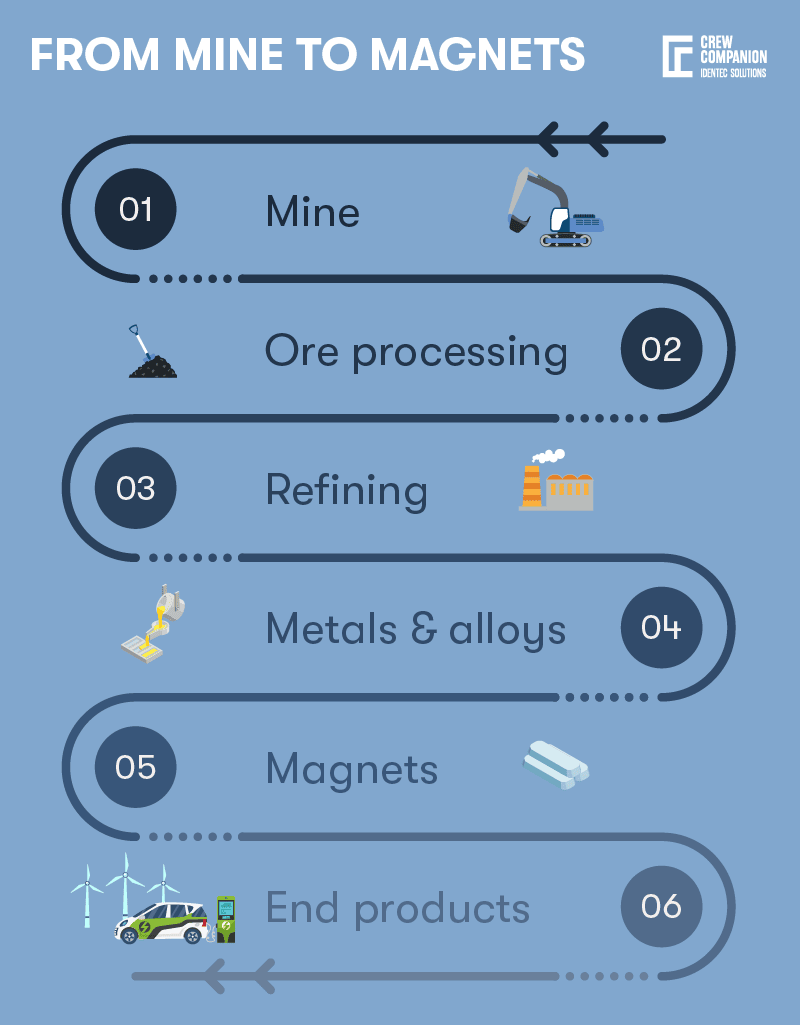
What the United States actually has in the ground
Rare earth minerals in the US are neither scarce nor evenly distributed, but their economic viability depends on geology, location, and processing options. American deposits occur in several geological settings, including carbonatite complexes, alkaline igneous rocks, and mineral sands containing monazite and xenotime. Some resources also exist as potential byproducts of phosphate mining or coal ash, though these pathways remain largely experimental at scale. It is important to distinguish between resources, which describe the total amount of rare earths present, and reserves, which represent quantities that can be economically extracted with current technology and prices (see also the open-pit mine atlas North America).
The United States holds significant resources by global standards, yet converting them into market-ready supply requires permitting, infrastructure, and access to separation facilities (compare it to rare earth mining in Canada). Light rare-earth elements such as cerium and lanthanum are relatively abundant, while heavy rare-earth elements like dysprosium and terbium are less common but critical for high-temperature magnet performance. Water availability, transportation access, and proximity to industrial customers all influence whether a deposit can be developed profitably.
Environmental considerations also play a major role, as rare earth processing can generate tailings and chemical waste that must be carefully managed. Over the past decade, federal and state agencies have increased geological mapping, research funding, and data transparency to better understand domestic potential. This has attracted new entrants, but it has also highlighted the gap between geological promise and industrial readiness.
Ultimately, the challenge is not whether the United States has rare earths, but how quickly and responsibly it can turn them into usable materials. (3)
A tour of major US rare earth locations
Rare earth activity in the United States is concentrated in a handful of regions where geology, infrastructure, and investment intersect. In the Mountain West, one prominent site has long been the most visible example of American rare earth mining, benefiting from established infrastructure and decades of technical knowledge. Nearby, several advanced projects are exploring different ore types that could diversify domestic supply if developed. In the Southeast, heavy mineral sands containing rare-earth-bearing monazite have attracted attention as a potential byproduct source, particularly in areas with existing mining and transport networks. The Gulf Coast has emerged as a hub for proposed processing and refining facilities due to its chemical industry expertise, ports, and access to skilled labour. In the Midwest, researchers and startups are testing recovery of rare earths from industrial waste streams, including coal ash and manufacturing residues, which could reduce reliance on primary mining over time. Each location faces distinct hurdles, from water management and community engagement to securing long-term customers and navigating complex permitting processes. Proximity to end users also matters: sites closer to automotive and defence manufacturers may find it easier to integrate into domestic supply chains. At the same time, logistics such as rail access, energy costs, and workforce availability shape project economics as much as geology. Taken together, these regional efforts illustrate that rebuilding a rare earth ecosystem in the United States is not a single project but a distributed network of mines, processors, and manufacturers evolving at different speeds. (4)
Why refining and processing remain the real bottleneck
The United States' rare earth supply chain has a significant gap between upstream mining potential and midstream refining capacity. Even though the country has significant ore resources, rare earth minerals in the US must go through chemical separation and refining before they can be used in magnets or other high-value products. These stages are technically complex and capital-intensive, involving solvent extraction, high-temperature chemical processes, and specialised infrastructure. The last decade has shown that having raw materials alone does not guarantee supply chain resilience. Many domestic projects struggle to secure access to refining facilities, forcing intermediates to be shipped overseas where established processors can efficiently convert concentrates into separated elements. This reliance on foreign separation capacity introduces strategic risk, long lead times, and exposure to geopolitical dynamics beyond US control. A second challenge is environmental and regulatory expectations. Separation plants generate chemical waste streams that require mitigation, permitting, and robust community engagement. Companies need time and capital to meet these requirements, and regulatory uncertainty can delay investment. Finally, qualifying new supply sources with downstream customers, such as automotive or defence manufacturers, takes years. These customers demand consistent quality, detailed material specifications, and long-term contracts. Together, these factors make refining and processing the most unpredictable and concentrated pinch points in the supply chain. Successfully scaling domestic separation and refining will require coordinated public-private investment, stable policies, and a transparent pathway from mining through midstream to end use.
Who actually operates in the US rare earth ecosystem
The rare-earth ecosystem in the United States includes a mix of miners, processors, magnet manufacturers, recyclers, and technology developers. Not all of these companies are large, household names; many are specialised firms focused on specific steps in the chain. On the mining side, a handful of developers operate or plan to develop deposits containing significant rare-earth deposits, often supported by exploration funding and long-term supply agreements with end users. Some firms are exploring ways to recover rare earths as byproducts of other minerals, which could reduce feedstock costs and diversify supply. In processing and separation, a few domestic facilities have begun to produce intermediate rare earth products, though capacity remains small relative to global leaders. These facilities often combine US feedstock with imported concentrates to maximise throughput. Downstream, specialist companies produce alloys and permanent magnets, particularly for defence and aerospace systems. New entrants are also emerging in recycling, seeking to recover rare earths from end-of-life electronics, magnets, and other products. Corporate strategies vary widely: some focus on vertical integration to capture value across multiple stages, while others specialise and partner to fill gaps. Governments and private investors increasingly participate through grants, tax incentives, and strategic investment funds to strengthen the domestic base. This patchwork of players reflects both the complexity of the supply chain and the emerging nature of industrial capacity in the United States, where rare earth minerals are becoming a commercially and strategically important asset rather than an overlooked resource. (5)
Geopolitics and international alliances
The rare earth landscape is inherently geopolitical. Even with growing domestic activity, rare earth minerals in the US cannot be fully understood without considering global trade dynamics, strategic partnerships, and competitive behaviour by other nations. For decades, much of the world’s refining and magnet-making capacity concentrated in a few countries, creating dependencies that governments now view as vulnerabilities. The United States, recognising this risk, has pursued policies to diversify supply chains through alliances with trusted partners in Europe, Asia, and Oceania. Trade agreements, joint research initiatives, and coordinated stockpiling efforts aim to reduce reliance on any single producer. At the same time, export controls and investment screening mechanisms have been used to protect sensitive technologies and ensure that critical supply chain infrastructure remains aligned with national security interests. Geopolitically, China remains the largest single player in rare earth processing and downstream manufacturing, and shifts in Chinese policy have historically led to price volatility and supply uncertainty. Other nations, from Australia to Japan, have invested in processing technology and trade relationships that complement US efforts. The broader context includes climate policy, defence industrial strategy, and trade negotiations that all influence where companies locate facilities and how governments support strategic industries. Understanding geopolitics helps explain why rare earth policy is not just about economics, but about resilience, trust, and global cooperation in a high-stakes industrial environment.
Markets, customers, and commercial dynamics
Customers of rare earth materials span a wide range of industries, from transportation to defence to consumer electronics. The most visible demand driver in recent years has been the automotive sector, where electric vehicle motors use powerful neodymium-iron-boron magnets that rely on separated rare-earth elements. Renewable energy, particularly wind energy, also relies on rare earth-containing generators for large turbines. Beyond these headline use cases, catalysts in petroleum refining, precision optics, medical devices, and glass polishing applications all contribute to steady industrial demand. Markets for rare earth minerals in the US are shaped by long qualification periods, contract structures, and quality specifications. Unlike commodity markets for widely traded metals, rare earths often trade through negotiated contracts that reflect product grade, delivery timelines, and processing origins. End customers typically demand supply traceability and consistency, which can give domestically produced materials a commercial edge when paired with quality assurance and long-term agreements. Price discovery is less transparent than for many metals, and spikes in rare-earth prices can occur when supply disruptions coincide with rising demand. Secondary markets, including recycling and remanufacturing, are emerging as customers seek to diversify sources and improve sustainability. Ultimately, commercial dynamics are influenced not only by physical supply and demand but by financial willingness to invest in inventory, futures contracts, and long-term planning in sectors where production lead times can stretch for years.
Outlook and what comes next for rare earths
The outlook for rare earth minerals in the US hinges on both industrial progress and broader economic and policy trends. Domestic activities in mining, processing, and magnet-making are moving forward, but they face a series of interdependent challenges. In the short term, expanding refining capacity and securing investment will be critical to turning resource potential into actual market supply. This means not only financing new facilities, but also streamlining permitting, building workforce capabilities, and integrating environmental best practices.
Policymakers have introduced incentives and strategic funds to accelerate these efforts, yet timelines for industrial development remain measured in years rather than months. At the same time, emerging technologies could reshape demand dynamics. Innovations in recycling and material substitution may reduce pressure on primary supply and create new commercial pathways (see also: Mining digital transformation). Companies are investing in circular approaches that reclaim rare earths from end-of-life magnets and electronics, which could mitigate some of the environmental impacts of mining and processing while contributing to supply resilience.
On the demand side, continued growth in electric vehicles, renewable energy systems, robotics, and defence technologies is expected to drive long-term expansion in the use of rare earths. However, this growth also depends on cost reductions, supply reliability, and geopolitical stability that reassure global manufacturers and investors. Looking ahead, rare earth minerals in the US are positioned at the intersection of economic opportunity and strategic necessity, and their development will depend on coordinated action across industry, government, and international partners. What ultimately comes next will be defined by patience, cooperation, and innovation across the entire supply chain.
FAQ
Are rare earth elements actually “rare”?
Not really. Most rare earth elements are relatively abundant in the Earth’s crust, in some cases more common than copper or nickel. The challenge is that they are usually dispersed at low concentrations and occur together within the same minerals, which makes extraction and separation complex and costly. What is “rare” is not their geological presence, but the combination of economically viable deposits, environmentally acceptable processing, and reliable refining capacity. This is why rare earth minerals in the US can exist in significant quantities while still being difficult to bring to market at scale.
Can recycling replace mining in the future?
Recycling will become increasingly important, but it is unlikely to fully replace primary mining in the near to medium term. Today, most rare earths are embedded in products such as permanent magnets, batteries, and electronics, making recovery technically challenging and not yet widely standardised. As collection systems improve and recycling technologies mature, secondary supply could meaningfully supplement primary production, reduce environmental impacts, and increase supply security, but growing demand from electric vehicles and renewable energy will still require new mined material.
Why does processing matter more than mining?
Mining is only the first step in a long and specialised supply chain. After extraction, rare earth concentrates must be chemically separated, refined, and converted into metals or alloys before they can be used in magnets or other applications. These midstream stages are capital-intensive, technically demanding, and environmentally sensitive, which is why they represent the main bottleneck for many projects. Without sufficient domestic processing capacity, even newly mined material must often be shipped abroad, limiting the strategic value of new mines.
Takeaway
Rare earth minerals in the US remain a strategic opportunity that depends as much on industrial coordination as on geology. Rebuilding a resilient supply chain requires consistent policy support, integrated mine-to-magnet planning, and close alignment between miners, processors, and end users. Equally critical is secured, long-term demand that allows companies to plan operations, justify capital investment, and maintain stable cash flow — a point repeatedly emphasised by the US administration in its critical minerals strategy. In this context, strong mine risk management around permitting, water and waste, community engagement, workforce, and offtake agreements will determine which projects can operate reliably and scale responsibly.

Delve deeper into one of our core topics: Miner safety
Glossary
Magnets are objects that produce a magnetic field, a region where magnetic forces act. Permanent magnets retain their magnetism because microscopic domains within the material remain aligned, as in hard ferromagnets such as Nd-Fe-B or ferrites. Electromagnets generate magnetism only when electric current flows through a coil, allowing for controllable strength and polarity. Magnets enable motors, generators, speakers, MRI, sensors, and data storage by converting electrical energy and motion via magnetic forces in countless modern technologies. (6)
References:
(1) https://www.usgs.gov/centers/nmic/rare-earths-statistics-and-information
(2) https://www.energy.gov/eere/amo/articles/critical-materials-supply-chain-white-paper-april-2020
(3) https://pubs.usgs.gov/fs/2014/3078/pdf/fs2014-3078.pdf
(4) https://www.gao.gov/products/gao-24-107176
(5) https://portal.ga.gov.au/persona/cmmi
(6) J. M. D. Coey, Magnetism and Magnetic Materials, Cambridge University Press, 2010. ISBN 978-0521816144.
Note: This article was partly created with the assistance of artificial intelligence to support drafting. The head image was created by AI.


Related Product