| Written by Constance Stickler
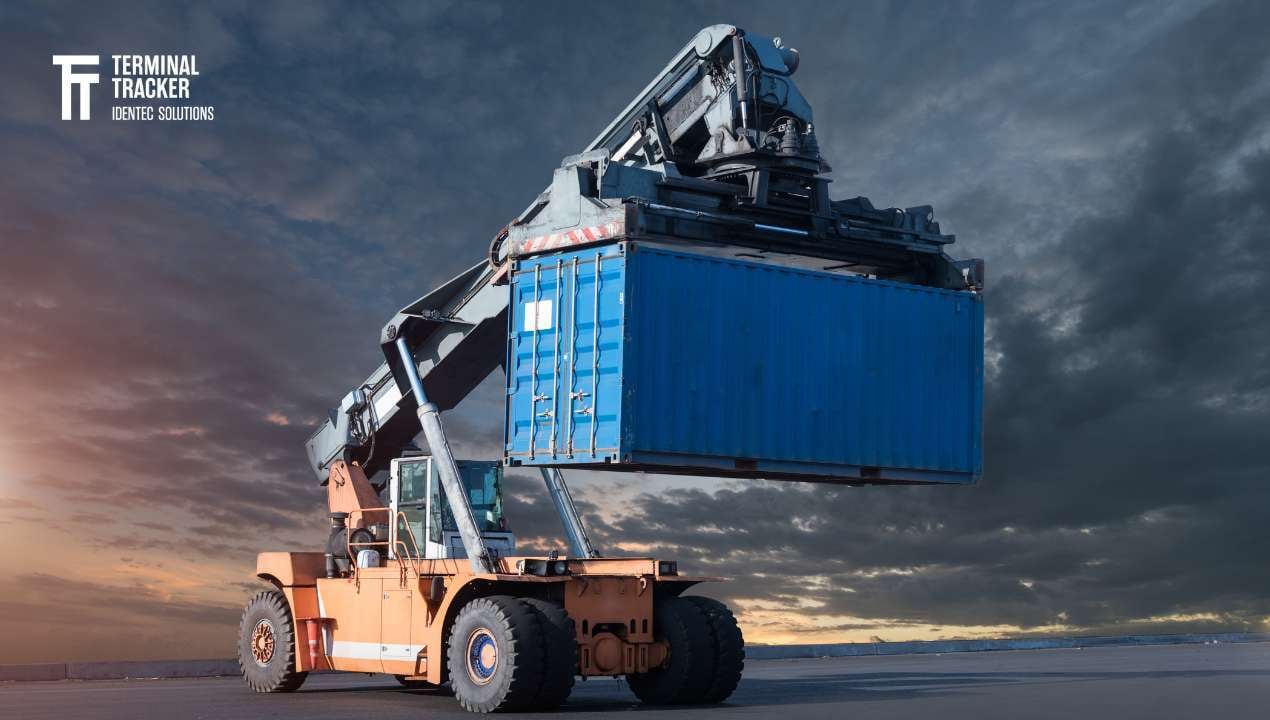
Table of contents:
- The Backbone of Container Handling: Why Are Reachstackers Indispensable?
- Anatomy of a Reachstacker
- How Do Reachstackers Handle Containers?
- Power and Precision: Performance Metrics That Matter
- How Automation Is Redefining Reachstacker Operations
- Safety First: The Role of Pre-Operational Safety Checks (POSC)
- FAQ
- Takeaway
- Glossary
The Backbone of Container Handling: Why Are Reachstackers Indispensable?
Few other machines in logistics combine power, manoeuvrability, and precision as skillfully as reachstackers. At container terminals and depots, where space and time are precious, these versatile vehicles prove to be a crucial aspect of efficient operations. They seamlessly switch between different tasks—lifting, transporting, stacking, and repositioning containers—at a speed that belies their size.
And this versatility is precisely where their greatest strength lies: Unlike cranes or straddle carriers, which are either fixed in place or limited in size and reach, reachstackers can move virtually freely around the site. They bridge the gap between transport, positioning, and intermodal handling. This adaptability makes them particularly valuable at terminals with fluctuating throughput.
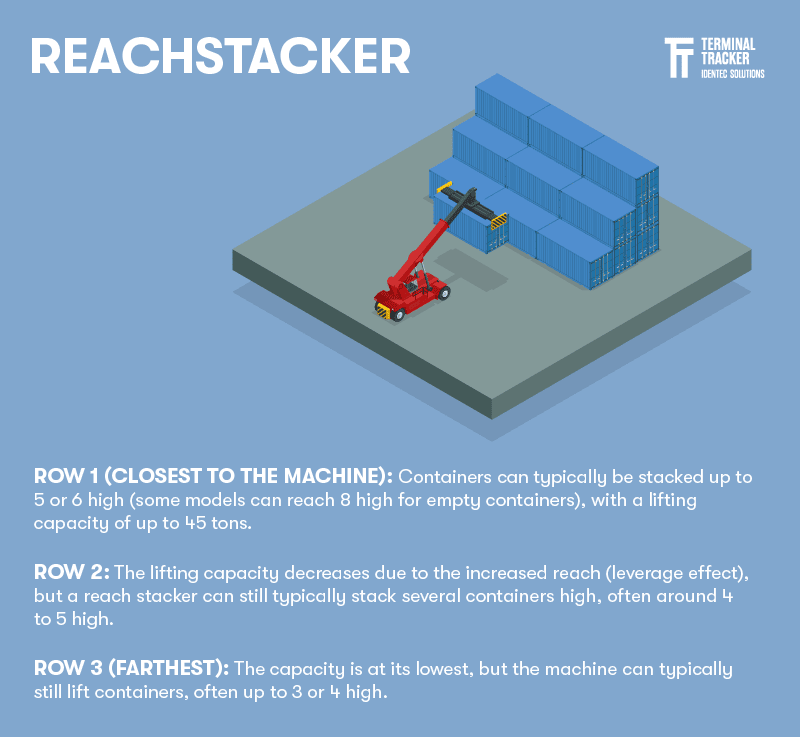
From an operational perspective, reachstackers offer an optimal balance between capacity and flexibility. Typically, they can weigh between 10 and 45 tons, the 35-45 tonnes segment securing the dominant share of 59,3% in 2025 (1) (models specifically designed for handling empty containers can handle less), up to three container rows deep and 5 to 6 containers high (special models extend beyond three rows and up to 8 containers high). The telescopic booms and precise hydraulics of this container handling equipment allow operators to maintain stability and control, even in confined spaces. This enables increased storage density without compromising safety or accessibility.
Another advantage is their ability to react dynamically to changing conditions. Whether a ship or train is delayed, a refrigerated container urgently needs to be connected to the power grid, or customs checks cause an unexpected bottleneck, reach stackers can be quickly redeployed to where they are most needed. Unlike more static equipment, they embody operational agility.
This agility opens up diverse opportunities for digital integration. Equipped with sensors, telematics, and IoT connectivity, modern reach stackers generate data streams on location, load weight, engine power, and fuel consumption. This data can be used for performance analysis, predictive maintenance, and real-time coordination with the terminal operating system (TOS). Intelligently networked, this creates a clearer picture of operational processes—enabling data-driven decisions that improve efficiency and safety.
Equipping reach stackers with semi-automated functions, such as positioning assistance systems or collision avoidance, allows terminals to modernise gradually and integrate smart technologies without having to completely redesign the site. In this way, reach stackers bridge the gap between traditional operations and the terminals of the future with advanced automation.
Their adaptability makes them suitable for small inland ports, container depots, and rail freight stations, as well as large seaports.
Learn also about the rubber-tired gantry crane (RTG)
Anatomy of a Reachstacker
To better understand the effectiveness of a reach stacker, we must first examine its construction. Every component, from the cab to the counterweight, is designed for the fast and safe lifting and moving of heavy containers in challenging environments.
At first glance, a reach stacker resembles a cross between a forklift and a crane. However, its design is more complex. The heart of the machine is its telescopic boom, a powerful arm that extends several meters to reach rows of containers. This boom is movable both vertically and horizontally, allowing the operator to pick up containers from the first, second, or even third row without having to reposition the vehicle.
At the end of the boom is the spreader, a rectangular frame with twist locks that secure the container's corner fittings. Modern spreaders often feature hydraulic or electronic control systems that automatically adjust to 20-, 40-, or 45-foot containers. Some are even equipped with rotation or side-shift mechanisms for more precise positioning – features that save time and reduce operator fatigue. The spreader is, in effect, the reach stacker's "hand": strong, precise, and capable of handling even a fully loaded container weighing over 40 tons, enabling delicate positioning.
Beneath the boom is the chassis, constructed of reinforced steel, which houses the engine, transmission, hydraulic systems, and counterweights. It must withstand immense loads while maintaining a low centre of gravity for stability. Counterweights – typically solid cast steel blocks – are positioned at the rear to balance the load lifted by the boom. This precise weight distribution ensures that the machine remains firmly planted on the ground, even with the boom extended and the container fully loaded.
Most models are still diesel-powered, but electric and hybrid drives are increasingly entering the market to meet the sustainability goals of the logistics industry. The engine powers both the vehicle's drive system and the hydraulics, providing the necessary power for simultaneous lifting and driving. Given the heat generated during continuous operation under harsh port conditions, efficient cooling systems and hydraulic filters are essential. These components are increasingly monitored by sensors that provide data on fuel consumption, oil pressure, and hydraulic fluid levels – enabling predictive maintenance and early fault detection.
The operator's cab is designed for optimal visibility, ergonomics, and control. Large panoramic windows offer an unobstructed view of the boom and container stacks, while joystick controls enable smooth and precise manoeuvring. Newer models feature digital dashboards and head-up displays that show critical performance data such as load weight, lift height, boom angle, and even proximity warnings. Some cabs are mounted on sliding or height-adjustable platforms, giving operators better visibility when stacking multi-layer containers. As automation progresses, these cabs are increasingly integrating with digital systems—from telematics dashboards to fleet management software—transforming operators into data-driven decision-makers rather than manual operators.
Reach stackers are typically equipped with large pneumatic tyres (usually between 6,000 and 8,000 mm) designed for uneven yard surfaces and heavy loads. The rear-wheel steering, in combination with the articulated steering, gives them exceptional manoeuvrability in tight spaces, enabling an amazingly tight turning circle.
How Do Reachstackers Handle Containers?
Flexible in their tasks and highly responsive, reach stackers play a crucial role in container handling. At its core, a reach stacker's job is simple: lifting, moving, and stacking containers. However, behind these seemingly simple actions lie processes that demand a high degree of coordination between strength and dexterity.
Picking and Placing Containers
The most common operation is loading and unloading containers from ocean-going vessels, which can carry tens of thousands of containers, to the yards of container terminals and depots, and back again. A reach stacker approaches the container, aligns its spreader with the upper corner fittings, and locks it with twistlocks. Once connected, the operator lifts the container using the hydraulic arm, adjusts its reach or height, transports it to the destination, and positions it with centimetre precision.
These processes are supported by camera systems, laser sensors, and automatic container recognition. These technologies minimise human error, reduce processing time, and increase safety by ensuring the correct positioning of the spreader. Each of these steps can be digitally recorded for the terminal's IT infrastructure. Data on lifting cycles, load weights, and transport routes are fed directly into the terminal operating system (TOS).
Transfer between different modes of transport
Reachstackers are particularly valuable in intermodal transport, where containers must be seamlessly transferred between container handling trucks, trains, and barges. Unlike cranes, which are tied to fixed positions, reachstackers can drive directly to a rail siding or quay, pick up containers from flatcars or barges, and transport them to the storage area.
Due to their ability to move containers even in confined spaces or on uneven terrain, they are ideally suited for smaller inland depots or combined transport terminals, where space constraints would otherwise limit throughput.
Transfer of empty containers
While empty containers are lighter, they still require speed and precision to maintain order on the premises. Many terminals use a combination of standard reach stackers and empty container stackers (lighter versions, optimised for fast movements).
Power and Precision: Performance Metrics That Matter
To truly understand and potentially improve the performance of their reachstackers, terminals need data. A fleet's efficiency isn't measured by the number of containers lifted, but by its intelligent operation: low fuel consumption, minimal downtime, seamless integration with digital systems, and reliable performance under pressure.
These key performance indicators (KPIs) are the crucial link between mechanical performance and digital insights. They transform reachstackers from heavy machinery into data-rich assets that uncover trends, identify inefficiencies, and support smarter automation strategies.
Cycle Time per Container Move
Cycle time is the most direct indicator of operational efficiency. It measures the average time a reach stacker takes to complete a full movement cycle—from picking up a container to placing it at its final location. Even slight reductions in average cycle time can lead to significant throughput increases and fuel savings across the terminal.
Digitally captured cycle time data provides deep insights into operations. By comparing times across different shifts, operators, and machines, terminals can identify patterns such as bottlenecks, inefficient yard layouts, or inconsistent driving practices. Integrated analytics platforms can even predict optimal routes or optimise the sequence of operations to minimise travel distances and idle time.
For IT managers, this means synchronising telematics data with the terminal operating system (TOS) and yard management software to ensure that cycle time analyses are directly integrated into productivity dashboards.
Fuel Consumption and Emissions
Since most reach stackers – 70% to 80% – are still diesel-powered, fuel efficiency is one of the most important key performance indicators (KPIs) in terms of cost and sustainability. Measuring consumption per container movement or operating hour provides a clear overview of energy efficiency. This data helps terminals evaluate the long-term economic viability of newer technologies such as hybrid or fully electric models.
The challenge for port IT departments lies in collecting, standardising, and visualising the necessary data to inform purchasing decisions and aligning it with the company's sustainability KPIs.
The increasing use of electrified reach stackers introduces a new dimension: Instead of fuel consumption, terminals must track energy consumption per cycle and battery efficiency. This shift requires new data models and interfaces with energy management systems – another area where the role of IT is rapidly growing.
Equipment Availability and Downtime
All this productivity is only achievable, of course, if the equipment is reliable. Equipment availability—usually expressed as a percentage of total operating hours—measures how much time a machine is in use and how much time it is out of service. Excessive downtime can be caused by mechanical defects, overdue maintenance, or operator error.
Tools such as telematics and on-board diagnostics now make it possible to monitor the condition of critical systems in real time—hydraulic pressure, oil temperature, engine load, and braking performance. These measurements feed into predictive maintenance models, enabling technicians to intervene before a failure occurs.
For IT teams, this means that telemetry data must be securely transmitted, stored, and made accessible across various maintenance platforms. A well-integrated data ecosystem transforms downtime tracking from a reactive to a predictive process, thereby improving fleet availability and terminal productivity.
From Data Points to Decisions
Key performance indicators (KPIs) are only as valuable as the decisions they enable. The challenge, therefore, lies in unifying the heterogeneous data streams – from onboard sensors and maintenance logs to fuel systems and TOS records – within a single, unified analytics framework. Once harmonised, these KPIs enable dynamic dashboards that display live performance indicators for the entire reach stacker fleet.
How Automation Is Redefining Reachstacker Operations
Until recently, reachstackers were an extension of the operator's skill and intuition; every lever and pedal translated human judgment into hydraulic precision. Increasingly, however, these machines are networked, semi-intelligent systems that continuously interact with their digital environment. The primary focus here is on supporting the human factor.
The goal is to reduce cognitive load, increase consistency, and minimise risk, while simultaneously achieving greater operational efficiency. From intelligent assistance systems and digital navigation to AI-powered task coordination, automation is gradually transforming how reachstackers move, think, and react within the terminal ecosystem.
From Manual Mastery to Assisted Intelligence
The first wave of automation in reach stackers focuses on driver assistance. Modern control systems take over repetitive or precision-based tasks. Load stabilisation and boom positioning systems, for example, automatically adjust hydraulic pressure to ensure balance during lifting. Camera- and radar-based collision avoidance systems detect nearby obstacles and warn drivers—or, in some cases, automatically brake the vehicle—to prevent accidents (see also: Position detection - yard intelligence for smart terminals).
Autonomous route guidance is also becoming established as a practical step: Optimal routes across the site are suggested, taking into account terrain, traffic volume, and container location data from the Terminal Operating System (TOS). Drivers follow visual or audible cues on the onboard displays, resulting in faster and safer movements with less stress and fewer errors.
Automated Container Identification and Task Assignment based on PDS
One of the biggest time savings is that equipment operators no longer have to manually record containers; instead, this is done using optical character recognition (OCR). The handover of containers to other equipment is transmitted via IoT tags attached to the machines. This allows drivers to concentrate fully on their actual work and be confident that the movement is updated in the terminal operating system (TOS).
This automation eliminates errors in manual data entry and creates seamless digital documentation for every container movement – essential for terminals that must meet high data accuracy and comply with audit requirements. Reachstackers receive optimised tasks based on location data collected by position detection systems (PDS). These tasks are prioritised according to distance, urgency, or energy efficiency, thereby reducing unproductive journeys and idle times.
Human & Machine: The Hybrid Yard Model
Despite all these advances, the immediate future of reachstacker automation is not fully autonomous, but rather hybrid. The operator will become the decision-maker, supported by real-time data analytics, enhanced interfaces, and predictive control. While automation takes over routine tasks, operators can focus on situational awareness and operational judgment—areas where human perception remains superior to algorithms.
Building the Digital Foundation for Automation
Implementing automation in reach stacker operations is more than just a hardware upgrade—it also presents a challenge to data architecture. Machine sensors, cameras, and positioning systems generate massive amounts of data every second. Without suitable data pipelines, storage strategies, and processing frameworks, the value of this information is easily lost.
IT leaders play a central role in building the digital foundation for automation. This includes:
Ensuring real-time connectivity.
Integrating machine data streams into operational, maintenance, and safety systems.
Using data analytics platforms that transform telemetry data into actionable insights.
Establishing cybersecurity protocols to protect the operational and enterprise-wide IT layer.
As automation increases, the line between IT and operational technology (OT) becomes blurred, creating a need for unified governance. Effective automation depends not only on intelligent machines but also on intelligent infrastructure.
Safety First: The Role of Pre-Operational Safety Checks (POSC)
A good example of human-machine collaboration is pre-operational safety checks (POSC). Modern equipment has sensors that can be queried, either partially or completely, in an automated self-check. These include:
- Fluid Levels and Pressure Checks: Hydraulic oil, engine oil, coolant, brake fluid
- Battery and Electrical System Status: Temperature, cell voltage balance, and charge cycles
- Tyre Monitoring: Pressure, temperature
- Brake System Functionality
- Lift and Boom Systems: Responsiveness of stroke and angle sensors, hydraulic pressure
- Light and Signal Check: Indicator lights, work lights, and alarms
- Sensor and Camera Diagnostics: Proximity sensors, light detection and ranging (LIDAR), radar, and rear-view cameras
- CAN Bus and Control System Integrity: Communication health between subsystems
Anything that cannot be checked by the reach stacker itself and is only visible externally or through experience must still be inspected by a person:
Visible Damage and Structural Integrity
- Cracks, dents, corrosion, or weld fractures
- Leaking hydraulic hoses or fittings
- Deformed or worn twistlocks, chains, and pins
- Tyre sidewall damage, uneven wear patterns
Cleanliness and Obstruction
- Windows, mirrors, and cameras
- Debris or obstructions
- Steps, handrails, and access points
Cabin Safety and Ergonomics
- Seatbelt and seat condition
- Fire extinguisher presence and validity
- Cabin cleanliness
- Visibility (mirrors, wipers, demisters)
Spreader and Attachment Function
- Cleanliness, alignment, and free movement of mechanical locks, twistlocks, and chains
- Lubrication of moving parts
Warning Devices and Emergency Equipment
- Audibility and visibility of the horn, lights, beacon, and alarms
- Emergency stop buttons
Environmental and Contextual Checks
- Ground condition
- Surrounding area
- Weather impact
General "Feel" of the Machine
- Delays in hydraulic response, unusual vibrations, or sounds
- Changes in steering feel or brake pedal travel
However, automated support is also available for this aspect, namely in the form of recording. A touchscreen displays various questions to the reachstacker operator (for example: Is the safety belt correctly fastened?), which they must verify. The results are automatically forwarded to the system. If critical errors are reported (for example, a leaking hydraulic hose), the system can prevent the reachstacker from being put into operation or used.
In short: Automation handles the measurable; humans handle the visible and contextual. The best practice is to merge both — automated self-checks for internal systems, and operator walk-arounds for the external, situational factors.
These automated checks offer significant advantages:
Immediate transparency: Fleet managers can see which machines have passed the POSC safety inspection before their shift begins.
Predictive maintenance: Data on recurring faults helps identify patterns and plan proactive maintenance.
Traceability: Digital records ensure traceability and compliance with ISO and HSE standards.
Integration: POSC data can be linked to maintenance management, reducing redundant inspections.
For IT departments, the introduction of digital POSC processes means integrating new data streams into existing systems. This requires particular attention to user interface design, data synchronisation, and security, especially when devices are used in harsh outdoor environments with intermittent connectivity issues.
In combination with IoT-enabled monitoring platforms, this creates a two-tiered safety net:
- The operator performs visual and functional checks.
- Simultaneously, the machine performs automatic self-diagnostics.
- Together, they ensure that no problem—whether caused by human error or mechanical failure—goes undetected.
FAQ
How are reachstackers prevented from tipping over?
Reachstackers lift extremely heavy loads over a wide reach, both of which are critical operational risk factors. A combination of advanced technologies and design features specifically developed for safe container handling protects against tipping over:
Dynamic Tilt Protection: This intelligent control technology continuously monitors operating parameters such as boom length and angle, hydraulic pressure, and the overall stability of the vehicle. It automatically adjusts operating limits and boom positions as soon as dangerous tipping conditions are detected to prevent rollover.
Automatic Speed and Lift Limitation: The reach stacker adjusts travel speed and boom movements based on load weight, height, and stability analysis. It limits lifting and telescoping functions to safe ranges to control the center of gravity.
Load and Overload Monitoring: Systems continuously measure load weight and distance to the vehicle, issue warnings, and automatically stop unsafe movements if the container is too heavy or incorrectly positioned. This prevents machine destabilisation.
Hydropneumatic Suspension and Mobile Counterweights: Special suspension dampens shocks and vibrations and improves stability on uneven terrain. The mobile counterweight technology dynamically shifts weight to balance the machine during lifting and driving.
Automatic braking and obstacle detection: Reachstackers use laser scanning and graphical identification to detect obstacles in their path and brake automatically. This prevents accidents that could lead to dangerous swaying or tipping.
Vertical boom lift control: Intelligent controls ensure the precise maintenance of the boom's vertical position during lifting. This centers the load and minimises the risk of tipping.
Takeaway
In the development of the reachstacker, steel meets software, and human expertise meets machine intelligence. Its automation doesn't mean replacing human operators, but rather enhancing their capabilities through data transparency, security assurance, and process consistency. From predictive maintenance and real-time performance analysis to digital security checks before operations begin, each layer of connectivity transforms the reachstacker into a strategic data source rather than an isolated tool.
For IT managers, this transformation marks a pivotal moment. Success in modern terminal operations no longer depends on acquiring state-of-the-art hardware, but on building digital ecosystems that enable this hardware to think, communicate, and evolve.

Delve deeper into one of our core topics: Smart Port
Glossary
Cycle time is the actual time taken to complete a specific operational task or step, such as moving a container from one point to another using a reachstacker. It measures the active working time involved in the process, excluding waiting or idle periods. For reachstackers, cycle time starts when the container is lifted and ends when it is safely placed at its destination. To fairly evaluate performance, cycle time should be adjusted for differing travel distances, creating a normalised metric that accounts for move length. This helps track efficiency and optimise the handling process by focusing on active processing time. (2)
A spreader on a reachstacker is a specialised lifting attachment designed to securely grasp containers. It is mounted at the end of the reachstacker's telescopic boom and features adjustable locking mechanisms called twistlocks that fit into the container's corner castings. This allows the reachstacker to lift, move, stack, and position containers with precision and safety. Some spreaders have the ability to rotate containers to align them properly, improving operational efficiency in container yards. The spreader's design ensures containers of various standard sizes (20 to 40 feet) can be handled reliably during loading and unloading operations. (3)
References
(1) https://www.coherentmarketinsights.com/industry-reports/reach-stacker-market
(2) Alan Rushton (2017). The Handbook of Logistics and Distribution Management. Kogan Page Ltd.
(3) Notteboom, Theo, et al. (2014). Container Terminals and Automated Transport Systems. Springer.
Note: This article was partly created with the assistance of artificial intelligence to support drafting.

Author
Conny Stickler, Marketing Manager Logistics
Constance Stickler holds a master's degree in political science, German language and history. She spent most of her professional career as a project and marketing manager in different industries. Her passion is usability, and she's captivated by the potential of today's digital tools. They seem to unlock endless possibilities, each one more intriguing than the last. Constance writes about automation, sustainability and safety in maritime logistics.
Related Articles
Related Product