| Written by Constance Stickler
Table of contents:
- Why Is Temperature Range Product-Specific?
- Product Temperature Ranges: What Cargo Actually Needs
- Reefer Operating Ranges and Setpoints
- Tight vs Wide Temperature Tolerances
- Where Does Temperature Stability Break Down Across the Cold Chain?
- Enter Mobile Real-Time Reefer Intelligence
- From Data to Decisions: Operational Impact of 5G Connectivity
- FAQ
- Takeaway
- Glossary
Why Is Temperature Range Product-Specific?
There is no single reefer temperature range that applies to the entire cold chain logistics. The actual temperature required is determined by the product being transported. The container is merely the means of transport – the requirements arise from the cargo itself.
Every perishable product exhibits unique biological or chemical properties that determine its temperature requirements; they all react differently to heat and cold. Frozen goods, for example, must remain frozen throughout transport. Any thawing must be avoided, as it can directly affect their structure and quality.
Chilled cargo operates according to a different logic. Fresh fruit, vegetables, dairy products, and flowers continue to evolve biologically after harvest. Temperature (among other parameters) influences respiration, ripening, and shelf life. Minor deviations won't immediately destroy the product, but they can significantly shorten its lifespan and reduce its market value.
And then there are temperature-controlled goods, such as bananas, the most frequently transported commodity in refrigerated containers. Bananas and other tropical fruits, as well as pharmaceuticals and chemicals, must be protected from both heat and cold.
This is the unique aspect of refrigerated logistics with reefers: The same container can be used for different types of cargo within just a few days, but the operational requirements change completely with each shipment. A target value that is ideal for one shipment may be completely unsuitable for the next.
Therefore, the crucial question is always the same: What condition must this specific shipment be in to guarantee its quality throughout the entire transport process?
Product Temperature Ranges: What Cargo Actually Needs
Product temperature ranges in cold chain logistics are not arbitrary limits – they result from biological stability, chemical sensitivity, and expectations regarding retail quality.
Deep frozen cargo
These products are transported at temperatures between -40°C and -20°C, sometimes at even lower temperatures. They include high-quality seafood (for example, premium tuna), certain pharmaceutical and biotechnological materials, enzymes, and special food ingredients such as specific pure-culture yeasts for breweries or wine production.
Frozen goods
Meat, seafood, and processed foods are typically transported at around -25°C to -18°C. At this temperature, the product is already stabilised, meaning microbial activity is practically stopped. The primary goal here is not the highest temperature accuracy, but rather maintaining a consistent temperature over an extended period.
Chilled cargo
Temperature ranges for refrigerated products are usually between just above 0°C and around +8°C, depending on the product. Since they continue their biological activity even after harvesting, maintaining the defined target values is essential.
Temperature-controlled goods (”Keep fresh”)
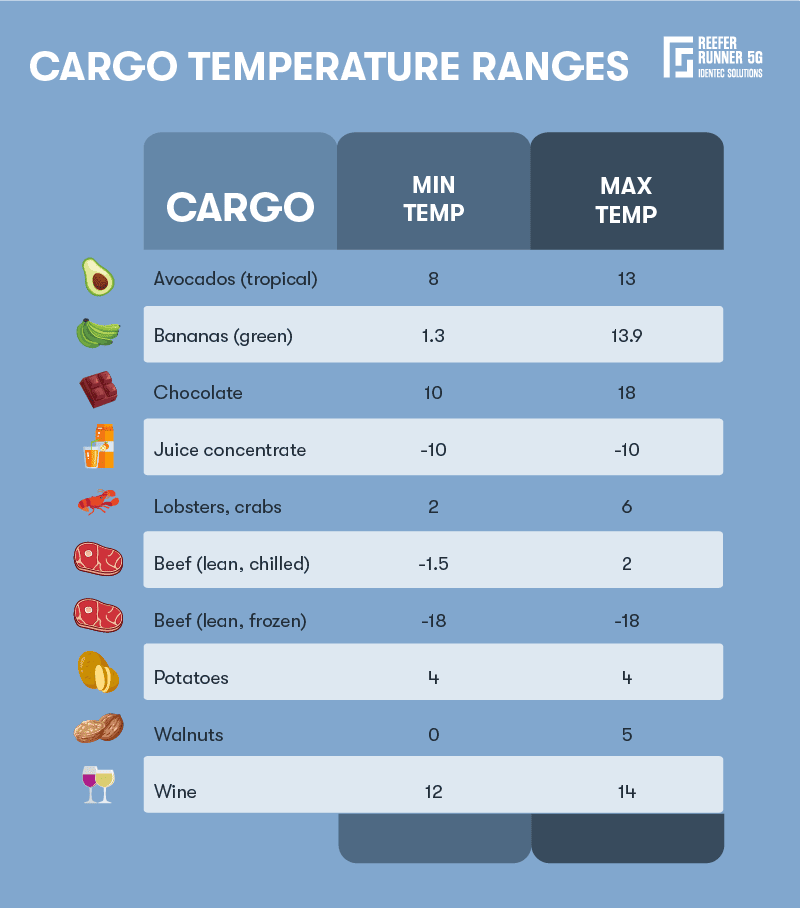
Some products require protection not only from heat but also from extreme cold. Bananas are a classic example and are typically transported at +13°C to +14°C. Low temperatures can lead to cold damage that only becomes apparent later in the supply chain. "Freeze protection is particularly critical in the winter, when goods may travel through climates in which the exterior temperatures are below freezing." (1) Certain pharmaceuticals and chemical products that fall within this reefer temperature range also require a strictly controlled environment, as deviations can have immediate commercial as well as regulatory consequences.
Operating a refrigerated container is therefore always based on the cargo’s temperature ranges, which are narrow for some products and looser for others. Everything that needs to be considered during storage and transport – target values, monitoring, deviations, and intervention strategies – depends on knowing and adhering to what the cargo actually needs to survive the journey in optimal condition.
Reefer Operating Ranges and Setpoints
Reefers typically operate within a wide temperature range, often from approximately -30°C to +30°C, depending on the type and configuration. Within this range, a setpoint is defined that reflects the required condition of the cargo, which the refrigeration system maintains throughout transport.
The setpoint is the target temperature for the air inside the container, not the actual product temperature. The relationship between the two is dynamic and affected by external factors such as ambient temperature, door openings, or power outages. The refrigeration unit cycles between cooling and standby phases to remain within the acceptable setpoint range. If this range is very narrow or more tightly defined, the refrigeration system must work harder or react more quickly to changes:
Tight vs Wide Temperature Tolerances
The extent of the temperature range determines the operational risk. How quickly does a deviation become critical? How much operational flexibility is there? How intensive do monitoring and intervention need to be?
While the overall temperature range for deep-frozen goods is large, the tolerance for individual products is often very low. Even slight, sustained increases can trigger quality risks such as partial thawing of the surface, structural weakening, or loss of product integrity at the microscopic level. This results in a different risk profile: not frequent, small fluctuations, but rare yet extremely critical deviations.
The situation is different with frozen cargo. As long as most products, such as meat and seafood, remain completely frozen, short-term fluctuations do not cause damage. However, repeated warming or even partial thawing leads to ice crystal formation and moisture loss, resulting in structural damage.
Many pharmaceuticals in the chilled range have very low tolerances for deviations. In these cases, not only the extent of the deviation but also its duration is crucial. Also, berries, leafy greens, and blossoms react to relatively small temperature increases. Apples, on the other hand, can tolerate a somewhat larger upward deviation—at least in the short term—but then they release more ethylene, which accelerates ripening. However, the situation is different with downward deviations. When the water in the cells freezes, it expands, ruptures the cell walls, and after thawing, the apples become soft, mushy, and inedible within a very short time.
With temperature-controlled goods as well, both directions must be considered. Bananas, for example, are sensitive to both heat and cold. Therefore, the permissible temperature range is defined by both the need to protect against cold damage and the refrigeration requirements. This results in a narrow "safety margin" that must be carefully maintained in both warm and cold environments.
The most important insight for cold chain operations is that tighter tolerances reduce error margins. The narrower the permissible tolerance range, the less time operators have to detect and correct deviations before the quality of the cargo is compromised. This directly impacts the selection of monitoring systems and the required response speed. With cargoes exhibiting large tolerances, occasional fluctuations can be absorbed without immediate consequences, allowing for somewhat slower detection and response cycles. However, increasing cargo values and operational complexity mean that even more tolerant cargoes benefit from faster visibility and response capabilities.
Where Does Temperature Stability Break Down Across the Cold Chain?
On their journey from the farm or producer to the retailer, reefers pass through various stations and modes of transport. Every transfer, every delay, and every environmental impact carries small risks that can accumulate into significant temperature deviations.
It begins with inland transport, mostly by truck, but also by rail or inland waterway vessel. This often has a lower infrastructure density and fewer fixed monitoring points than, for example, in the terminal environment specialising in reefer handling. Long distances are sometimes covered between the individual transshipment points, occasionally through regions with different environmental conditions. Truck transport is particularly susceptible to traffic delays, while rail transport can cover long distances with limited direct intervention options. Early detection of deviations is especially important here. Inland waterway transport, although often more stable in its movements, can of course also be affected by delays at inland ports or transshipment points.
Some container depots specialise in the storage, inspection, and preparation (PTI) of reefers, while others only house them occasionally. In both cases, repositioning and temporary disconnection from the power grid can cause instabilities; in the latter, the human factor, or rather the fact that handling refrigerated containers is not an everyday occurrence, also plays a role.
While container terminals are generally very well equipped for reefer handling, there are still critical moments. One example is transport from the ship to the yard, during which the container is not connected to a power supply. When dozens, if not hundreds, units arrive in a single shipload, connecting them takes time.
In all modes of transport, handovers represent one of the most critical points in the cold chain. Every transfer between terminal, depot, truck, rail, or inland waterway vessel carries the risk of changes in responsibility and temporary gaps in information. Even with correct execution by all parties involved, coordination or data gaps can compromise overall temperature stability.
Another often overlooked factor is the variability of dwell time. Containers can remain at certain stations significantly longer than planned due to bottlenecks, schedule changes, or operational disruptions. These delays are difficult to predict but can have a direct impact on temperature-controlled goods, especially when combined with environmental impacts.
Temperature stability, therefore, depends on the performance of the equipment, but also on the continuity between systems, stakeholders, and modes of transport. The weakest link is often not the container itself, but the transitions between environments where control, visibility, and responsibility temporarily change.
Learn more about cold chain solutions
Enter Mobile Real-Time Reefer Intelligence
The traditional monitoring approach relies on periodic inspections and alarms that are only visible locally at the unit and are only triggered after deviations occur. This creates blind spots. Real-time reefer intelligence fundamentally changes this model.
Instead of isolated checkpoints, modern, networked systems enable continuous operational visibility. And instead of fixed infrastructure like at the terminal, mobile solutions are used that travel with the container. Temperature, power status, alarms, movement events, and operating conditions can now be monitored in real-time as containers are transported between terminals, depots, trucks, rail networks, and inland waterways.
This real-time connectivity drastically reduces latency. Instead of waiting for the next scheduled update, operators gain near real-time insight into the reefer's behavior. This enables the early detection of anomalies, such as slow temperature drift, delayed temperature recovery after handling, intermittent power outages, or units operating under excessive thermal stress.
Instead of receiving confirmation at two separate points in time—as is typical with conventional monitoring—that the temperature is within the acceptable range, the time between these confirmations is now also recorded. This is particularly important for goods with tight tolerances. For highly sensitive products, a few hours, or even minutes, under adverse conditions like tropical heat, can be crucial.
Another major advantage is transparency beyond fixed infrastructure environments. Historically, monitoring reefers was most effective at terminals, as the containers could be connected to local monitoring networks there. Once a container was transported inland by truck, rail, or barge, visibility was often incomplete or delayed. Mobile real-time connections close these gaps by allowing monitoring to accompany the container instead of being tied to a fixed location.
This creates a significantly more consistent picture across all modes of transport. Furthermore, all stakeholders – from freight owners and forwarders to logistics coordinators – can access the current status. For example, a technician can gain a comprehensive overview of the condition and the urgency of necessary measures before being called to an inland port.
The transition from snapshots to real-time data also changes how operators interpret reefer behaviour. Monitoring is no longer limited to detecting limit violations as they occur. Instead, patterns can be analysed, and developing anomalies can be identified and addressed.
In practice, monitoring involves both data recording and active operational control. Continuous transparency transforms reefer management from a reactive process into a dynamic decision-making environment where integrity measures can be taken before the cargo is at risk.
From Data to Decisions: Operational Impact of 5G Connectivity
It is not that local surveillance methods produce too little data, but that the way in which this data is collected, transmitted and used remains limited. Modern, mobile solutions now transmit temperature and operational data continuously and with low latency. This transforms monitoring from a static recording into a live stream, allowing for the observation of changes in conditions.
This has immediate consequences. A temperature deviation is detected the moment it develops. Subtle trends—such as a gradual deviation due to delayed plugging in, obstruction of airflow, or rising ambient temperature—become visible early enough to allow for a response. The difference lies not only in the speed but also in the timing: interventions shift from reactive to preventive.
Why is 5G connectivity being used? Essentially, 5G is the fifth generation of mobile communication technology. Compared to previous mobile networks, it enables significantly faster data transmission, lower latency, higher connection density, and more stable communication between a large number of connected devices.
Conventional communication methods often reach their limits when it comes to the demands of a modern cold chain for fast and reliable transmission. Older mobile communication standards and interval-based transmission systems lead to delays between measurement and display. Data may only be available after predetermined polling intervals, meaning operators are essentially viewing historical data rather than the current situation.
The most important advantage is the low latency, meaning the delay between an event occurring and its display in the monitoring system. This allows for significantly faster responses to problems. The second advantage is the connection density. Even when many units need to be networked simultaneously, 5G can handle these high device densities much more efficiently than previous technologies.
But bandwidth also plays a role. Since modern cooling systems increasingly produce more extensive operational data sets such as live diagnostic data, motion events, energy consumption and historical trend information, it is important to be able to transport these data volumes without bottlenecks.
For cold chain logistics, the solution's mobility is of paramount importance. A reefer transported inland no longer disappears from monitoring after leaving the terminal. Continuous communication allows operators to make the entire transport route transparent, rather than just monitoring individual checkpoints.
FAQ
What is 5G?
5G is the fifth generation of global wireless cellular technology, designed to deliver significantly faster speeds, ultra-low latency, and greater capacity than previous 4G networks. It allows more devices to connect simultaneously, enabling real-time data sharing essential for modern smart technology and daily mobile use.
Its main advantages are:
Blazing Speeds: 5G peak speeds can exceed 1 Gbps, allowing for downloading high-definition movies and large files in seconds.
Ultra-Low Latency: Network delay (the time it takes for data to travel from a device to the server and back) drops to about 1 millisecond, eliminating lag for streaming, gaming, and video calls.
Massive Capacity: It connects up to 100 times more devices per square kilometre without network slowdowns, which helps power crowded concerts, industry applications, and smart city infrastructure.
5G achieves its performance by utilising a much wider array of radio frequencies. The network is divided into three main spectrum bands:
- Low-Band: Travels the furthest and provides the best coverage, making it ideal for rural areas.
- Mid-Band: Offers the best balance of fast speeds and solid coverage.
- High-Band (mmWave): Operates on extremely high frequencies to deliver the fastest multi-gigabit speeds, though its range is short and struggles to pass through solid walls.
Takeaway
Reefer temperature range is not a standardised technical specification, but rather a product-specific requirement that varies from shipment to shipment. Some goods tolerate moderate fluctuations, while others require extremely stable conditions throughout the entire transport chain.
As cold chains become increasingly interconnected and operationally demanding, reliable and compliant adherence to these conditions increasingly depends on continuous transparency rather than periodic checks. Real-time reefer intelligence and 5G connectivity enable operators to move from delayed response to proactive control—not only in terminals, but also in trucks, trains, barges, and refrigerated container depots.
Ultimately, the future of cold chain logistics lies in more precise, connected, and continuously monitored transport.
Delve deeper into one of our core topics: Cold Chain Monitoring
Glossary
Airflow is the controlled movement of cooled air through a refrigerated container so the cargo stays at a uniform temperature. Good airflow pushes cold air around or through the load, removes heat, and prevents hot spots, condensation, and uneven cooling. It depends on how the cargo is stacked, whether vents or pallet channels are blocked, and how the reefer unit circulates air. For fresh produce, airflow is especially important because the cooling air must pass through the load, not just around it. Poor airflow can cause spoilage even when the set temperature looks correct. (3)
Temperature stability means keeping a product within its required temperature range with minimal fluctuations from storage to delivery. It matters because even short excursions can reduce quality, safety, or efficacy for foods, vaccines, and other temperature-sensitive goods. In practice, stability depends on refrigeration equipment, insulation, packaging, monitoring, handling time, and rapid response to deviations. The goal is not just “cold,” but a consistent temperature profile that protects the product until it reaches the end user. (4)
References:
(1) https://www.atsinc.com/blog/what-is-freeze-protection-in-freight-shipping
(3) M.C. Dodd (2012). Managing Airflow inside Reefer Containers Benefits Produce Quality. Acta Horticulturae / International Society for Horticultural Science.
(4) Rolf T. W. (2023). Cold Chain Management. Springer.
Note: This article was partly created with the assistance of artificial intelligence to support drafting.
Author
Conny Stickler, Marketing Manager Logistics
Constance Stickler holds a master's degree in political science, German language and history. She spent most of her professional career as a project and marketing manager in different industries. Her passion is usability, and she's captivated by the potential of today's digital tools. They seem to unlock endless possibilities, each one more intriguing than the last. Constance writes about automation, sustainability and safety in maritime logistics.
Related Articles
Related Product