| Written by Mark Buzinkay

Table of contents:
- Economic Trends Shaping Finished Vehicle Logistics 2026
- Regional Shifts Reshaping Global Finished Vehicle Logistics 2026
- Technical Innovations Driving Finished Vehicle Logistics 2026
- FAQ
- Takeaway
- Glossary
Finished vehicle networks don’t fail because people “don’t try hard enough.” They fail because variability is engineered into the system: handovers without verified events, yards run on tribal knowledge, transport plans that ignore physical constraints, and exception handling that starts only when a dealer escalates.
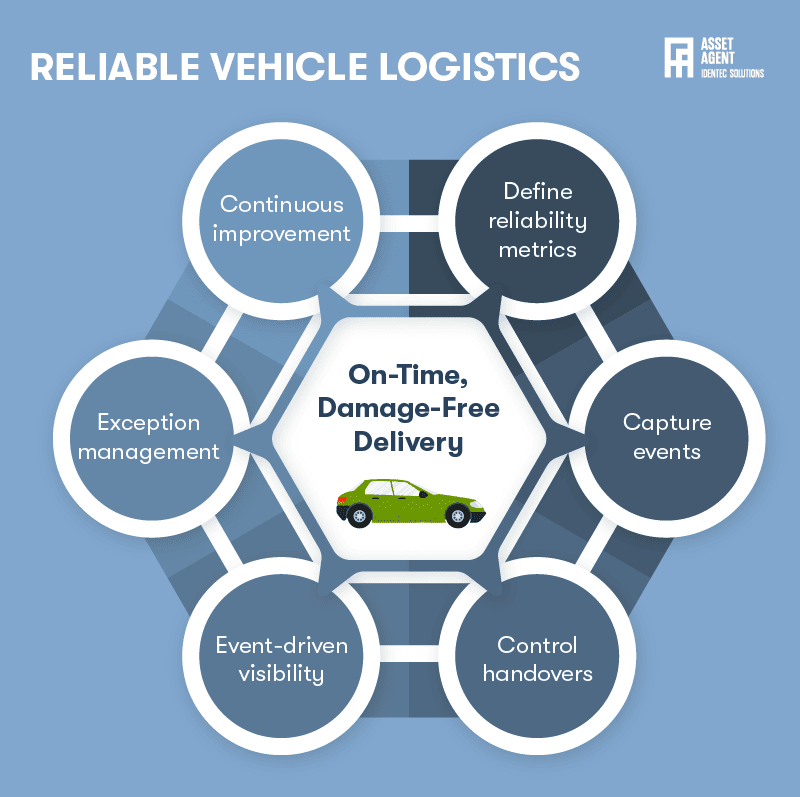
Reliable vehicle logistics is achievable, but it requires treating the finished vehicle supply chain like a controlled technical system: you define events, instrument the network, enforce process discipline at interfaces, and continuously reduce variation. This article focuses on the practical levers that actually move reliability metrics—OTD/ETA accuracy, dwell time, damage rate, claim cycle time, and utilisation—across road, rail, sea, ports, and compounds.
What does “reliable” mean at VIN level—and how do you measure it?
Most networks say “reliable” when they mean “fast” or “cheap.” For logistics managers, reliability is measurable at VIN level, and it is multi-dimensional:
Define reliability as a set of service outcomes
- Delivery reliability: VIN delivered within promised window (not just “on the right day,” but within a defined hours window where applicable).
- Information reliability: status is correct, timely, and decision-grade (no phantom scans, no late manual updates).
- Quality reliability: vehicle arrives damage-free (or with damage detected, coded, and assigned at the correct handover point).
- Capacity reliability: promised capacity actually materialises (carriers, rail slots, vessel bookings, yard space).
Use metrics that expose process capability, not averages
Averages hide the problem. Use distributions and “tail” metrics:
- OTD / On-time-in-full (OTIF) by lane and mode with percentile view (P50/P90).
- ETA accuracy: error at 24h/12h/6h horizons (in hours), not “green/red.”
- Dwell time at each node (plant buffer, yard, port, terminal) with variance.
- Exception lead time: time from deviation occurrence to detection + first action.
- Damage rate per 1,000 VIN movements, separated by location and activity type (loading, shunting, storage, PDI, etc.).
- Rework & rehandle rate: number of touches per VIN and “unplanned moves” in yards.
Create an “event completeness” KPI (the reliability multiplier)
If you only adopt one operational KPI, make it this:
- Event completeness = % of VINs that have all mandatory events captured at each control point (gate-in, unload, load, depart, arrival, handover acceptance).
When event completeness drops, every other reliability KPI becomes suspect because you’re operating blind.
Industry work on common event definitions and VIN visibility exists (e.g., AIAG Finished Vehicle Logistics materials). (1)
How do you engineer reliable processes at the handovers?
In finished vehicle logistics, the interfaces are where reliability is won or lost. Every interface needs three things: a physical rule, a digital event, and an accountability handshake.
Treat each handover as a “control point”
Typical control points:
-
Plant gate-out → carrier pickup acceptance
-
Yard/compound gate-in + location assignment
-
Load confirmation (truck/rail/vessel)
-
Port terminal receiving and staging
-
Vessel load/unload
-
Rail terminal unload + dispatch
-
Dealer handover acceptance / POD
At each control point, define:
- What must be physically true (vehicle condition, fuel level rule, key status, accessories, battery state for EVs).
- What must be digitally recorded (event type, timestamp, location, responsible party, optional evidence).
- Who owns the next step (the “baton pass” must be explicit).
Stop “soft handovers”
A soft handover is when:
-
a carrier drops VINs “somewhere” in a yard without confirmed location,
-
a yard receives VINs without an agreed inspection window,
-
a port books units that aren’t physically ready,
-
a status update happens without evidence or validation.
Soft handovers create downstream chaos: searching, rehandling, missed sailings, and mis-assigned damage.
Implement a minimum viable handling standard (then enforce it)
Vehicle handling and damage prevention are not “nice to have”; they are reliability drivers because damage creates holds, rework, claim friction, and missed delivery windows.
Adopt a recognised quality/handling baseline (e.g., ECG Operations Quality Manuals; AIAG/ECG transport damage guidance) and translate it into enforceable yard/terminal SOPs, training, and audits. (2)
Practical enforcement tools:
-
Role-based checklists on handhelds (don’t rely on PDFs).
-
Mandatory inspection windows (e.g., “first point of rest” policy) and cutoffs aligned to sailing/rail departure times.
-
Photo evidence rules for exceptions (damage, missing items, special equipment).
-
Damage coding discipline (consistent codes, locations, severity), so you can actually root-cause and improve.
Design buffer as a control strategy, not as parking
Buffers are unavoidable, but unmanaged buffers become delay factories. Make buffers explicit:
-
Time buffer: SLA-defined pre-collection readiness at plant, pre-sailing cutoffs at port.
-
Space buffer: yard capacity thresholds that trigger inbound throttling or outbound prioritisation.
-
Capacity buffer: secondary carrier/rail options with clear activation rules.
Reliability improves when buffer consumption is visible and governed (e.g., “buffer burn-down” dashboards before peak weeks).
What systems and data architecture enable reliable vehicle logistics?
You don’t get reliable vehicle logistics from “more tracking.” You get it from trusted events and automation that removes manual ambiguity.
Build an event-driven visibility model (not status spam)
Status-based visibility (“In transit,” “At port”) is too coarse. The operational model should be event-driven, where each event answers:
-
What happened? (load, unload, gate-in/out, inspection complete, hold released)
-
Where? (geofence, yard zone, ramp, vessel, rail terminal)
-
When? (timestamp, time zone)
-
Who asserted it? (system, operator, partner)
-
With what confidence? (scan source, automatic vs manual)
Standards for sharing supply chain event data exist (e.g., GS1 EPCIS, together with common business vocabularies). This matters because finished vehicle networks are multi-party; you need interoperability, not a one-off integration per partner. (3)
Focus on data integrity mechanics
Reliability collapses if your data is late, contradictory, or unverifiable. Implement:
- Event validation rules: prevent impossible sequences (e.g., “departed” without “loaded”).
- Duplicate and latency handling: separate “event time” from “receive time.”
- Reconciliation jobs: compare carrier manifests vs. yard inventory vs. planned bookings.
- Master data discipline: VIN, model, dimensions, restrictions (EV battery SOC constraints, hazardous declarations where relevant), key counts, special equipment needs.
Close the loop between planning and execution
Many networks have planning tools that don’t “feel” execution reality:
- A transport plan is created, but gate processes, yard congestion, or rail loading constraints make it infeasible.
- A port booking exists, but vehicles aren’t released from holds in time.
Connect systems so that:
- Plan → execution: planned moves create “expected events” (a digital contract).
- Execution → plan: missing expected events trigger exceptions automatically.
- Constraints are codified: yard capacity, cutoffs, loading rules, carrier calendars.
Digitise the legal/commercial documents that slow operations
Manual document handling introduces silent delay: missing CMRs, wrong PODs, and manual corrections. e-CMR work under UNECE provides a legal pathway for electronic consignment notes in road transport (the technical implementations vary, but the direction is clear). (4)
Even if your network is not fully e-CMR-enabled, treat documents as process artifacts linked to the VIN movement, not as email attachments:
- document completeness checks before dispatch,
- automated exception when missing,
- controlled versions (no “final_final2.pdf”).
How do you run exception and damage management like an engineering process?
Exceptions are not an edge case. In finished vehicle logistics they are a core operational stream. Reliability comes from shortening the time between deviation → detection → decision → corrective action.
Create a tiered exception model
Not every exception deserves the same response. Define tiers:
-
Tier 1 (self-healing): minor delays within buffer; system adjusts ETA and continues.
-
Tier 2 (operational intervention): missed cutoff risk, yard congestion, carrier no-show; requires dispatcher action within hours.
-
Tier 3 (management escalation): missed sailings, plant stops, major damage event, theft/security incident; requires cross-party response.
Each tier needs:
-
an owner,
-
an SLA for first action,
-
a playbook (not a free-form email thread).
Root cause is a structured taxonomy, not a paragraph
If you can’t aggregate root causes, you can’t improve reliability. Use structured categories:
-
Process: gate delays, incorrect sequencing, inspection backlogs.
-
Capacity: carrier shortfall, rail slot cancellation, yard overflow.
-
Infrastructure: terminal outages, weather closures, equipment breakdown.
-
Data/document: missing release, incorrect VIN list, document mismatch.
-
Quality/damage: handling error, inadequate securing, load/unload procedures.
Then connect root cause to prevention:
-
training updates,
-
SOP change,
-
carrier contract clauses,
-
system validation rule,
-
yard layout adjustment.
Treat damage as both quality and flow disruption
Damage drives unreliability via:
-
holds (cannot ship),
-
rework time (PDI, repair),
-
claim cycle time (cash, disputes),
-
rehandling (moving VINs to repair zones).
Operational tactics that reduce damage-driven disruption:
-
Define inspection responsibility at each “first point of rest” and enforce timelines.
-
Standardise damage reporting (codes, grid location, severity) so assignment at the correct handover is defensible.
-
Separate “repair logistics” from “throughput logistics” in yards (zones, capacity, staffing), otherwise repair work clogs outbound staging.
AIAG/ECG damage reporting guidance exists specifically to standardise how damage is described and processed across partners, which is essential for consistent assignment and learning. (5)
Where do efficiency and reliability reinforce each other?
Many teams think reliability costs money. In practice, the biggest reliability gains come from removing waste that also costs money—searching, waiting, rehandling, and rework.
Reduce “touches per VIN” (the hidden cost driver)
Every unplanned move is risk:
-
higher damage probability,
-
higher labour,
-
higher congestion,
-
more inventory mismatch.
Technical levers:
- Precise location management (zone → row → slot) with enforced scan discipline.
- Directed put-away based on planned outbound mode and cutoff.
- Load sequencing rules that align with route and dealer priority.
- Gate appointment systems with enforcement (no appointment, no service—except true exceptions).
Use yard capacity as a governed constraint, not a surprise
When a yard is full, everything becomes unreliable. Implement:
- Real-time capacity dashboards (by zone and by capability: EV handling, repair bays, high-value).
- Threshold-based actions: inbound throttling, diversion to overflow, prioritised dispatch.
- Daily “cutoff readiness” routines: list VINs that must be staged by time X to meet rail/vessel.
Automate what humans are bad at: consistency and timestamps
Humans are great at problem-solving and negotiation. They’re terrible at consistent event capture. Reliability improves when you automate:
- identity capture (VIN scanning),
- gate-in/out events,
- geofence-based arrivals/departures (with validation),
- document completeness checks,
- “expected vs actual” exception triggers.
Align incentives across OEM, LSP, terminal, carriers
If one party is rewarded for utilisation while another is punished for delay, reliability suffers. Build contracts and scorecards that include:
-
event completeness,
-
dwell time at partner-controlled nodes,
-
damage rate attributable by control point,
-
on-time performance with clear definitions (what counts as “on time”?).
This is where reliable vehicle logistics becomes a network property, not an internal KPI.
Closing: a practical checklist to increase reliable vehicle logistics in 90 days
If you want impact without a multi-year IT programme, run a focused reliability sprint:
-
Pick 3 critical handovers (e.g., plant → carrier, yard → vessel, rail terminal → last mile).
-
Define mandatory events and evidence per handover and measure event completeness.
-
Implement validation rules to prevent impossible event sequences.
-
Standardise damage reporting and inspection timing at first point of rest.
-
Create tiered exception playbooks with owner + SLA.
-
Reduce touches per VIN by enforcing location accuracy and directed put-away.
Do these well, and reliability improves quickly—not because you “tracked more,” but because you controlled the process.
FAQ: Reliable vehicle logistics
What is the biggest obstacle to reliable vehicle logistics in practice?
The main obstacle is not a lack of transport capacity or IT tools, but weak control at handover points. When physical acceptance, digital events, and responsibility transfer are not aligned, errors propagate downstream. Missing or late events lead to searching, rehandling, damage misattribution, and missed cut-offs, all of which directly undermine reliability.
Does improving reliability always increase logistics cost?
No. In most finished vehicle networks, reliability improvements reduce cost by eliminating waste. Better event discipline, fewer unplanned yard moves, lower damage rates, and faster exception detection typically reduce labour, rework, and inventory dwell time. Cost increases usually occur only when reliability is addressed by adding buffers instead of fixing processes.
Which KPI best indicates whether vehicle logistics is truly reliable?
Event completeness at VIN level is the strongest leading indicator. If mandatory events are consistently captured at every control point, on-time delivery, ETA accuracy, and damage attribution all improve. When event completeness drops, reported performance metrics quickly lose credibility, even if headline KPIs still look acceptable.
Takeaway
Reliable finished vehicle logistics is not achieved through isolated optimisation, but through disciplined control of physical processes, data integrity, and accountability across the entire network. Consistent performance depends on clearly defined handovers, event-based visibility at VIN level, and structured exception management that shortens reaction time when deviations occur (see also: the Vehicle Processing Center). Operators who treat yards, terminals, and transport legs as engineered systems—rather than black boxes—reduce damage, dwell time, and uncertainty simultaneously. In finished vehicle logistics, reliability is ultimately the result of repeatable execution, not heroic intervention.
Continue reading about our innovative solution to enhance your finished vehicle logistics.

Delve deeper into one of our core topics: Car logistics
Glossary
In finished vehicle logistics, a handover is the formal transfer of responsibility for a vehicle from one party, location, or process step to the next (e.g. plant to carrier, carrier to yard, yard to port terminal). A proper handover combines physical acceptance of the vehicle, confirmation of its condition, and a validated digital event. Reliable handovers prevent ambiguity, enable damage attribution, and ensure downstream planning is based on verified operational reality. (6)
References:
(1) https://www.aiag.org/expertise-areas/supply-chain-management/finished-vehicle-logistics
(2) https://www.ecgassociation.eu/publications-and-reports/quality-manuals/
(3) https://www.gs1.org/standards/epcis
(4) https://unece.org/trade/documents/2023/10/executive-guide-e-cmr
(5) https://www.ecgassociation.eu/wp-content/uploads/2019/10/M22-version-4-1.pdf
(6) ECG – Operations Quality Manual for Finished Vehicle Logistics
https://www.ecgassociation.eu/publications-and-reports/quality-manuals/
Note: This article was partly created with the assistance of artificial intelligence to support drafting. The head image was generated by AI.