| Written by Mark Buzinkay

Table of contents:
- Why Is Offshore HSE Essential in Oil, Gas, and Wind Operations?
- What Safety Equipment Exists on Offshore Platforms and Vessels—and Who Is Responsible for It?
- How Do Safety Procedures and Digital Safety Assistance Solutions Protect Offshore Personnel?
- FAQs
- Takeaway
- Glossary
Why Is Offshore HSE Essential in Oil, Gas, and Wind Operations?
Health, Safety, and Environment (HSE) management is not a compliance formality in offshore energy—it is a fundamental operating principle. Whether in oil and gas production or offshore wind generation, work is carried out in isolated, high-risk environments where small failures can escalate rapidly. Distance from shore, harsh weather, complex machinery, and rotating crews create a risk profile fundamentally different from that of the onshore industry. This is why offshore HSE frameworks, supported by appropriate safety equipment offshore, are critical to protecting lives, assets, and the environment.
At its core, offshore HSE exists because offshore installations combine industrial hazards with maritime risks. Workers operate above open water, often at height, surrounded by heavy equipment, high voltages, pressurised systems, and hazardous substances. Emergency response times are longer than onshore, evacuation options are limited, and external rescue depends on helicopters or vessels that may be grounded by weather. In this context, prevention, preparedness, and situational awareness become decisive factors.
In the oil and gas sector, the most probable HSE scenarios are linked to hydrocarbons and process safety. Gas leaks, fires, and explosions remain among the most dangerous risks, even with modern engineering standards. Loss of containment can occur through corrosion, mechanical failure, or human error, and when it does, consequences are immediate and potentially catastrophic. Alongside these high-impact scenarios, there are more frequent but less visible risks: slips and falls on wet decks, dropped objects during lifting operations, exposure to toxic gases such as hydrogen sulphide, and injuries during maintenance activities in confined spaces. These incidents may not make headlines, but they account for a large share of offshore injuries and fatalities.
Offshore wind installations present a different, but no less serious, risk profile. While the absence of hydrocarbons reduces the risk of explosions, offshore wind introduces its own set of hazards. Technicians routinely work at height, climbing towers or transferring from vessels to turbines in rough seas. Manual handling injuries, falls, and vessel-to-structure transfer accidents are among the most common scenarios. Electrical hazards are significant, particularly during commissioning and maintenance of high-voltage systems. In addition, offshore wind farms are often located far from shore, increasing exposure time and complicating emergency evacuation. As projects move into deeper waters and harsher environments, these risks intensify rather than diminish.
Across both industries, weather and environmental conditions are a constant threat multiplier. Sudden changes in wind, wave height, or visibility can turn routine tasks into dangerous situations within minutes. Cold-water immersion following a fall overboard, heat stress in enclosed modules, or fatigue from long shifts and night work all contribute to elevated risk. Human factors—such as communication breakdowns, situational overload, or complacency in familiar tasks—are frequently present in incident investigations.
What makes offshore HSE particularly challenging is the combination of low-probability, high-consequence events with high-frequency, lower-severity incidents. Major accidents, such as blowouts or structural failures, are rare but devastating. At the same time, everyday operational hazards continuously test the effectiveness of safety equipment, procedures, and crew training. Effective HSE management must address both ends of this spectrum, ensuring readiness for extreme emergencies while systematically reducing routine risks.
Ultimately, offshore HSE is essential because there is no margin for improvisation when something goes wrong at sea. The question is not whether risks exist—they are inherent to offshore energy—but whether organisations have anticipated realistic scenarios and equipped their workforce accordingly. Understanding these scenarios is the first step toward selecting the right safety equipment offshore, designing robust safety procedures, and deploying digital safety assistance solutions that support crews when conditions are most demanding.
What Safety Equipment Exists on Offshore Platforms and Vessels—and Who Is Responsible for It?
Offshore safety equipment is designed to address the layered risk environment of offshore energy operations, where individual exposure, structural integrity, and organisational preparedness are inseparably linked. On platforms and vessels serving oil and gas fields or offshore wind farms, safety equipment is therefore deployed at three levels: personal protection for individuals, structural systems embedded in the asset, and organisational tools that enable coordinated response. Together, these layers form a safety ecosystem rather than a collection of isolated items.
At the most visible level, personal protective equipment is the frontline of offshore safety. Helmets, flame-retardant clothing, safety footwear, gloves, eye protection, and hearing protection are standard across offshore installations (see also: Offshore safety standards). In oil and gas environments, PPE must often be certified for fire resistance and chemical exposure, while gas detectors worn by individuals provide early warning of invisible hazards. In offshore wind, fall-arrest systems, harnesses, and immersion suits are essential due to frequent work at height and over water. Personal flotation devices and emergency breathing systems further reflect the reality that falling into the sea or encountering smoke-filled spaces are credible scenarios, not theoretical ones. While PPE is the most basic form of safety equipment offshore, it is also the last line of defence, intended to mitigate harm when other controls fail.
Beyond personal protection, offshore safety depends heavily on structural and technical safety systems integrated into platforms and vessels. These include fire and gas detection systems, fixed firefighting installations, emergency shutdown systems, blast walls, lifeboats, and escape routes designed to function even under extreme conditions. In oil and gas facilities, process safety systems play a critical role by preventing loss of containment and isolating hazardous areas during abnormal events. Offshore wind structures rely more on access control, safe transfer systems, electrical isolation mechanisms, and rescue equipment designed for tower and nacelle environments. On vessels, dynamic positioning systems, collision avoidance tools, and marine firefighting equipment are equally part of the safety equipment offshore landscape, ensuring both station-keeping and emergency readiness.
A third, increasingly important layer of safety equipment offshore is organisational and digital in nature. This includes systems that do not physically protect a worker but enable visibility, coordination, and decision-making during routine operations and emergencies. Muster lists, alarm systems, and communication tools have long been part of offshore safety, but digitalisation has transformed their effectiveness. Electronic personnel-on-board systems, electronic mustering, and real-time crew-tracking solutions provide operators with immediate insight into who is on board, where they are, and who may require assistance during an incident. These systems are particularly critical when evacuation or rescue must be executed under time pressure and limited visibility. In this sense, safety equipment offshore now includes data-driven tools that support human response rather than replacing it.
Responsibility for offshore safety equipment is shared, but not ambiguous. Asset owners and operators carry the primary legal and moral responsibility for ensuring that appropriate safety equipment offshore is specified, installed, maintained, and continuously improved. This includes compliance with regulatory requirements, risk assessments, and verification processes. Employers are responsible for providing suitable PPE, ensuring it is fit for purpose, and training personnel in its correct use. Vessel owners and operators are accountable for marine safety systems and crew preparedness, even when working under contract to energy companies.
At the same time, responsibility extends to individuals and contractors. Offshore workers are expected to use safety equipment correctly, report defects, and follow procedures. Contractors must ensure that their equipment and personnel meet the same standards as the operator's. Regulators and classification societies provide oversight, but they do not replace operational responsibility.
Ultimately, safety equipment offshore is only effective when it is part of a coherent safety philosophy. Personal, structural, and organisational measures must reinforce each other, supported by clear accountability. In offshore energy, safety is not delivered by equipment alone, but by the disciplined integration of technology, procedures, and human behaviour in one of the most demanding working environments in the world.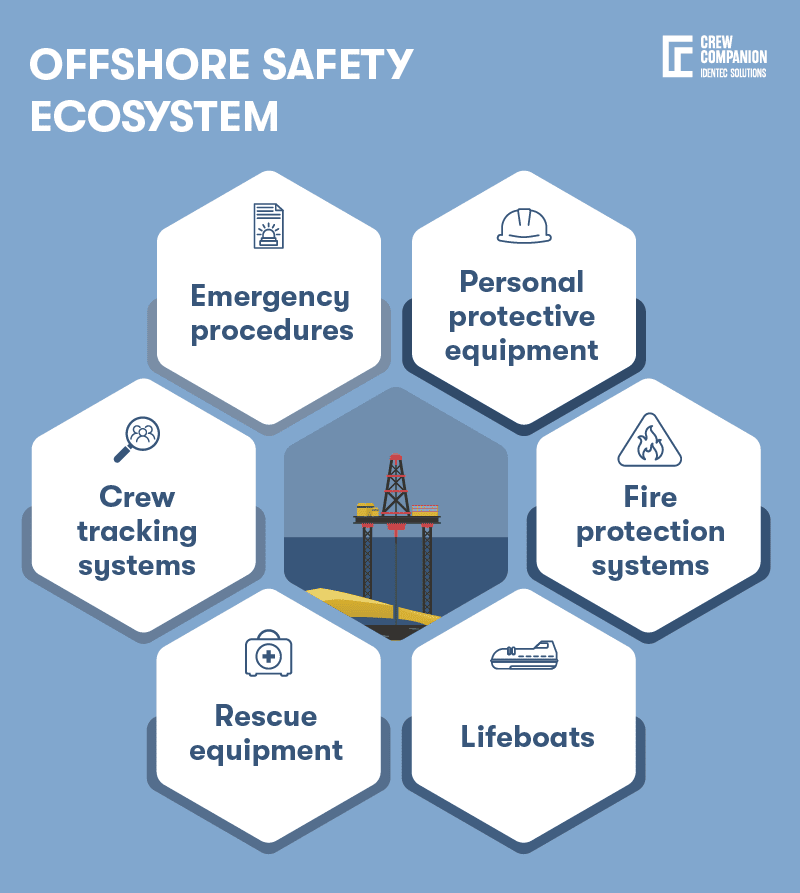
How Do Safety Procedures and Digital Safety Assistance Solutions Protect Offshore Personnel?
Safety procedures are the operational backbone of offshore HSE. While safety equipment offshore provides physical protection and technical safeguards, procedures define how people act before, during, and after abnormal situations. In offshore oil and gas and offshore wind operations, these procedures are designed to manage predictable risks, coordinate human behaviour, and enable rapid, structured response when incidents occur. Increasingly, digital safety assistance solutions are being introduced to support these procedures, improving reliability in environments where time, visibility, and communication are critical.
Core offshore safety procedures begin long before an emergency occurs. Permit-to-work systems regulate hazardous activities such as hot work, confined space entry, electrical isolation, and lifting operations. Toolbox talks and shift handovers ensure that risks are understood and controlled at the task level. Access control and induction procedures define who is allowed on board and under which conditions. These processes rely on accurate personnel information and disciplined execution, as even minor deviations can create cascading risks offshore.
When an incident occurs, emergency response procedures take precedence. Alarm management, emergency shutdowns, and predefined response plans are designed to stabilise the situation and protect personnel. Central to these plans is the concept of personnel on board, commonly referred to as POB. POB represents the total number of people present on a platform or vessel at any given time, including crew, technicians, and visitors. In an offshore emergency, knowing exactly who is on board is not optional—it determines evacuation strategy, search-and-rescue priorities, and ultimately survival outcomes.
Mustering is the procedure that translates POB information into physical accountability. When an alarm is triggered, personnel are required to move to designated muster stations, where their presence is checked against the expected POB. This process allows emergency commanders to identify missing persons, confirm evacuation status, and direct rescue efforts. In traditional setups, mustering is often performed manually using printed lists or verbal confirmation, which can be slow and error-prone under stress. Smoke, darkness, noise, and time pressure can compromise even well-trained teams.
This is where digital safety assistance solutions become critical extensions of established procedures. Electronic POB systems replace or augment manual tracking by continuously updating who is on board through access control, check-in systems, or wearable technologies. Instead of relying on periodic headcounts, operators have real-time visibility of personnel movements across platforms and vessels. During normal operations, this improves planning and compliance; during emergencies, it provides an immediate, accurate POB status that supports faster decision-making.
Electronic mustering builds on this foundation by digitally confirming personnel presence at muster points. Using badges, RFID, or other identification technologies, eMustering systems automatically register when individuals reach a safe area. Command centres receive instant updates, allowing them to see who has mustered, who is missing, and where each individual was last detected. This dramatically reduces uncertainty at the most critical moment of an incident. In complex offshore environments, eMustering can also account for multiple muster locations, lifeboats, or temporary safe refuges, adapting to the evolving situation.
Beyond emergency response, safety assistance solutions also support drills, audits, and continuous improvement. Digital records of mustering times, evacuation sequences, and personnel movements provide objective data for analysing performance and identifying procedural weaknesses. This feedback loop strengthens offshore HSE management by moving it from assumption-based planning to evidence-based optimisation. In both oil and gas and offshore wind, where regulatory scrutiny is high, this transparency is increasingly valued.
Importantly, ePOB and eMustering do not replace human judgment or established safety procedures. They are designed to support them, reducing cognitive load and administrative effort when conditions are most demanding. Safety equipment, procedures, and digital assistance must function as an integrated system. Alarms still need to be heard, escape routes still need to be followed, and leaders still need to make decisions—but they do so with better information and fewer blind spots.
In offshore energy, emergencies allow little time for correction. By reinforcing fundamental procedures such as POB management and mustering with digital safety assistance solutions, operators increase their ability to protect personnel in scenarios where clarity and speed can mean the difference between control and catastrophe.
FAQ: Safety Assistance Solutions Offshore
What are safety assistance solutions in offshore operations?
Safety assistance solutions are digital and organisational systems that support offshore safety procedures by improving visibility, coordination, and decision-making. They complement safety equipment offshore by providing real-time information on personnel presence, location, and status, especially during emergencies. Typical solutions include electronic personnel-on-board systems, electronic mustering, access control, and integrated communication platforms.
How do ePOB and eMustering improve emergency response offshore?
ePOB and eMustering systems provide real-time accountability of all personnel on platforms and vessels. Instead of relying on manual headcounts, operators can instantly see who is on board, who has reached muster points, and who may be missing. This speeds up evacuation decisions, prioritises rescue efforts, and reduces uncertainty during high-stress emergency situations.
Are safety assistance solutions relevant for offshore wind as well as oil and gas?
Yes. While risk profiles differ, offshore wind installations face similar challenges related to remote locations, vessel transfers, and emergency evacuation. Safety assistance solutions help manage rotating crews, contractors, and technicians, ensuring accurate POB tracking and effective mustering. As offshore wind farms move farther from shore, these digital tools are becoming as critical as traditional safety equipment offshore.
Takeaway
Offshore safety is built on the interaction of people, procedures, and safety equipment offshore, not on isolated measures. While PPE and structural safeguards reduce everyday risks, true resilience is proven during emergencies. In these moments, clear procedures and reliable information are decisive. Emergency mustering, supported by accurate POB data and digital eMustering solutions, transforms accountability from a manual task into a real-time capability, enabling faster decisions, targeted rescue efforts, and greater confidence when conditions are at their most critical.
Delve deeper into one of our core topics: Emergency Response Management
Glossary
A hazard is any source, situation, or act with the potential to cause harm to people, damage to property, or adverse effects on the environment. In occupational health and safety, a hazard does not describe the outcome itself, but the inherent potential for injury or loss. Offshore hazards can arise from equipment, processes, environmental conditions, or human factors, and require systematic identification before risks can be assessed and controlled. (4)
References:
(1) https://www.hse.gov.uk/offshore/safetycases.htm
(2) https://www.sciencedirect.com/science/article/pii/S1364032123007864
(3) https://www.nationalacademies.org/read/18327/chapter/4
(4) ISO 45001:2018 – Occupational health and safety management systems – Requirements with guidance for use
Note: This article was partly created with the assistance of artificial intelligence to support drafting. The head image was generated by AI.