| Written by Mark Buzinkay
Table of contents:
- Venezuela Oil & Gas Resources: Onshore and Offshore Hydrocarbon Wealth
- The Rise of Venezuela Oil & Gas: From Early Discoveries to State Control
- Why Is Venezuela's oil and gas in Its Current State?
- Can Venezuela Oil & Gas Overcome Its Structural and Global Challenges?
- FAQ
- Takeaway
- Glossary
Venezuela Oil & Gas Resources: Onshore and Offshore Hydrocarbon Wealth
Venezuela possesses some of the most extensive oil and gas resources in the world. Hydrocarbons are the backbone of its natural resource endowment and shape its economic geography. The country’s energy wealth is spread across vast onshore basins and significant offshore areas in the Caribbean Sea and Atlantic margin. Oil dominates in scale and strategic importance, while natural gas is increasingly viewed as an underutilized complement.
The most prominent oil resource is located in eastern Venezuela, in the Orinoco Belt, also known as the Orinoco Oil Belt. Stretching along the northern edge of the Orinoco River, this immense onshore region contains extra-heavy crude oil deposits that, by volume, represent the largest accumulation of petroleum resources globally. Estimates by Venezuelan authorities and international organizations place recoverable resources in the hundreds of billions of barrels, although the technical and economic recoverability depends heavily on upgrading capacity, dilution, and sustained investment. The crude found here is dense and viscous, requiring specialized extraction and processing techniques, which have shaped the infrastructure and cost structure of Venezuela’s oil industry for decades.
In western Venezuela, the Lake Maracaibo Basin stands as the historical heart of the country’s conventional oil production. The early twentieth century marked the first oil discoveries here. For decades, the shallow waters of Lake Maracaibo and the adjacent onshore fields ranked among the most productive globally. While many of these fields are now mature and in decline, they still hold significant remaining reserves and play an important part in the national resource base. Associated natural gas, which is natural gas found along with oil deposits, is also present. Historically, much of this gas has been flared or underutilized due to limited gas infrastructure.
Beyond these two flagship regions, Venezuela hosts additional onshore oil and gas resources in basins such as the Barinas-Apure and Eastern Venezuela, where a mix of conventional crude oil, condensates, and non-associated gas is found. These areas are less well developed but underscore the country’s geological diversity and long-term potential, provided exploration activity can be revived.
Offshore, Venezuela’s natural gas resources stand out. Significant gas fields lie off the northeastern coast, including areas near the Paria Peninsula and the maritime border with Trinidad and Tobago. Projects such as Mariscal Sucre highlight the scale of offshore gas potential. Reserves here could support domestic power generation, petrochemicals, and exports of liquefied natural gas. Offshore oil potential also exists in the Gulf of Venezuela and the eastern Caribbean margin. However, it remains comparatively underexplored, constrained by political, legal, and financial factors.
Taken together, Venezuela’s onshore and offshore oil and gas resources form one of the largest hydrocarbon endowments on the planet. This sheer scale has underpinned the country’s historical role as a major energy producer and exporter. At the same time, it shapes the technical, environmental, and economic challenges that define Venezuela’s oil and gas sector today.
The Rise of Venezuela Oil & Gas: From Early Discoveries to State Control
The history of the Venezuelan oil industry is closely tied to the country’s political development, economic structure, and relationship with the global energy system. In the early twentieth century, Venezuela was a marginal agricultural exporter. Within a few decades, it became one of the world’s leading oil-producing nations. Petroleum revenues reshaped the state, society, and its position on the international stage.
Commercial oil production in Venezuela began in the 1910s, following early discoveries in the western part of the country near Lake Maracaibo. The 1914 Zumaque I well is often cited as the symbolic starting point of the industry, but it was the massive 1922 blowout at the Barroso II well that drew global attention to Venezuela’s petroleum potential. During this period, foreign oil companies, primarily from the United States, the United Kingdom, and the Netherlands, played a dominant role. They brought capital, technology, and expertise, while the Venezuelan state focused on collecting royalties and taxes. By the late 1920s, Venezuela had become one of the world’s largest oil exporters, supplying rapidly industrializing economies abroad.
Throughout the mid-twentieth century, oil production expanded rapidly, particularly in the Lake Maracaibo Basin and later in eastern Venezuela. The country benefited from relatively low production costs and proximity to major markets in North America and Europe. Oil revenues enabled large-scale public spending, urbanization, and infrastructure development, but also fostered a high degree of economic dependence on a single commodity. This dependence became a defining feature of Venezuela’s political economy and influenced debates over sovereignty and control of resources.
A major turning point came in the 1960s and 1970s, when Venezuela emerged as a key advocate of producer cooperation and resource nationalism. In 1960, it became a founding member of the Organization of the Petroleum Exporting Countries (OPEC), seeking to assert greater influence over pricing and production policies. Rising oil prices in the early 1970s strengthened the government’s resolve to take direct control of the industry. In 1976, Venezuela formally nationalized its oil sector, creating Petróleos de Venezuela S.A. (PDVSA) as the state-owned oil company. Nationalization was widely supported domestically and initially seen as a success, as PDVSA developed into a technically capable and internationally active company with operations across the value chain.
During the 1980s and 1990s, however, declining oil prices, mounting public debt, and economic stagnation exposed structural weaknesses. To attract foreign investment and boost production, Venezuela introduced a partial opening of the oil sector known as the “Apertura Petrolera.” International companies were allowed to participate in joint ventures, particularly in the development of the Orinoco Belt’s heavy oil resources. This period saw technological advances and increased output, but it also reignited political controversy over foreign involvement and revenue sharing.
The election of Hugo Chávez in 1998 marked another decisive shift. His government reasserted state control over PDVSA, increased taxes and royalties, and redirected oil revenues toward social programs. Tensions between the government and PDVSA’s management culminated in a nationwide strike in 2002–2003, after which thousands of skilled employees were dismissed. While high oil prices in the mid-2000s masked underlying operational problems, investment levels fell, and production capacity gradually eroded.
Following Chávez’s death in 2013, a combination of falling oil prices, economic mismanagement, corruption, and international sanctions accelerated the decline of Venezuela’s oil industry. Production dropped sharply, infrastructure deteriorated, and exports contracted. What had once been one of the world’s most dynamic oil sectors entered a prolonged crisis, setting the stage for the profound challenges that characterize the industry today.

Why Is Venezuela's oil and gas in Its Current State?
The current state of Venezuela’s oil industry reflects the cumulative impact of long-term underinvestment, institutional decline, economic crisis, and geopolitical isolation. Once a cornerstone of global oil markets, the sector today operates far below its historical capacity, struggling to maintain production, infrastructure, and access to international markets despite the country’s vast remaining resource base.
Crude oil production has fallen dramatically from its peak of more than three million barrels per day in the late 1990s to a fraction of that level. While output has shown periods of modest recovery, particularly through operational adjustments and cooperation with a limited number of foreign partners, overall production remains constrained by technical, financial, and human capital limitations. Many fields suffer from equipment shortages, unreliable power supply, and a lack of routine maintenance. In mature regions such as Lake Maracaibo, aging infrastructure and declining reservoir pressure have further reduced output, while spills and leaks have become more frequent.
The Orinoco Belt, which holds the largest share of Venezuela’s oil resources, illustrates both the industry’s potential and its difficulties. Producing extra-heavy crude requires continuous investment in upgrading facilities, blending agents, and transport infrastructure. Sanctions, financing restrictions, and the loss of technical expertise have severely disrupted these operations. As a result, many projects operate intermittently or below design capacity, and the quality and consistency of exports vary significantly.
Petróleos de Venezuela S.A. remains the dominant actor in the sector, but its role has changed markedly. PDVSA faces acute financial stress, a heavily reduced workforce, and limited access to international capital and technology. Years of politicization and the departure of experienced engineers and managers have weakened its operational capabilities. At the same time, the company carries significant debt and obligations, leaving little room for reinvestment in core upstream and downstream assets.
Refining and domestic fuel supply represent another major challenge. Venezuela possesses one of the largest refining systems in Latin America, yet much of it operates sporadically or is offline due to disrepair and lack of spare parts. As a result, fuel shortages have become common, forcing the country to rely on imported refined products or emergency supply arrangements, despite its status as a major oil producer. This paradox underscores the depth of the sector’s structural problems.
On the export side, Venezuela continues to sell crude oil primarily to a limited group of buyers, often under complex arrangements involving intermediaries, discounts, or debt repayment mechanisms. Traditional markets have shrunk, and logistical constraints, including tanker availability and insurance, complicate shipments. Natural gas, despite substantial reserves, remains largely underdeveloped, with domestic production focused mainly on reinjection and limited local consumption rather than large-scale commercial use.
Overall, the Venezuelan oil industry today is characterized by low efficiency, high operational risk, and constrained strategic options. While the country still possesses immense hydrocarbon wealth, translating that potential into stable production and revenue remains difficult under current conditions. The gap between geological abundance and industrial performance defines the present reality of Venezuela’s oil sector and frames the debate over its possible recovery.
In contrary, read: Brasil Offshore: FPSO Leadership and Deepwater Energy Growth
Can Venezuela Oil & Gas Overcome Its Structural and Global Challenges?
The future challenges facing Venezuela’s oil industry are profound and multidimensional, extending far beyond the technical task of increasing production. While the country retains one of the largest hydrocarbon endowments in the world, converting this geological wealth into sustainable economic value will require structural changes in governance, investment frameworks, and international relations.
A central challenge is the condition of physical infrastructure. Years of inadequate maintenance have left wells, pipelines, storage facilities, and refineries in a state of advanced deterioration. Restoring even a portion of lost capacity will require substantial capital investment over many years, along with access to equipment and spare parts that are not readily available under current constraints. Environmental damage, particularly in regions such as Lake Maracaibo, also poses a growing liability, raising cleanup costs and increasing public and international scrutiny (see also: Emergency response technologies).
Institutional capacity represents an equally serious obstacle. Petróleos de Venezuela S.A. faces the task of rebuilding technical expertise after a prolonged exodus of skilled personnel. Attracting and retaining qualified engineers, geologists, and managers will depend on broader economic stabilization and credible reforms. Without a professionalized operating environment and clearer separation between political objectives and commercial decision-making, efficiency gains are likely to remain limited.
International sanctions and geopolitical isolation further complicate the outlook. Restrictions on financing, technology transfer, and market access have sharply reduced Venezuela’s ability to modernize its oil sector and diversify its customer base. Any significant recovery will be closely linked to shifts in diplomatic relations and the terms under which foreign companies are allowed to participate. Even in a more favorable external environment, investors are likely to demand legal certainty, contract stability, and transparent regulatory frameworks as preconditions for long-term commitments.
Market dynamics also present a strategic challenge. Global energy systems are undergoing a gradual transition toward lower-carbon sources, with increasing emphasis on efficiency, renewables, and emissions reduction. Venezuela’s oil resources are dominated by heavy and extra-heavy crudes, which are more carbon-intensive and costly to produce than lighter alternatives. This raises questions about long-term competitiveness, particularly if global climate policies tighten and financing for carbon-intensive projects becomes more restricted.
Finally, Venezuela must confront the broader issue of economic dependence on oil. Decades of reliance on petroleum revenues have left other productive sectors underdeveloped, amplifying the social and political impact of oil market volatility. The future challenge is not only to revive oil production but to redefine its role within a more diversified economic model. Whether Venezuela can use its oil industry as a platform for stabilization and gradual transition, rather than a source of recurring crisis, will shape the country’s trajectory for decades to come.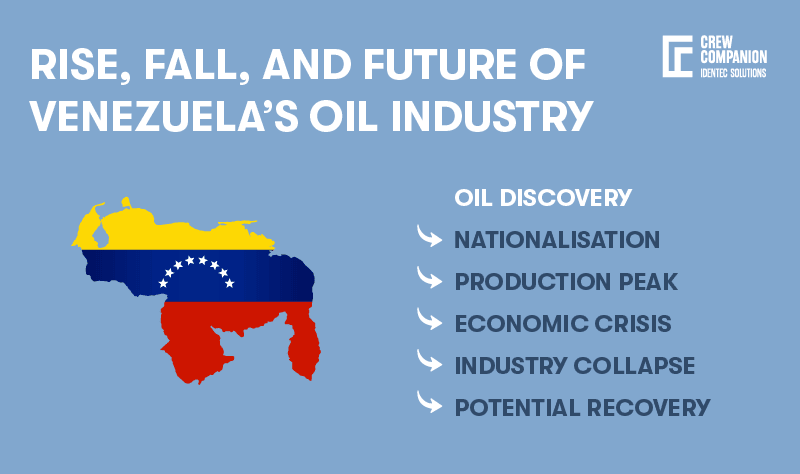
FAQ: Venezuela Oil & Gas
What does the term Venezuela Oil & Gas refer to?
Venezuela Oil & Gas refers to the country’s hydrocarbon sector, encompassing crude oil and natural gas resources, production, refining, and exports. It includes vast onshore reserves such as the Orinoco Belt, offshore gas fields in the Caribbean, and the institutional framework dominated by the state-owned energy sector.
Why is Venezuela Oil & Gas so important globally?
Venezuela Oil & Gas is significant because the country holds some of the world’s largest proven oil resources. Historically, Venezuela has played a key role in global energy markets, particularly as a supplier to the Americas, and its production levels can still influence regional trade and geopolitics.
What are the main challenges facing Venezuela Oil & Gas today?
The main challenges include deteriorated infrastructure, limited investment, loss of technical expertise, international sanctions, and changing global energy markets. Together, these factors have constrained production and exports despite the country’s vast remaining oil and gas resources.
Takeaway
Venezuela Oil & Gas remains defined by vast resources and persistent structural constraints that shape production, exports, and recovery prospects. Geological abundance alone will not determine outcomes; governance, investment, and operational discipline matter as much as reserves. Looking ahead, oil rig safety must become a central priority. Aging onshore and offshore facilities increase the risks of accidents, spills, and shutdowns. Robust maintenance regimes, modern monitoring systems, and clear emergency procedures are essential. Rebuilding skills through training, enforcing safety standards, and separating safety decisions from political pressure can reduce incidents. Improved safety protects workers, communities, the environment, and operational continuity across Venezuela today.
Delve deeper into one of our core topics: Personnel on board
Glossary
A pipeline is a closed, pressurized conduit system used to transport fluids—such as crude oil, natural gas, refined products, water, or slurry—over short or long distances. It typically consists of steel or polymer pipe, valves, pumps or compressors, metering stations, and control/monitoring (SCADA) to manage flow, detect leaks, and maintain safe operating pressure. Pipelines can be onshore or subsea, buried or above ground, and are designed to meet specific codes and to minimize environmental risk. (4)
References:
(1) https://en.wikipedia.org/wiki/Orinoco_Belt
(2) https://energy-cg.com/OPEC/Venezuela/Venezuela_OilGas_Industry.html
(3) https://www.opec.org/venezuela.html
(4) Mohitpour, M., Golshan, H., & Murray, A. Pipeline Design & Construction: A Practical Approach. ASME Press.
Note: This article was partly created with the assistance of artificial intelligence to support drafting. The head image was created by AI.