| Written by Mark Buzinkay
Table of contents:
- Why Video Analytics Is Becoming Essential in Modern Mining
- Video Analytics Requires More Than Cameras
- From Visual Awareness to Operational Awareness
- Optimising Crew Management with Video Analytics and Localisation
- Enhancing Fleet Management and Underground Traffic Control
- Building the Future of Connected Mining Operations
- FAQ
- Takeaway
- Glossary
Why Video Analytics Is Becoming Essential in Modern Mining
Mining operations are becoming increasingly complex. Underground mines, in particular, face unique challenges related to limited visibility, confined spaces, vehicle traffic, worker safety, and operational efficiency. At the same time, mining companies face growing pressure to improve productivity while meeting stricter safety regulations and sustainability goals.
This environment has created a strong demand for technologies that can provide better visibility into daily operations. Among these technologies, video analytics has emerged as one of the most promising.
Traditional surveillance systems were primarily designed to record events for later review. Their usefulness was often limited to incident investigations and security monitoring. Modern video analytics systems, however, use artificial intelligence and machine learning to analyse video streams in real time. Instead of simply recording footage, they continuously evaluate what is happening within the camera’s field of view.
Video analytics can identify a wide range of operational and safety-related events, including:
- Personnel entering restricted areas
- Missing personal protective equipment (PPE)
- Unsafe interactions between workers and machinery
- Traffic congestion
- Vehicle speeding
- Unauthorized access
- Abnormal equipment behaviour
- Smoke, fire, or environmental anomalies
As a result, operators receive alerts immediately rather than discovering problems only after an incident occurs. The benefits extend beyond safety. Mining companies can also use video analytics to improve compliance, reduce downtime, optimise workflows, and gain a better understanding of how people and equipment move throughout the operation. For example, a camera positioned near a loading area may reveal recurring bottlenecks that reduce productivity. A camera at an underground intersection may detect dangerous vehicle interactions before they lead to accidents. A video analytics platform can continuously monitor hundreds of such locations simultaneously, providing insights that would be impossible to obtain through manual observation alone. (1)
Yet despite these advantages, video analytics alone cannot answer every operational question. Cameras can show what happened. They cannot always identify who was involved, where a worker came from, or whether a vehicle was authorised to enter a specific zone. This is where real-time localisation becomes essential.

Video Analytics Requires More Than Cameras
A common misconception is that installing cameras automatically improves safety. In reality, successful video analytics deployments depend on well-defined processes, proper maintenance, and clear operational objectives.
Many mining operations invest heavily in camera infrastructure but fail to achieve the expected results because they overlook the importance of operational workflows. The first challenge is environmental. Underground mines are harsh environments. Dust, vibration, humidity, and changing lighting conditions can affect camera performance. Cameras must be positioned strategically and maintained regularly to ensure reliable image quality.
The second challenge involves alert management. Modern video analytics systems can generate large volumes of notifications. Without clear procedures, operators may experience alarm fatigue and begin ignoring alerts.Successful implementations therefore require:
- Defined safety objectives
- Clear ownership of alerts
- Maintenance schedules
- Camera performance monitoring
- Regular system reviews
- Staff training
Another critical consideration is process integration. Rather than asking where cameras should be installed, mining companies should first identify which operational processes they want to improve. Examples include:
- Worker safety
- Traffic management
- Emergency response
- Asset utilization
- Maintenance coordination
- Shift management
Only after defining these objectives should the organisation determine how video analytics can support them. The most successful projects treat video analytics not as a standalone technology but as part of a larger operational intelligence strategy.
Learn more about operations and mining safety training
From Visual Awareness to Operational Awareness
The real transformation occurs when video analytics is combined with real-time localisation technologies. Localisation systems use technologies such as RFID, Bluetooth Low Energy (BLE), Ultra-Wideband (UWB), Wi-Fi positioning, and GPS to determine the location of personnel, vehicles, and equipment throughout a mining operation.
While video analytics provides visual information, localisation provides context. Together, they answer critical operational questions:
- Who is involved?
- Where are they located?
- How long have they been there?
- Which equipment is nearby?
- Is access authorised?
- What risks exist in the surrounding area?
This combination creates a far more comprehensive picture of operations. (2) Consider a worker entering a restricted blasting zone. A camera may detect a person's presence and generate an alert. However, the system may not know who that individual is or whether they have authorisation to be there. A localisation platform can immediately identify the worker, verify qualifications, confirm work assignments, and determine whether the entry is permitted.
Similarly, imagine a haul truck approaching an underground intersection. Video analytics can identify the approaching vehicle and detect potential hazards. Localisation data can simultaneously determine the location of nearby workers, other vehicles, and mobile equipment. Instead of reacting to a near miss, the mine can prevent it. This integration becomes particularly valuable during emergencies.If an incident occurs underground, operators need immediate visibility into personnel locations. Localisation systems can identify everyone in the affected area, while video analytics provides visual confirmation of on-site conditions.
Emergency responders gain access to information such as:
- Number of workers involved
- Last known locations
- Available evacuation routes
- Nearby equipment
- Potential hazards
The result is faster, more informed decision-making in critical situations.
Optimising Crew Management with Video Analytics and Localisation
Crew management remains one of the most challenging aspects of mining operations.Supervisors must coordinate workers across large and often remote environments while maintaining safety, productivity, and compliance.
Traditional methods frequently rely on manual reporting, radio communication, and periodic headcounts. These approaches provide only limited visibility into actual workforce movements. Combining video analytics with localisation data changes this dramatically. Supervisors gain real-time awareness of:
- Worker locations
- Zone occupancy
- Shift attendance
- Work progress
- Lone worker situations
- Emergency status
This information enables more effective workforce planning and resource allocation. For example, localisation data may reveal that maintenance crews spend significant portions of their shifts walking between work areas. Video analytics can then help identify the causes, such as congestion, waiting times, or inefficient routing. The result is a more accurate understanding of operational inefficiencies.
Another important application involves contractor management. Mining sites often host contractors, visitors, and temporary personnel. Video analytics can monitor site access and movement patterns, while localisation systems verify identities and permissions. This helps ensure that only authorised personnel enter sensitive areas. Crew scheduling can also benefit significantly. By analysing historical movement patterns and operational activities, mines can identify:
- Peak workforce demand
- Staffing shortages
- Shift overlap requirements
- Inefficient deployment strategies
The outcome is improved productivity without compromising safety.
Enhancing Fleet Management and Underground Traffic Control
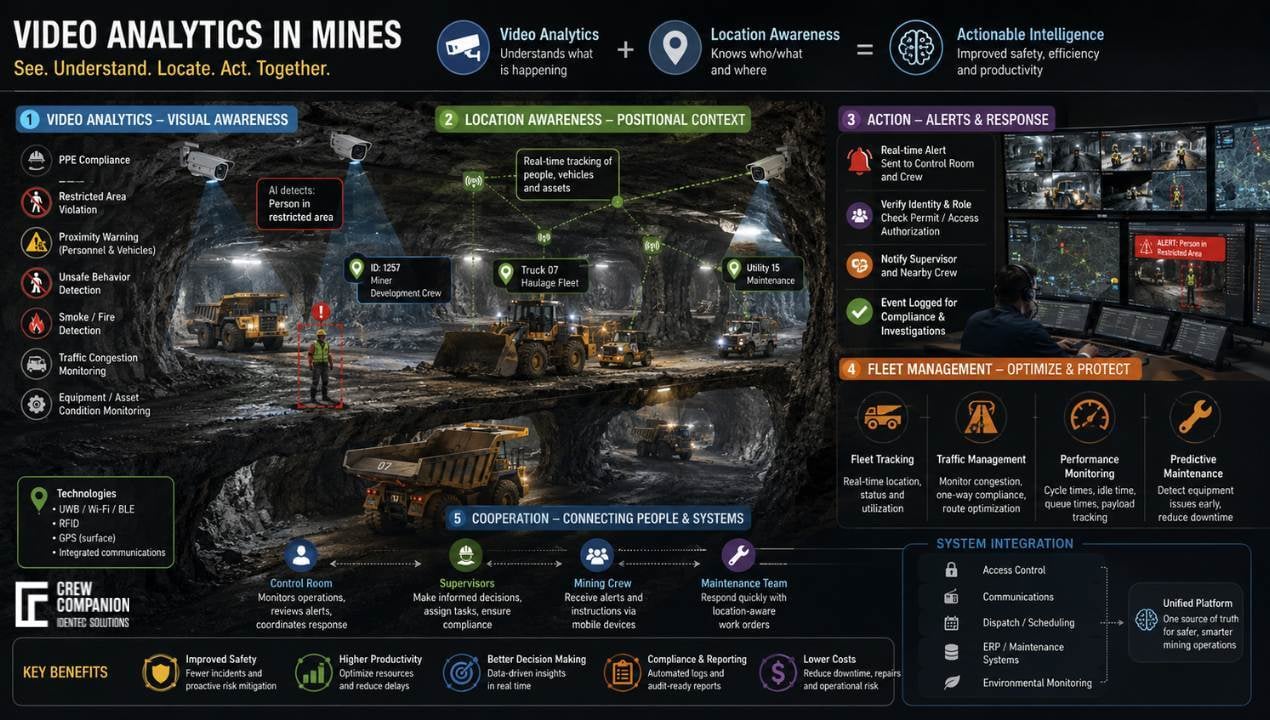
Fleet management is another area where video analytics and localisation data deliver significant value. Underground mines frequently operate dozens or even hundreds of vehicles simultaneously. Haul trucks, loaders, service vehicles, personnel carriers, and maintenance equipment often share limited roadways and intersections. Managing this traffic safely is a major challenge. Video analytics can continuously monitor vehicle behaviour and identify:
- Speed violations
- Unsafe driving practices
- Queue formation
- Congestion points
- Unauthorized vehicle access
- Near-miss incidents
Meanwhile, localisation systems provide precise information about vehicle positions, routes, utilisation, and travel times. When combined, these technologies create a powerful traffic management solution. For example, an underground intersection may experience recurring congestion during shift changes. Video analytics identifies the congestion visually. Localisation data quantifies vehicle density, waiting times, and route patterns. Management can then redesign traffic flows based on objective data rather than assumptions. The same approach supports loading and hauling operations.Video analytics can measure:
- Queue lengths
- Loading durations
- Unloading times
- Vehicle interactions
Localisation systems add information regarding:
- Travel routes
- Cycle times
- Idle time
- Equipment utilization
Together, these insights help maximise productivity while reducing safety risks. Fleet management also benefits from predictive maintenance capabilities. Video analytics may detect unusual equipment behaviour such as abnormal movement patterns or visible signs of wear. Localisation data adds information about operating hours, utilisation rates, and equipment exposure to specific environmental conditions. Maintenance teams can therefore prioritise interventions before failures occur. (3)
Building the Future of Connected Mining Operations
Mining is moving toward a future where operational decisions are increasingly driven by data. Video analytics represents a critical component of this transformation, but its greatest value emerges when it becomes part of a broader ecosystem. Real-time localisation, workforce management, fleet management, access control, environmental monitoring, and operational scheduling all contribute valuable information.
When these systems operate independently, organisations often struggle to obtain a complete picture of mine operations. Integration changes this. Instead of viewing separate dashboards for cameras, personnel tracking, and vehicle monitoring, operators gain a unified operational view. Future developments are likely to include:
- AI-driven risk prediction
- Dynamic geofencing
- Automated dispatching
- Digital twins
- Autonomous vehicle coordination
- Predictive safety management
These capabilities will allow mines to move beyond incident response and toward continuous optimisation. The ultimate goal is not simply collecting more data. It provides the right information to the right people at the right time, enabling safer, more effective decisions.
FAQ
What is video analytics in mining?
Video analytics uses artificial intelligence to analyse live video streams and automatically detect events, behaviours, or conditions that may affect safety, security, or operational performance. Unlike traditional CCTV systems, video analytics actively interprets footage and generates actionable alerts.
How does localisation data improve video analytics?
Localisation data provides context by identifying the location of workers, vehicles, and equipment in real time. When combined with video analytics, operators gain a more complete understanding of who is involved in an event, where it occurs, and how to respond effectively.
Can video analytics reduce the risks of underground traffic?
Yes. Video analytics can detect speeding, congestion, unsafe driving behaviour, and near misses. Combined with real-time localisation data, mines can monitor vehicle movements more accurately, optimise traffic flows, and improve overall underground transportation safety.
Takeaway
Video analytics is evolving from a surveillance tool into a core operational technology that supports safety, productivity, and decision-making throughout mining operations. Its true potential emerges when visual intelligence is combined with real-time localisation data, creating a comprehensive understanding of people, assets, and activities. In underground mines, this integrated approach significantly improves worker safety, emergency preparedness, and traffic management by reducing collision risks, improving fleet coordination, and providing real-time visibility into vehicle and personnel movements (see: miners safety).
Delve deeper into one of our core topics: Mining safety
Glossary
Visual awareness refers to the ability to perceive, interpret, and understand activities, objects, people, and conditions within an operational environment through visual information. In mining, visual awareness is created through cameras, video analytics, and monitoring systems that provide real-time visibility into workforce movements, equipment activity, traffic conditions, and potential hazards. It forms the foundation for situational awareness by helping operators recognise what is happening, understand its significance, and make informed decisions to improve safety, productivity, and operational efficiency. (4)
References:
(2) https://www.cdc.gov/niosh/mining/
(4) Endsley, M. R. (1995). A Taxonomy of Situation Awareness Errors. In R. Fuller, N. Johnston & N. McDonald (Eds.), Human Factors in Aviation Operations. Ashgate Publishing.
Note: This article was partly created with the assistance of artificial intelligence to support drafting. The head image and the illustration was created by AI.