| Written by Mark Buzinkay
Table of contents:
- The Energy Era of the North Sea
- The Rise of Offshore Wind Farms
- The Offshore Wind Industry in the North Sea
- FAQ
- Takeaway
- Glossary
The Energy Era of the North Sea
The commercial story of energy in the North Sea began in the mid-19th century. In 1851, Scottish chemist James Young succeeded in extracting oil from torbanite mined in the Midland Valley, marking the first commercial oil production linked to the region. A few years later, in 1859, more than seventy oil fields were discovered onshore in Germany, including the Wietze field near Hanover, which alone produced around 13,400 barrels per day. These early successes laid the foundation for what would become one of the world’s most dynamic energy regions.
Gas discoveries followed in the early 20th century. In 1910, gas was found accidentally during water drilling near Hamburg, triggering further exploration in Germany’s Zechstein dolomites. The UK joined the search in the late 1930s, when British Petroleum discovered gas in the Eskdale anticline and oil at Eakring in Nottinghamshire. A second wave of British exploration between 1953 and 1961 led to the discovery of the Gainsborough field and several smaller accumulations across the East Midlands.
A decisive turning point came in 1964 with the UK Continental Shelf Act, which enabled systematic offshore exploration. Early wells were unsuccessful, but in September 1965, BP struck gas at the West Sole Field. The achievement was overshadowed by tragedy when the Sea Gem drilling platform capsized, killing 13 workers. Despite this setback, offshore gas discoveries accelerated. By 1966, major fields such as Leman Bank, Hewett, and Indefatigable had been identified. However, strict export bans and low gas prices temporarily dampened industry interest.
Everything changed at the end of 1969, when Phillips Petroleum discovered oil at Ekofisk in Norwegian waters. This breakthrough transformed the North Sea into a global oil province. Major discoveries followed rapidly, including the Montrose and Forties oil fields near the UK and the giant Brent field east of the Shetland Islands. The Frigg gas field, straddling Norwegian and British waters, further underlined the region’s significance.
The 1973 oil crisis and subsequent price increases cemented the North Sea’s strategic importance. Production began in earnest during the mid-1970s, with fields such as Argyll (later Ardmore), Forties, and Beatrice coming online. Over the following decades, the North Sea evolved into one of the world’s most active offshore drilling regions. By the early 2020s, hundreds of platforms were operating, and in 2023, Equinor announced that the Johan Sverdrup field had reached its plateau production of 755,000 barrels per day.
At the same time, global priorities began to shift. In 2015, 196 countries adopted the Paris Agreement, committing to limit global warming to well below 2°C and preferably to 1.5°C. Achieving this goal requires a dramatic reduction in greenhouse gas emissions. By the end of 2023, most North Sea countries had yet to fully align their oil and gas policies with these climate commitments, though momentum toward change has been building.
The North Sea is now entering a new energy chapter. Decades of offshore experience, infrastructure, and investment are being redirected toward renewable technologies. Offshore wind farms are increasingly viewed as multi-purpose energy hubs capable of producing large volumes of green hydrogen using desalinated seawater. In 2023, energy companies RWE and Equinor announced a joint hydrogen initiative linking Norwegian production with German demand via pipeline infrastructure.
Beyond wind, other marine energy sources are being tested. Offshore solar pilot projects in Dutch waters have proven resilient in extreme conditions, while wave and tidal energy technologies are advancing along the Scottish coast. Together, these complementary energy sources promise a more balanced and sustainable offshore energy system.
From oil and gas to wind, hydrogen, and marine renewables, the North Sea is once again redefining its role—this time as a cornerstone of Europe’s clean energy future.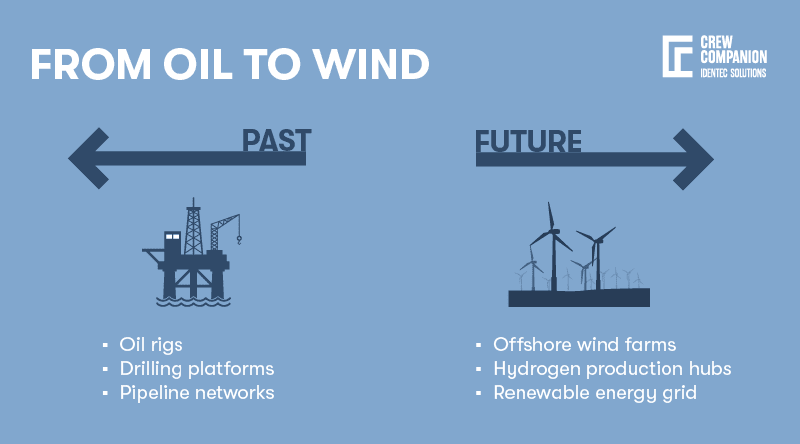
The Rise of Offshore Wind Farms
Since the mid-19th century, carbon dioxide emissions have raised the Earth’s average surface temperature by around 1.1°C. While this increase may appear modest, its consequences pose serious risks to ecosystems, economies, and human life worldwide. The Paris Agreement recognises this challenge and aims to limit global temperature rise to well below 2°C, preferably to 1.5°C. Central to achieving this goal is the decarbonisation of the energy sector, with renewable sources such as wind and solar power playing a decisive role.
Wind energy, both onshore and offshore, has become one of the most promising tools for reducing greenhouse gas emissions. By 2023, global installed wind capacity had reached approximately 837 GW, producing more than 2,000 TWh of electricity annually. If current expansion rates continue, wind power could supply over 30% of global electricity by 2050, potentially reducing projected global warming by up to 0.6°C by the end of the century.
Offshore wind farms are a growing pillar of this transition. Although they currently account for only about 7% of total wind capacity worldwide, their contribution is increasing rapidly. By 2030, offshore wind is expected to prevent up to five billion tonnes of CO₂ emissions. One prominent example is the Dogger Bank wind farm, located around 130 kilometres off the UK’s east coast. When completed, it will be the world’s largest offshore wind project, covering an area twice the size of New York City and delivering 3.6 GW of capacity—enough to power six million homes annually.
Recognising this potential, European Union member states have committed to deploying 111 GW of offshore renewable energy capacity by 2030. The United Kingdom, a global leader in offshore wind, aims to reach 50 GW by that date. These investments not only reduce dependence on fossil fuels but also strengthen energy security and industrial competitiveness.
Wind power is not a new concept. Along the North Sea coast, especially between Belgium and the Netherlands, historic windmills have harnessed wind energy for centuries. The move offshore, however, is driven primarily by efficiency. Offshore wind speeds are typically around 20% higher than onshore and far more consistent, with fewer obstacles causing turbulence. This results in higher energy yields and longer operating hours per year.
Visual impact and noise concerns also encourage offshore development. Onshore wind farms often face public opposition due to landscape changes and audible noise, which can limit turbine size and output. Offshore installations, located far from populated areas, significantly reduce these issues. As a result, turbines can operate closer to optimal speeds, improving overall performance.
The modern offshore wind era began in 1990, when Sweden commissioned the world’s first offshore wind turbine as a pilot project to study environmental, technical, and economic impacts. Shortly thereafter, Denmark launched the Vindeby Offshore Wind Farm in 1991. Despite scepticism at the time, Vindeby demonstrated that offshore wind could outperform onshore installations within just a few years.
Further progress followed with projects such as Tunø Knob in 1995, which introduced commercially built offshore turbines by Vestas. These early developments also advanced foundation technology, showing that steel structures offered greater strength with only modest cost increases, enabling deployment in deeper waters.
Today, offshore wind technology has advanced far beyond fixed foundations. In 2023, Equinor commissioned Hywind Tampen, the world’s largest floating offshore wind farm. Located 140 kilometres off the Norwegian coast, it supplies renewable power to offshore oil and gas installations, demonstrating how wind energy can decarbonise even energy-intensive industries.
Looking ahead, scale continues to grow. Ørsted’s planned Hornsea 3 project will become the world’s largest single offshore wind farm, with a capacity of 2.9 GW. Situated in the North Sea, it reflects the region’s unique advantages: shallow waters, extensive sandbanks, and stable wind conditions. Together, these factors have positioned the North Sea as a global hub for offshore wind and a cornerstone of the future renewable energy system (see also: Windfarm construction).

The Offshore Wind Industry in the North Sea
Wind energy accounted for approximately 19% of Europe’s total electricity production in 2023, underlining its growing importance within the continent’s energy mix. Offshore wind plays a particularly significant role in this transition. With around 34 GW of installed offshore wind capacity, the North Sea has become the backbone of Europe’s offshore wind industry and a major contributor to regional energy security.
Europe’s offshore wind infrastructure is already extensive. By 2022, 108 offshore wind parks were operating across European waters, including 41 large-scale projects exceeding 300 MW each. These major wind farms typically consist of 50 to 120 turbines and together account for roughly 4,000 offshore wind turbines. Growth is set to continue, with around 25 new offshore wind parks scheduled to come online between 2023 and 2025.
The North Sea is central to this expansion. Its shallow waters, stable seabed, and strong, consistent wind conditions make it one of the most favourable offshore wind locations worldwide. Based on current projections, cumulative offshore wind capacity is expected to reach 160 GW by 2030 and approximately 430 GW by 2050. Achieving these targets would firmly establish the North Sea as a cornerstone of Europe’s long-term decarbonisation strategy.
From an environmental perspective, offshore wind offers substantial benefits, particularly in reducing greenhouse gas emissions. A single 2 MW wind turbine can save up to 4,500 tonnes of CO₂ annually—roughly equivalent to removing 700 cars from the road. Multiplied across thousands of turbines already in operation, the climate impact is considerable. At the same time, offshore wind development is not without challenges. Studies have shown that certain species, such as red-throated loons, may experience significant population declines within close proximity to wind farms. In addition, vessel collisions with turbine structures pose a risk of oil spills, highlighting the need for careful planning, monitoring, and regulation.
Beyond energy production, the offshore wind sector has become a major driver of employment and economic growth. Large-scale investments have created jobs not only on wind farms and installation vessels, but also across shipbuilding, maintenance, logistics, and supply chains. According to Rystad Energy, offshore wind could support up to 350,000 jobs across Europe by 2030.
The United Kingdom illustrates this trend clearly. In 2023, the offshore wind industry supported more than 31,000 jobs, a 16% increase compared to the previous year. Of these, around 19,600 roles were directly linked to offshore wind activities. By 2030, employment is projected to rise sharply to approximately 97,000 jobs, with 61,000 direct and 36,000 indirect roles. Additional labour demand is also expected in related sectors such as hydrogen production and carbon capture.
Denmark currently hosts the largest offshore wind labour market in Europe, employing nearly 33,000 people—around 2% of the country’s private-sector workforce. Norway is also positioning itself strongly, with estimates suggesting that a mature offshore wind industry could create up to 50,000 jobs by 2050, generate annual value creation of 80 billion NOK, and support exports worth up to 100 billion NOK per year. In the Netherlands, investments of €15–20 billion between 2024 and 2030 are expected to create around 10,000 new jobs.
Service Operation Vessels (SOVs) represent a particularly important segment of the offshore wind workforce. While exact global figures are difficult to determine, estimates suggest that between 10,000 and 20,000 people were working on SOVs in the North Sea in 2023. As offshore wind farms grow larger and move further offshore, demand for specialised vessels and skilled crews is expected to rise. Projections indicate that around 100 SOVs could be operating in the North Sea by 2030.
Finally, offshore wind is reshaping the wider North Sea economy. As oil and gas production declines—currently by around 7% annually—new opportunities are emerging in renewable energy, hydrogen imports, and the decommissioning of ageing offshore infrastructure. By 2035, the total economic value of North Sea activities is expected to double, reaching €20–27 billion. In this evolving landscape, offshore wind stands out as a central pillar of economic renewal and sustainable growth.
FAQ: Wind Farm North Sea
What is meant by “Wind Farm North Sea”?
The term Wind Farm North Sea refers to the network of offshore wind farms located in the North Sea, primarily in the waters of the UK, Denmark, Germany, the Netherlands, and Norway. These wind farms use strong, consistent offshore winds to generate large-scale renewable electricity for millions of homes and industries across Europe.
Why is the North Sea so important for offshore wind energy?
The North Sea offers ideal conditions for offshore wind development, including shallow waters, stable seabed geology, and reliable wind resources. Its proximity to major industrial regions and existing offshore infrastructure also makes the Wind Farm North Sea a cost-effective and strategic choice for Europe’s energy transition.
How does a Wind Farm North Sea contribute to climate and economic goals?
Offshore wind farms in the North Sea significantly reduce CO₂ emissions by replacing fossil-fuel-based power generation. At the same time, they create thousands of skilled jobs in construction, wind farm operations, and maritime services, while supporting long-term economic growth and energy security across the region.
Takeaway
The North Sea’s evolution into a leading offshore wind region demonstrates how renewable energy can drive decarbonisation, economic growth, and energy security at scale. As wind farms move further offshore and increase in size, operational complexity rises accordingly. In this context, offshore HSE becomes critical, requiring robust safety standards, real-time monitoring, trained crews, and reliable vessel operations. Strong HSE practices are essential to protect personnel, marine environments, and assets while ensuring the long-term success and social acceptance of offshore wind developments.

Delve deeper into one of our core topics: Emergency Response Management
Glossary
MW (megawatt) is a unit of power equal to one million watts and describes the rate at which energy is produced or consumed at a given moment. In the energy sector, MW is commonly used to express the capacity of power plants, wind turbines, or grids. For example, a 10 MW wind farm can generate up to 10 MW of electrical power under optimal conditions.
References:
(1) M. Buzinkay & M. Wozniakowski-Zehenter (2025): The Journey. Life and Work on a SOV.
(2) International Energy Agency (IEA), Key World Energy Statistics, latest edition.
Note: This article was partly created with the assistance of artificial intelligence to support drafting. The head image was created with AI.