| Written by Constance Stickler
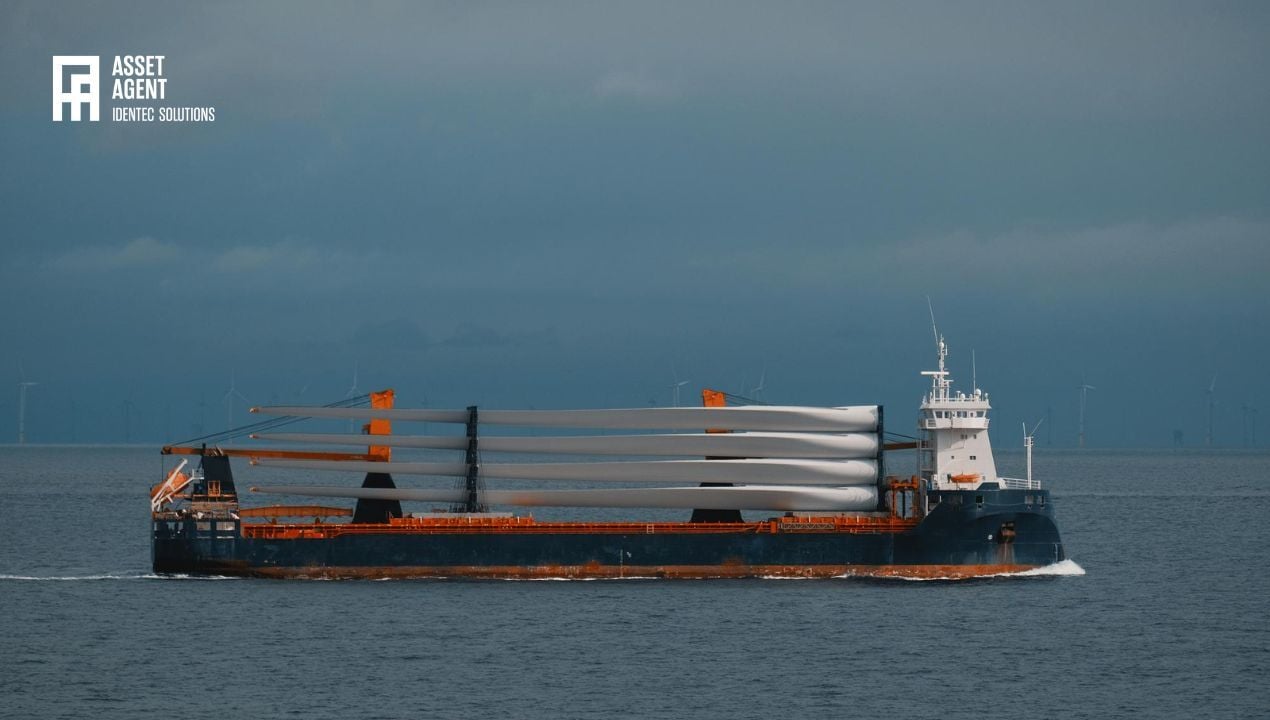
Table of contents:
- What Makes Breakbulk Shipping Different?
- What Are Breakbulk Carriers?
- From Cargo Arrival to Vessel: Preparing for the Operation
- How Is Breakbulk Cargo Identified Before Loading?
- How Is Breakbulk Cargo Loaded and Positioned on a Ship?
- How Is Breakbulk Cargo Secured for the Voyage?
- What Happens During Unloading?
- From Physical Cargo to Digital Record
- What Makes a Breakbulk Operation Successful?
- FAQ
- Takeaway
- Glossary
What Makes Breakbulk Shipping Different?
Breakbulk cargo is not standardised. There is no single shape, no standardised set of dimensions, and no universal identification system.
One item might weigh a few hundred kilograms, another several dozen tonnes. Some cargo is compact and easy to handle; other cargo is long, fragile, oversized, or awkwardly shaped. Each item has its own requirements.
Breakbulk carriers transport goods that don't fit into a container: machinery, steel products, pipes, timber, vehicles, industrial components, and project cargo, to name just a few. These vessels offer flexibility, but it requires customised procedures. The cargo itself dictates much of the process.
Instead of repeating the same movement hundreds or thousands of times, the teams at the terminal and on the ship must adapt their approach to each specific cargo. For example, loading a large machine might require very specific lifting points and even two cranes, while steel products may need special support to prevent shifting.
Even before arriving at the terminal, operators need to know what the item is, how much it weighs, how it can be lifted, where it should be placed on the ship, and how it will ultimately be unloaded. This information is almost as critical as the actual handling.

What Are Breakbulk Carriers?
The term encompasses various types of vessels. Some are multipurpose vessels designed for handling breakbulk cargo and project cargo, while heavy-lift vessels specialise in particularly large or heavy goods. Ro-ro vessels can also be part of the wider breakbulk cargo market, as wheeled cargo can be driven or rolled on and off the vessel rather than lifted.
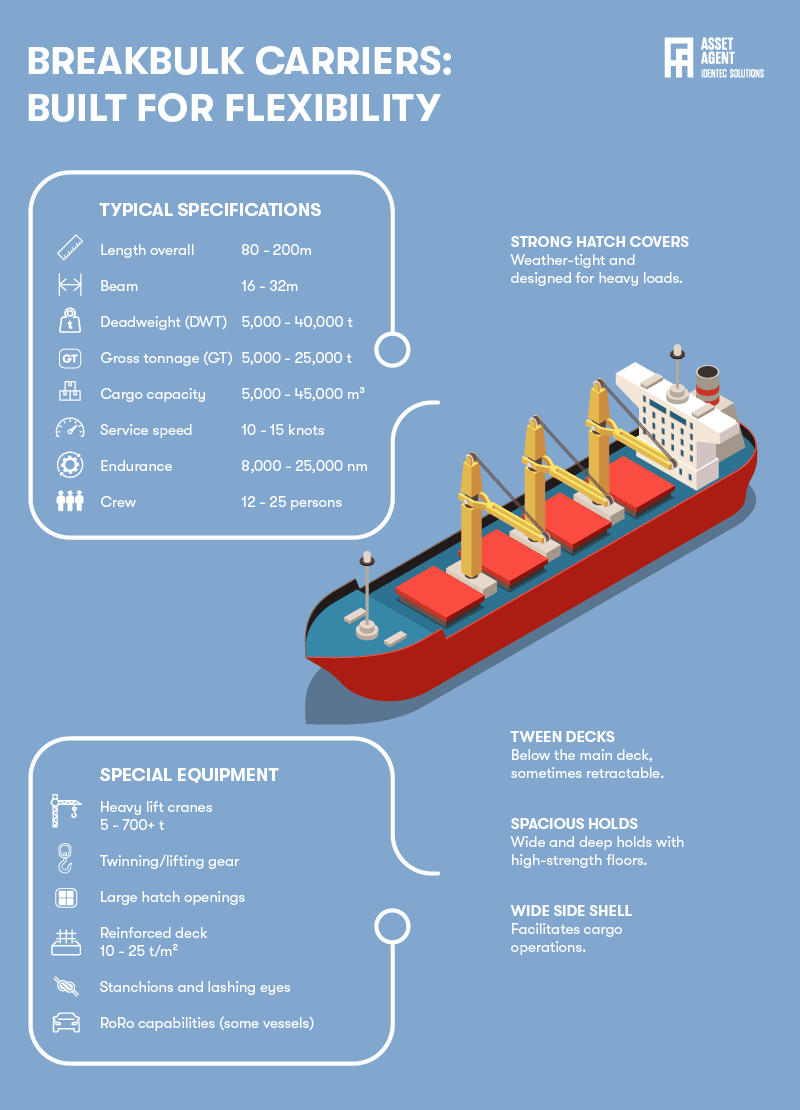
All these vessels share a common characteristic: flexibility. Their cargo holds, decks, hatches, and lifting equipment are designed to accommodate cargo that doesn't conform to standard container dimensions. Many vessels have their own cranes, enabling them to load and unload cargo even where land-based lifting equipment is limited or unavailable.
The size of breakbulk carriers, also known as multipurpose vessels (MPVs) or heavy-lift vessels, varies considerably, from smaller coastal vessels to large multipurpose and specialised heavy-lift ships. Their size is primarily measured in deadweight tonnes (DWT), which describes the total weight a vessel can safely carry.
From Cargo Arrival to Vessel: Preparing for the Operation
The most visible part of breakbulk cargo handling is the loading of the cargo by crane. However, much of the important work takes place beforehand.
The cargo can arrive at the terminal days, if not weeks, before it is loaded onto the ship. Some items are even assembled at the port, and not all components always arrive at the same time.
Cargo lists and loading instructions form the starting point, but the physical properties of the cargo are equally important. How heavy is it? How large is it? Where are the lifting lugs located? Is the weight evenly distributed? Does it require special handling? Where should it be placed on the ship?
All these parameters influence the process: The weight determines whether the available lifting equipment is suitable and where the load can be positioned on the ship. The dimensions are also crucial for the latter. When lifting, particular attention must be paid to the centre of gravity: if the load's weight is unevenly distributed and the lifting arrangement does not account for it, the cargo can tilt or rotate while suspended.
The condition of the cargo should be documented before loading. Photos and inspection reports provide valuable information for this purpose, especially for valuable machinery and project cargo. If damage is discovered later, knowing the cargo's condition upon entry into operation significantly facilitates the investigation of the cause of the damage.
How Is Breakbulk Cargo Identified Before Loading?
A container has a unique identity. With breakbulk cargo, identification is significantly more complex.
Individual items can have serial numbers, painted markings, barcodes, QR codes, or other identifiers. The same item can also have multiple different references in the documents of the shipper, terminal, carrier, and consignee. The operational challenge lies in matching these references to the physical item.
The breakbulk terminal needs to be certain that the part in front of it actually corresponds to the part described in the shipping documents. Location is part of this identification. It is not enough to simply know that a component exists. The team must know where it is located on the premises, especially if the part is moved several times before loading. If the documented and actual locations differ, the loading process can quickly turn into a search.
Humans are quite adept at using various identifying features; however, manual data entry is prone to transmission errors. Modern automated solutions can read a wide range of features and also offer fast and reliable data transfer to the system, including the locations of the item or its components. Furthermore, additional notes, photos, or videos can be added to document any damage.
Cargo identification is not just an administrative check. It is the link between the physical object and the information used to manage it.
How Is Breakbulk Cargo Loaded and Positioned on a Ship?
The position of each individual item depends on its weight, dimensions, shape, and destination. Heavy cargo may need to be placed in a specific area to ensure the ship's stability. Oversized items may only fit in certain holds or on deck. Cargo destined for an early port call must remain accessible, while items that will remain on board longer can be positioned differently. The loading plan must therefore consider the entire voyage.
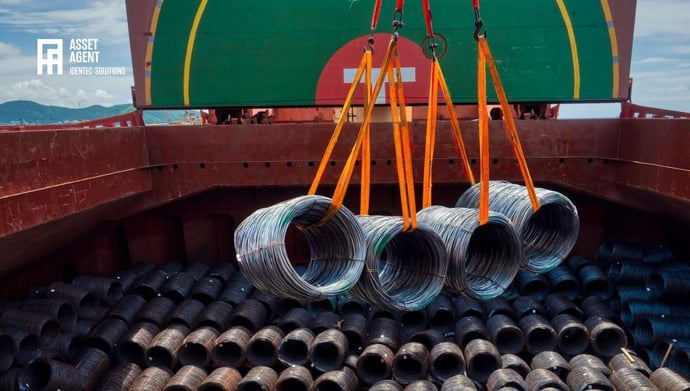
Once this plan is finalised, the actual loading can begin. Depending on the ship and cargo, cranes lift the items from the quay directly into a hold or onto the deck. Specialised lifting equipment may be required for particularly heavy, long, or bulky loads. Stevedores guide the cargo while the crane operator directs its movement into the ship.
Positioning items in their designated locations often takes place in confined spaces and amidst already loaded cargo. A misplaced item can obstruct another, necessitate a change in the loading sequence, or cause additional effort during unloading.
Therefore, in breakbulk shipping, the plan provides the structure, but those involved must be able to react flexibly if the cargo arrives late, conditions change, or the local circumstances differ from expectations.
How Is Breakbulk Cargo Secured for the Voyage?
A piece of cargo may appear perfectly stable on a ship in port. However, conditions change drastically at sea. Rolling, pitching, heaving, wind, and other forces can cause cargo movement. Cargo securing must therefore keep each item in its designated position throughout the entire voyage.
There is no one-size-fits-all solution. Heavy machinery, steel products, pipes, and irregularly shaped project cargo behave differently and therefore require different approaches. Lashing straps, chains, wires, wedges, blocks, and dunnage may be used, depending on the cargo and the vessel.
Before departure, the securing arrangements must be checked and documented in accordance with the vessel's approved cargo securing manual and applicable requirements. This is part of the physical cargo handling process and an important point at which the ship's crew confirms that the cargo is ready for voyage.
Once the ship leaves port, the opportunities for error correction are limited. A poorly positioned or inadequately secured piece of cargo may only become problematic when the ship encounters difficult conditions.
What Happens During Unloading?
At the destination port, the process begins anew, but unloading is not simply the reverse of loading, as is the case with containers.
The unloading team must first know what is to be unloaded from the ship, where it is located, and in what order. The cargo may have shifted during the voyage, so the securing devices must be carefully released before lifting begins. Again, identification is crucial.
The team must distinguish the correct piece of cargo from similar cargo and confirm that it is destined for the current port.
Once the cargo is located, the securing devices are removed, and the appropriate lifting equipment is made available. The piece is then transported from the ship to the quay, where it is either loaded directly onto a truck or railcar or temporarily stored (see also: a breakbulk warehouse as an operational transhipment centre).
The condition of the cargo must also be considered at this stage. Damage may not become visible until the securing devices have been removed and the object is fully exposed. Photographs and inspection reports provide valuable evidence of what the terminal observed during unloading.
From Physical Cargo to Digital Record
Breakbulk cargo exists in the physical world, but much of the information needed to manage it resides in freight lists, spreadsheets, photos, emails, and terminal systems. There is a risk that the physical cargo and its digital documentation will drift apart over time.
A piece of breakbulk cargo can arrive at the terminal with a unique identity and documented condition. It is then stored, repositioned before loading, brought aboard the ship, changes location during the voyage, and is eventually discarded. Each movement carries the risk of the physical cargo and its associated information becoming separated.
This leads to a surprisingly fundamental problem: the system may display something different than the actual location of the cargo.
A reliable digital record helps maintain this connection. It can aggregate information such as cargo identity, dimensions, weight, destination, location, status, and condition, creating a common reference for everyone involved in the operation.
Whether the information is captured manually, through scanning, electronic identification, photos, or other digital tools, the goal remains the same: to ensure that the information follows the physical cargo.
This proves particularly valuable when something goes wrong. If a part cannot be located, its condition is disputed, or its loading position needs to be confirmed, fragmented records can complicate the investigation.
The physical cargo and its digital record should provide consistent information.
This is increasingly becoming an important component of transparency in breakbulk shipping—without altering the fundamentally physical nature of the process.
What Makes a Breakbulk Operation Successful?
It all starts with precise information. The terminal needs to know what's arriving, how it should be handled, and where it needs to be transported. The cargo requires reliable identification that remains linked to its physical location. Ship planners need sufficient information to create a practical stowage plan, while stevedores and crews need the necessary information for safe execution.
Then comes disciplined execution. The right equipment must be available, lifting devices must be adapted to the cargo, and teams must coordinate the process under changing conditions.
Safety is paramount. Large and heavy cargo poses obvious physical risks, but uncertainty can also create risks. An incorrect weight, an unclear lifting point, or an unidentified part can influence the decisions of several people.
The condition of the cargo is also crucial. Knowing what a piece looked like upon arrival and documenting its condition during key handovers makes it easier to reconstruct the sequence of events in case of damage.
And then there's transparency.
In breakbulk cargo handling, individual items go through several phases. The more reliably the operation can answer fundamental questions – What is it? Where is it? Has it been loaded? Where has it been placed? Is it secured? Has it been unloaded? – the easier it is to manage.
Breakbulk cargo handling will never be as standardised as container transport, nor does it need to be. Its strength lies precisely in its ability to transport goods that don't conform to the standard model.
However, this flexibility brings complexity.
The future challenge is not to treat every breakbulk item like a container. Rather, it's about making the entire process surrounding these goods more transparent, interconnected, and predictable, while simultaneously maintaining the expertise required for handling non-standard goods.
FAQ
What Is the Bale Capacity of a Breakbulk Carrier?
Bale capacity refers to the volume of a ship's cargo holds available for cargo measured and stowed by volume, not weight. It is usually expressed in cubic meters (m³).
The term can be misleading because bale capacity does not simply represent the total internal volume of a ship. It refers to the usable cargo volume within the holds, taking into account the shape of the space and the structures that define it. Areas occupied by frames, beams, ladders, ventilation ducts, and other fixed structures are not included in the usable bale capacity.
Bale capacity is typically calculated by measuring the usable dimensions of the cargo holds and adding their individual volumes. For a simple rectangular space, the calculation might look like this:
Length × Width × Usable Height = Cargo Volume
However, real ship holds are rarely perfect cuboids. Therefore, naval architects and ship operators use detailed measurements of the actual cargo spaces to determine the ship's capacity.
Takeaway
Cargo transported on breakbulk carriers will never achieve the uniformity of container transport, and that is precisely why it is so valuable. Its flexibility makes it possible to transport goods that don't fit into the standardised container model.
However, this flexibility brings with it greater complexity: numerous different methods of identification, versatile and reinforced yards at the terminal, constantly changing lifting requirements, and special securing measures on board the ships to prevent cargo from shifting, even in rough seas.
The goal is not to be able to treat breakbulk cargo like containers, but rather to make an inherently individual process more transparent, traceable, and predictable.

Glossary
Geared vessels have their own onboard cargo-handling equipment, such as cranes or derricks, for loading and discharging freight. They can therefore serve ports with limited shore-based equipment. Gearless vessels do not carry such cargo gear and depend on terminal cranes or other shore facilities. Geared ships offer greater port flexibility, but their cranes add weight, maintenance needs, and cost. Gearless ships can use more of their design for cargo capacity and may achieve faster handling at well-equipped terminals with powerful shore cranes. (2)
An asymmetrical/inhomogeneous centre of gravity exists when the centre of mass of an object is not located at its geometric centre. This occurs because the mass is unevenly distributed—for example, when one side is heavier than the other.
The centre of gravity shifts closer to where the object weighs more. A hammer, for instance, has a heavy metal head and a light wooden handle. The centre of gravity is located almost at the front of the head, not in the middle of the handle. In curved shapes (like a ring or a horseshoe), the centre of gravity can even lie in mid-air, "in nothingness," that is, outside the actual material. (3)
References:
(1) https://seawayprojectcargo.com/en/equipment/breakbulk-vessels
(2) Rowbotham, Mark (2022): Break Bulk and Cargo Management. Routledge.
(3) David Halliday, Robert Resnick und Jearl Walker (2021): Fundamentals of Physics. Wiley.
Note: This article was partly created with the assistance of artificial intelligence to support drafting.

Author
Conny Stickler, Marketing Manager Logistics
Constance Stickler holds a master's degree in political science, German language and history. She spent most of her professional career as a project and marketing manager in different industries. Her passion is usability, and she's captivated by the potential of today's digital tools. They seem to unlock endless possibilities, each one more intriguing than the last. Constance writes about automation, sustainability and safety in maritime logistics.