| Written by Constance Stickler
Table of contents:
- The Growing Complexity of Modern Cold Chains
- What Is Cold Chain Management Automation?
- Why Is Automation Becoming Essential for Cold Chain Success?
- Core Technologies Driving Automation
- Automated Temperature Monitoring and Control
- Improving Cold Chain Performance Through Visibility and Automation
- Compliance, Traceability, and Risk Reduction
- The Role of Predictive Analytics in Cold Chain Operations
- Emerging Trends Shaping the Future
- FAQ
- Takeaway
- Glossary
The Growing Complexity of Modern Cold Chains
Cold chain logistics no longer operates in a stable environment. As industry analyses show, rising global temperatures and increasingly unpredictable weather patterns are putting enormous pressure on temperature-sensitive supply chains and forcing companies to rethink their strategies for ensuring product integrity in long and complex distribution networks. (1)
This shift is particularly critical for goods where even minor deviations from defined parameters can compromise product safety and efficacy, such as pharmaceuticals. Extreme heat waves, floods, storms, and infrastructure failures are no longer exceptions but recurring operational risks. In this context, traditional cold chain approaches—based on static planning and reactive interventions—are proving increasingly inadequate.
Cold chain management is rapidly evolving towards smarter, data-driven, and more resilient systems. Automation, real-time transparency, and predictive analytics are establishing themselves as essential capabilities to ensure continuity and control in an environment characterised by uncertainty.
What Is Cold Chain Management Automation?
Solutions for automated cold chain management utilise digital technologies to monitor, control, and optimise temperature-controlled supply chains with minimal manual intervention. Instead of periodic checks and paper-based documentation, continuous data is available, allowing for the analysis of operating conditions and the triggering of predefined actions as soon as deviations occur.
Automation extends across the entire cold chain. It begins in refrigerated production facilities, continues in cold storage facilities and various modes of transport, and finally reaches distribution centres and delivery points. Sensors, communication networks, software platforms, and intelligent algorithms work together to ensure product quality and operational efficiency.
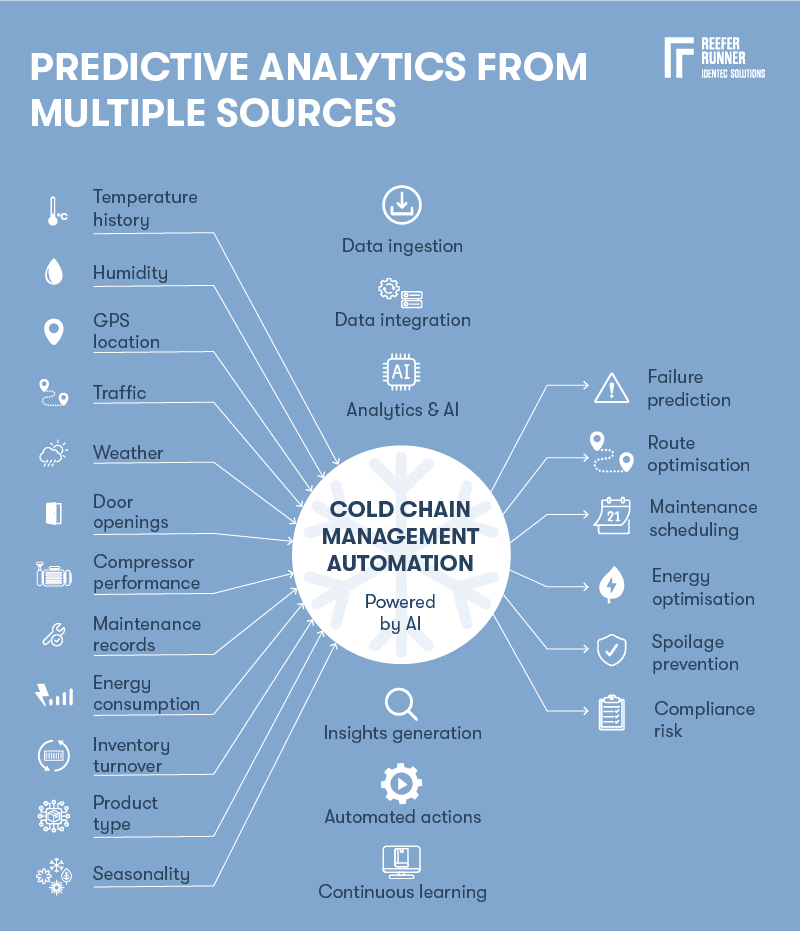
Modern solutions typically combine technologies such as IoT, cloud computing, artificial intelligence (AI), automated alarms, and integrated platforms. This allows for real-time monitoring of temperature, humidity, door openings, system performance, energy consumption, and product location. Problems are not detected during routine checks but are reported immediately upon occurrence.
These systems go far beyond simple temperature monitoring. They support inventory management, maintenance planning, energy optimisation, compliance reporting, and operational planning. By capturing large amounts of operational data, companies gain valuable insights into recurring problems, performance trends, and areas for improvement.
It is important to note that human expertise is not replaced. Skilled workers in the cold chain remain responsible for operational decisions, maintenance, and handling exceptional cases. Automation simply provides faster information, greater transparency, and a better basis for decision-making, allowing employees to focus on problem-solving rather than data collection.
Why Is Automation Becoming Essential for Cold Chain Success?
Several industry trends have made automation a business necessity. Growing shipment volumes, increasingly valuable products, stricter regulations, and higher customer expectations are putting significant pressure on traditional operating models.
Visibility
Manual inspections only allow for sporadic snapshots; automated monitoring closes the gaps. Temperature deviations or equipment failures no longer go undetected for disastrously long periods.
Skills shortage
Many logistics providers and warehouse operators struggle to attract and retain qualified staff. Automated monitoring, reporting, and routine tasks help companies maintain a high level of service without proportionally increasing their staffing needs.
Financial losses
Cold chain cargo is becoming increasingly valuable, whether it involves biotechnology, speciality chemicals, or high-quality seafood. The financial consequences of a total loss, often threatened even by minor deviations, are severe.
Customer satisfaction
Customers and partners in the supply chain increasingly expect real-time updates on shipment status, immediate notifications of disruptions, and complete traceability throughout the entire logistics process. Automation enables this transparency while simultaneously reducing manual reporting efforts.
Sustainability and waste reduction
Besides using environmentally friendly refrigerants and reducing energy consumption (which is also easier to achieve with more accurate data), one of the greatest environmental benefits of automating cold chain management lies in preventing product losses from the outset. Every spoiled shipment represents more than just wasted goods. It also encompasses all the resources invested in the production, processing, packaging, storage, and transportation of those products. (2)
Competition
Today's competitive environment rewards companies that make decisions based on continuous operational information, which supports better planning, predictive maintenance, performance measurement, and continuous improvement.
Core Technologies Driving Automation
The rapid advancement of digital technologies has made the automation of complex cold chains technically feasible and economically viable. It combines several complementary technologies to create networked and intelligent supply chains.
The foundation is IoT sensors that continuously monitor environmental and operating conditions. Parameters such as temperature, humidity, energy status, and consumption can be measured in real time. Wireless communication technologies enable these sensors to transmit data automatically, eliminating the need for manual data collection.
Modern systems provide the necessary infrastructure to store, process, and share this information on central platforms across multiple locations and organisations.
Large datasets can be analysed using artificial intelligence and machine learning to identify patterns that can predict future events, such as the failure of individual refrigeration units.
Automation platforms integrate data from multiple sources, such as refrigeration systems, warehouse management systems, transportation management systems, ERP software, and monitoring devices, into a unified operational overview. This results in faster, more informed decisions across the entire supply chain.
Digital twins—virtual representations of physical cold chain facilities and processes—are increasingly being used to simulate various scenarios and identify the greatest potential for improvement without disrupting ongoing operations.
Together, these technologies create an ecosystem where data flows continuously, routine tasks are automated, and decision-makers gain unprecedented visibility into every stage of the cold chain. As these technologies continue to evolve, they will enable even greater levels of automation, intelligence, and operational resilience.
Automated Temperature Monitoring and Control
Maintaining the correct temperature is the primary goal of every cold chain, as deviations can compromise product quality and shelf life. Automated temperature monitoring has therefore become one of the most important applications of cold chain management automation.
Networked sensors continuously measure a set of conditions, providing a complete picture of the product's condition – ideally from origin to destination.
If deviations occur, automated alarm systems immediately notify the responsible personnel via dashboards, mobile apps, SMS, or email. This enables early intervention before problems escalate. Some advanced systems even allow corrective actions to be set remotely. This further reduces response time, as there is no need to go to the reefer unit itself.
In addition to temperature, many monitoring systems also record humidity, air circulation, door openings, compressor performance, and energy consumption. By combining these measurements, operators gain a more comprehensive understanding of the factors that influence product quality and cooling performance.
Improving Cold Chain Performance Through Visibility and Automation
Automation leads to measurable improvements across the entire cold chain by increasing transparency, optimising processes, and enabling faster responses to operational challenges.
In automated warehouses, digital systems improve the efficiency and accuracy of storage and handling operations. Automated storage and retrieval systems (AS/RS), robotics, and intelligent warehouse management systems optimise the movement of goods, reduce manual intervention, and ensure stable temperature conditions by minimising unnecessary door openings and handling times.
Transportation automation extends these benefits beyond warehouse facilities. Refrigerated trucks, containers, and other transport vehicles can be monitored throughout their journeys, while route optimisation systems help reduce delays and improve resource utilisation by considering factors such as traffic, weather, and delivery priorities.
By combining transparency, warehouse automation, and intelligent transportation solutions, companies create a more responsive and resilient cold chain. Products remain protected, operational decisions are made faster and more reliably, and companies gain greater control over increasingly complex global supply chains.
Compliance, Traceability, and Risk Reduction
Food and drug safety, as well as the requirements for sensitive electronics and chemicals, make compliance with legal regulations one of the most important tasks in cold chain management. All stakeholders must demonstrate that the products were stored and transported under suitable conditions throughout the entire supply chain.
Automation simplifies compliance by creating accurate, continuous, and tamper-proof records. These form comprehensive audit logs that can be accessed at any time.
In addition to temperature tracking, all steps of the product journey are recorded, including storage locations, transport processes, handling procedures, and handovers between supply chain partners. This allows for the rapid identification of the causes of quality problems.
Beyond its operational benefits, digital compliance strengthens customer relationships. Manufacturers, distributors, healthcare providers, and retailers increasingly expect transparent documentation that proves products have been stored under the prescribed conditions.
As regulatory requirements continue to evolve, companies that invest in automated compliance and traceability systems now are better positioned to meet new standards.
The Role of Predictive Analytics in Cold Chain Operations
Automated cold chain operations enable real-time insights, while predictive analytics goes a step further. It helps companies anticipate future events by analysing historical and current operational data and identifying patterns.
One of the most valuable applications is predictive maintenance. Instead of waiting for fixed appointments, intervention occurs when signs indicate the need for it. Large amounts of operating data, such as compressor performance, energy consumption, operating temperatures, vibration levels, and maintenance history, are analysed for signs of wear or equipment deterioration. Maintenance is then scheduled accordingly.
In addition to preventing temperature fluctuations caused by equipment failures, data such as historical shipping data, environmental conditions, transport routes, seasonal trends and system performance can also be used to estimate the most likely risks and, if necessary, adjust cooling settings, select alternative routes or schedule additional inspections.
Energy optimisation also benefits. Forecasting models analyse weather forecasts, facility utilisation, cooling load, and historical consumption patterns to determine the most efficient operating strategies. This allows companies to reduce energy costs while simultaneously ensuring the environmental conditions necessary for product integrity.
Predictive analytics are only achievable through automation and the resulting vast amounts of data. They facilitate proactive decision-making by anticipating operational challenges. With the advancement of artificial intelligence, they are becoming an increasingly important component of cold chain management automation.
Emerging Trends Shaping the Future
The automation of cold chain solutions is constantly evolving with the advancement and networking of digital technologies. While today's automated systems already offer continuous monitoring, real-time transparency, and predictive analytics, the next generation of solutions will focus even more on autonomy, intelligence, and sustainability.
Future AI systems will be able not only to recommend operational decisions but also to execute them automatically by incorporating increasing amounts of data into their calculations, such as weather forecasts based on current conditions.
If cloud platforms cannot perform reliably due to unstable network connections, for example, in remote locations, edge devices process the information locally, thus enabling significantly faster decision-making.
Sustainability remains a key driver of innovation. Future automation platforms will increasingly optimise cooling systems for energy efficiency, reduce product losses through more accurate forecasting, and support CO₂ reporting by capturing detailed operational data. In light of stricter environmental regulations, automated reporting will help companies measure and demonstrate their sustainability performance.
Interoperability will continue to connect more and more individual systems and improve collaboration between supply chain partners by enabling increasingly comprehensive overviews of processes from production to delivery.
While fully autonomous cold chains remain a long-term vision, the industry is steadily evolving towards smarter and self-optimising processes. Companies that leverage these new technologies are better equipped to improve their resilience, reduce waste, strengthen regulatory compliance, and ensure the high reliability expected in modern temperature-controlled supply chains.
FAQ
What Speciality Chemicals Require Cold Chain Transport?
Some products, such as laboratory reagents, diagnostics, catalysts, adhesives and coatings, as well as electronics and agrochemicals, must be stored and transported within defined temperature ranges to ensure their chemical stability, performance, and safety.
Some of these become unstable when exposed to excessive heat, while others may crystallise, segregate, polymerise, or lose their desired properties if temperatures fall outside the specified limits. For manufacturers, the consequences extend beyond product spoilage. Temperature deviations can lead to failed quality checks, production downtime, scrap, regulatory problems, and significant financial losses.
Takeaway
Automating cold chain management transforms temperature-controlled logistics into proactive, data-driven operations. By combining real-time monitoring, integrated digital platforms, predictive analytics, and automated workflows, companies gain greater control over their products and processes.
The benefits extend beyond temperature monitoring: transparency across the entire supply chain is improved, more efficient warehousing and transportation processes are supported, compliance is strengthened, predictive maintenance is enabled, and costly product losses are avoided. At the same time, better data and smarter decisions contribute to sustainability by reducing energy consumption and preventing unnecessary waste.
The signs point to increasingly complex cold chains that are more vulnerable to external disruptions. Automation is therefore becoming an essential capability. Companies that adopt these technologies are better equipped to maintain product integrity, improve operational resilience, and meet the growing demands of customers, regulators, and global markets.
Delve deeper into one of our core topics: Cold Chain Monitoring
Glossary
Air circulation in reefers is the controlled movement of refrigerated air through the container so the cargo stays at a stable temperature. Cold air is typically blown along the floor, passes through or around the load, absorbs heat, and then returns to the refrigeration unit to be cooled again. Good circulation prevents hot spots, moisture problems, and uneven cooling, which is especially important for perishables packed on pallets. If cargo is loaded above the line or blocks airflow, the reefer cannot cool evenly, and quality can suffer. (3)
Operational resilience is an organisation’s ability to keep delivering essential services during disruptions, then recover quickly and adapt afterward. It goes beyond simple backup planning: it looks at risks across technology, people, facilities, and suppliers so the business can anticipate problems, absorb shocks, and continue operating. In logistics, that could mean keeping freight moving despite port congestion, IT outages, labour shortages, or weather events. The goal is not to avoid every disruption, but to stay functional and recover fast when one happens. (4)
References:
(1) https://www.pharmaceuticalcommerce.com/view/cold-chain-logistics-in-a-warming-world
(3) Gaur, P.K. (2017): Refrigerated Cargoes. Witherby Publishing.
(4) Sheffi, Yossi (2005): The Resilient Enterprise. MIT Press.
Note: This article was partly created with the assistance of artificial intelligence to support drafting.

Author
Conny Stickler, Marketing Manager Logistics
Constance Stickler holds a master's degree in political science, German language and history. She spent most of her professional career as a project and marketing manager in different industries. Her passion is usability, and she's captivated by the potential of today's digital tools. They seem to unlock endless possibilities, each one more intriguing than the last. Constance writes about automation, sustainability and safety in maritime logistics.