| Written by Mark Buzinkay
Table of contents:
- Why Emergency Response Technologies Matter Offshore
- Emergency Response Processes: From Detection to Safe Evacuation
- Real-Time Localisation and Crew Management: The Backbone of Modern Emergency Response Technologies
- Optimising Emergency Response with Integrated Monitoring Technologies
- The Future of Emergency Response Technologies Offshore
- FAQ
- Takeaway
- Glossary
Why Emergency Response Technologies Matter Offshore
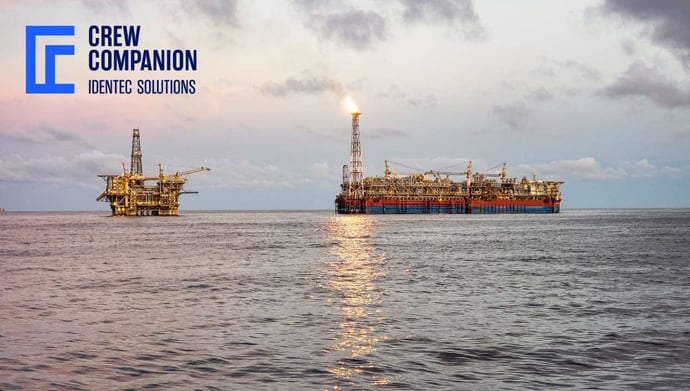
Offshore oil and gas installations are among the most complex industrial workplaces in the world. Whether operating on fixed platforms, semi-submersible drilling rigs, drillships, or Floating Production, Storage, and Offloading (FPSO) vessels, every installation involves hazardous processes, heavy equipment, flammable hydrocarbons, confined spaces, and challenging environmental conditions. Unlike onshore facilities, offshore assets are often located hundreds of kilometres from land, where external emergency services cannot provide immediate assistance. During an emergency, the offshore crew must therefore rely primarily on trained personnel, established procedures, and onboard emergency systems.
For this reason, emergency response technologies have become an essential component of offshore safety management. Their purpose extends far beyond sounding alarms or initiating evacuations. Modern digital technologies enable operators to obtain an accurate picture of the developing situation, understand where personnel are located, coordinate emergency teams, and support informed decision-making under significant time pressure.
Emergency scenarios offshore can develop rapidly. Fires and explosions remain among the most critical risks due to the presence of pressurised hydrocarbons. Gas releases can create explosive atmospheres within seconds, requiring immediate isolation of affected areas and rapid evacuation of personnel. Structural failures, equipment malfunctions, helicopter incidents, man-overboard situations, medical emergencies, and extreme weather events all require different response strategies, yet they share one common requirement: accurate, real-time information.
Historically, offshore emergency management depended heavily on manual procedures. Personnel-on-board (POB) lists were often maintained manually, mustering relied on roll calls, and supervisors collected information by radio. While these procedures formed the backbone of emergency preparedness for decades, they introduced unavoidable delays during situations where every minute matters.
The offshore industry has steadily moved towards digital emergency management. Today’s emergency response technologies integrate multiple information sources into a common operational picture. Fire detection systems, gas monitoring, access control, personnel databases, electronic Permit to Work systems, communication platforms, and real-time location systems can now exchange information automatically. Instead of relying on fragmented reports, emergency coordinators receive continuously updated situational awareness throughout the incident.
This digital transformation does not replace emergency procedures—it strengthens them. Well-defined processes remain the foundation of offshore emergency management, but technology enables them to be executed faster, with greater accuracy, and with improved coordination. Modern emergency management therefore combines trained personnel, standardised procedures, and intelligent technologies into one integrated safety ecosystem.Industry guidance increasingly reflects this integrated approach. The International Association of Oil & Gas Producers (IOGP) emphasises that effective offshore emergency response depends on comprehensive planning, competent personnel, reliable communication, and coordinated emergency services supported by robust management systems. (1)
See also: HSE standards
Emergency Response Processes: From Detection to Safe Evacuation
Technology alone does not save lives. Successful emergency management depends on clearly defined processes that guide personnel from the first indication of danger through incident resolution and recovery. Emergency response technologies are most effective when they support each stage of this operational workflow rather than functioning as isolated systems.
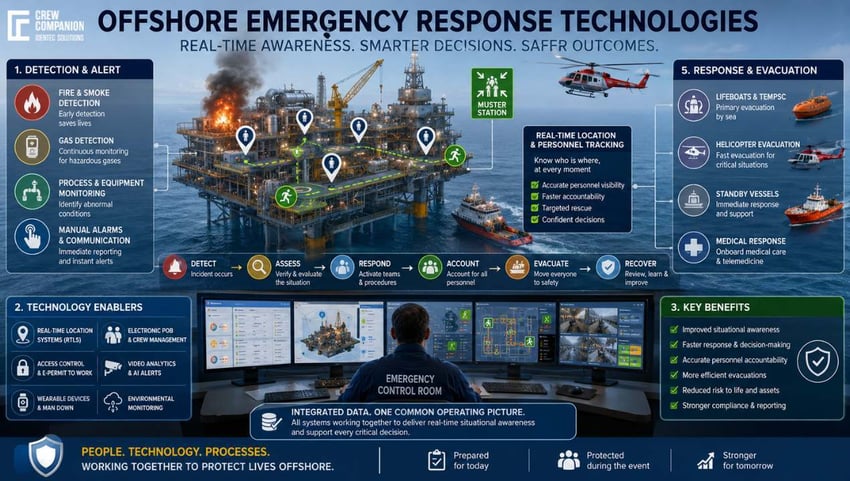
The emergency response process begins with early detection. Offshore installations are equipped with numerous monitoring systems designed to identify abnormal conditions before they escalate. Fire detectors, smoke detectors, gas detection systems, pressure monitoring equipment, process alarms, and manual alarm stations continuously monitor both production processes and accommodation areas. Their purpose is not only to detect incidents quickly but also to provide emergency teams with the earliest possible warning.
Once an abnormal condition has been identified, the incident must be assessed. Emergency coordinators need to understand what has happened, where it has occurred, how difficult the situation is, and which personnel may be affected. At this stage, rapid access to accurate operational information becomes critical. Delayed or incomplete information may lead to inappropriate decisions, increasing the risk to personnel and assets (see also: defensive design for offshore safety).
The Offshore Installation Manager (OIM) and emergency response team then establish command and control. Communication channels are activated, emergency teams are mobilised, and operational priorities are defined. Depending on the incident, these priorities may include isolating production equipment, activating fire suppression systems, controlling hazardous energy sources, or preparing rescue operations.
Personnel accountability forms the next critical stage. Offshore installations typically accommodate permanent employees, contractors, visitors, inspection teams, and temporary maintenance personnel. During an emergency, emergency coordinators must rapidly determine who is on board, who is working in hazardous process areas, and whether anyone remains in danger.
Modern crew management systems significantly improve this process by maintaining continuously updated Personnel-on-Board information. Rather than relying solely on static personnel lists, digital systems automatically synchronise crew movements, contractor registrations, accommodation assignments, and work permits. This creates a far more accurate operational picture than traditional manual methods.
Mustering follows immediately after personnel accountability begins. Crew members proceed to their assigned muster stations in accordance with established emergency procedures. Traditional roll calls can become time-consuming, particularly on large offshore facilities with hundreds of personnel. Electronic mustering systems automate much of this work by rapidly confirming personnel presence, immediately identifying missing individuals, and providing emergency coordinators with continuously updated accountability information.If conditions deteriorate further, evacuation procedures are initiated. Depending on the situation, evacuation may involve Totally Enclosed Motor Propelled Survival Craft (TEMPSC) lifeboats, helicopters, standby vessels, or walk-to-work gangways where available. Evacuation decisions require confidence that personnel have been accounted for correctly before abandoning the installation. Any uncertainty about missing personnel entails difficult decisions between delaying evacuation and initiating additional search-and-rescue activities.
This illustrates why emergency response should never be viewed simply as evacuation. The objective is to maintain situational awareness throughout the entire incident lifecycle—from the first alarm until every individual has reached safety and recovery operations begin.
As offshore operations become increasingly digital, emergency response technologies are supporting every step of this process by reducing uncertainty, accelerating information flow, and enabling emergency teams to make decisions based on real-time operational data rather than assumptions. The result is improved coordination, faster personnel accountability, and more effective emergency management under highly demanding conditions. (2)

Real-Time Localisation and Crew Management: The Backbone of Modern Emergency Response Technologies
One of the greatest challenges during an offshore emergency is not simply understanding what has happened—it is knowing exactly where people are. Fire detection systems, gas sensors, and process alarms may identify the location of an incident, but emergency coordinators also need immediate visibility of personnel who may be affected. This is where real-time localisation has become one of the most valuable emergency response technologies available to offshore operators.
Traditional Personnel-on-Board (POB) lists provide only a snapshot of who is present on an installation. They do not indicate whether a technician is working in a compressor module, whether a contractor has entered a restricted area, or whether maintenance personnel are still inside an enclosed space. During an emergency, this missing information can delay rescue operations and complicate evacuation decisions.
Modern Real-Time Location Systems (RTLS) continuously monitor the movement of personnel throughout the installation. Depending on operational requirements, these systems may use Active RFID, Bluetooth Low Energy (BLE), Ultra-Wideband (UWB), or hybrid positioning technologies. Each technology offers different advantages regarding accuracy, coverage, power consumption, infrastructure requirements, and environmental suitability.
For offshore emergency response, the objective is rarely centimetre-level positioning. Instead, operators require reliable knowledge of which operational zone a person occupies, whether they have reached a muster station, or whether they remain inside an affected process area. Zone-based awareness is often sufficient to support emergency decision-making while reducing infrastructure complexity.
Localisation data becomes significantly more valuable when integrated with crew management. Modern crew management platforms combine personnel records with continuously updated operational information, creating a dynamic overview of everyone onboard.Typical crew management information includes:
- Employee or contractor identity
- Company and employer
- Emergency contacts
- Medical considerations
- Competencies and certifications
- Shift schedules
- Cabin assignments
- Work permits
- Access permissions
- Current operational location
- Muster status
- Last detected position
Rather than searching multiple systems, emergency coordinators can access this information through a single operational dashboard. If a fire develops within a production module, they can immediately determine who was working in that area, identify personnel who have not yet reported to a muster station, and assign rescue teams more effectively.
Crew management also improves routine operations. Supervisors gain better visibility of contractor activities, shift changes, permit-controlled work, and personnel distribution across the installation. Because the same infrastructure supports both daily operations and emergency response, data quality remains consistently high.
Another significant benefit is reducing uncertainty. During emergencies, uncertainty often leads to delays while response teams attempt to verify incomplete information. Real-time localisation dramatically reduces this uncertainty by providing continuously updated visibility into personnel.
This operational awareness becomes particularly valuable during evacuation. Emergency coordinators can verify that everyone has reached the correct muster station, identify missing personnel within seconds, and determine whether additional search-and-rescue activities are required before abandoning the installation. Instead of relying on repeated manual roll calls, decisions are supported by continuously updated digital information.
Ultimately, real-time localisation should not be viewed as a standalone technology. Its greatest value lies in supporting informed decision-making throughout the entire emergency response process, enabling safer, faster, and more coordinated actions. (3)
Optimising Emergency Response with Integrated Monitoring Technologies
The true potential of emergency response technologies is realised when multiple systems work together rather than operating independently. Offshore installations already generate enormous amounts of operational data. Integrating these data sources transforms isolated information into comprehensive situational awareness.
Electronic Permit to Work (ePTW) systems provide valuable context by identifying where hazardous maintenance activities occur. During an emergency, responders can immediately determine whether personnel are working in confined spaces, performing hot work, or conducting maintenance in hazardous process areas.
Access control systems complement this information by recording entry into controlled locations. If an evacuation is initiated, emergency coordinators can quickly verify which personnel may still be inside restricted zones.
Electronic Personnel-on-Board systems continuously maintain accurate personnel records, automatically updating arrivals, departures, and contractor registrations. This eliminates much of the administrative work traditionally associated with emergency accountability.
Video analytics adds another layer of operational awareness. Intelligent camera systems can automatically detect smoke, unauthorised access, abnormal movement, or personnel remaining inside restricted areas after an alarm. While cameras cannot replace localisation systems, they provide valuable visual confirmation that supports emergency decision-making.
Wearable technologies are becoming increasingly important as well. Smart safety devices may include panic buttons, man-down detection, motion monitoring, and environmental sensors that identify hazardous conditions affecting individual workers. These devices can generate immediate alerts while simultaneously transmitting the worker’s location to emergency coordinators.
Environmental monitoring remains fundamental to offshore safety. Fire detectors, gas detectors, smoke sensors, weather-monitoring stations, and process instrumentation continuously provide information on changing operational conditions. Integrating these systems with personnel location data allows emergency teams to understand not only where hazards exist but also who may be exposed.
All these technologies contribute to a common operational picture. Instead of displaying isolated alarms, modern emergency management platforms correlate personnel location, environmental hazards, equipment status, work permits, communication systems, and emergency procedures into a single decision-support environment.
This integrated approach also supports continuous improvement. Incident reports, evacuation exercises, and mustering drills generate valuable operational data that can be analysed to identify process improvements. Operators can evaluate response times, evacuation routes, muster performance, communication effectiveness, and personnel movement patterns to strengthen future emergency preparedness.
Emergency response technologies therefore extend beyond reacting to incidents. They create opportunities to predict risks, improve preparedness, and continuously optimise emergency management throughout the operational lifecycle. (2)
The Future of Emergency Response Technologies Offshore
Digital transformation continues to reshape offshore emergency management. Artificial intelligence is beginning to assist operators by identifying abnormal operating conditions, prioritising alarms, and supporting incident assessment. Digital twins increasingly combine engineering models with live operational data, enabling emergency teams to visualise developing incidents before making critical decisions.
Autonomous inspection robots and drones reduce personnel exposure by entering hazardous environments that would otherwise require manual inspection. At the same time, advances in wearable technologies continue to improve worker monitoring through integrated health indicators, environmental sensing, and enhanced communication capabilities.
Cloud connectivity and edge computing are also improving information availability across geographically distributed operations. Offshore installations, onshore support centres, emergency response organisations, and vessel operators can increasingly collaborate using the same operational information, improving coordination during major incidents.
Despite these technological advances, the objective remains unchanged. Emergency response technologies exist to support people—not replace them. Well-trained emergency teams, clearly defined procedures, and effective leadership remain the foundation of offshore emergency preparedness. Technology provides the operational awareness needed to execute those procedures faster, more accurately, and with greater confidence.
As offshore operations become increasingly connected, integrated emergency management platforms will continue to evolve from reactive tools into predictive decision-support systems that reduce operational risk before emergencies occur.
FAQ: FPSO Operations and Safety
What are emergency response technologies in offshore oil and gas?
Emergency response technologies are digital systems that support the detection, management, and resolution of offshore emergencies. They include fire and gas detection, electronic Personnel-on-Board systems, crew management platforms, Real-Time Location Systems (RTLS), access control, video analytics, communication systems, and decision-support software that improve situational awareness and personnel accountability.
Why is real-time localisation important during offshore emergencies?
Real-time localisation enables emergency coordinators to determine where personnel are located throughout an installation. This significantly improves mustering, rescue operations, evacuation planning, and personnel accountability while reducing uncertainty during rapidly evolving incidents.
How does crew management improve offshore emergency response?
Modern crew management systems integrate personnel information with live operational data, including location, work permits, access permissions, certifications, and muster status. This enables emergency teams to quickly identify affected personnel, coordinate rescue efforts more effectively, and make informed evacuation decisions.
Takeaway
Emergency response technologies are fundamentally changing how offshore operators prepare for and manage emergencies. By integrating real-time localisation, digital crew management, environmental monitoring, access control, electronic POB, and intelligent decision-support systems, organisations can improve situational awareness, accelerate evacuation, and strengthen personnel accountability. Similar principles are increasingly influencing underground mine safety and traffic management, where integrated monitoring solutions provide continuous visibility of people and mobile equipment to reduce collision risks, optimise emergency response, and support safer day-to-day operations.

Delve deeper into one of our core topics: Emergency Response Management
Glossary
Hybrid systems combine multiple positioning technologies to overcome the limitations of individual solutions. An offshore installation may integrate Active RFID for zone-based personnel tracking, BLE for low-power indoor positioning, UWB for high-precision locations in selected operational areas, and GPS for vessels or outdoor assets. By intelligently selecting the most suitable technology for each environment, hybrid systems improve coverage, reliability, scalability, and operational resilience while maintaining continuous personnel visibility across complex offshore facilities.
References:
(1) International Association of Oil & Gas Producers (IOGP). Incident Management System for the Oil and Gas Industry. Available:
https://www.iogp.org/bookstore/product/incident-management-systems/
(2) International Association of Oil & Gas Producers (IOGP). Offshore Emergency Response Services (Report 699). Available:
https://www.iogp.org/bookstore/product/offshore-emergency-response-services/
(3) International Association of Oil & Gas Producers (IOGP). Risk Assessment Data Directory – Escape, Evacuation and Rescue (Report 434-19). Available:
https://www.iogp.org/bookstore/product/risk-assessment-data-directory-evacuation-escape-rescue/
Note: This article was partly created with the assistance of artificial intelligence to support drafting. The images were created via AI.