| Written by Mark Buzinkay
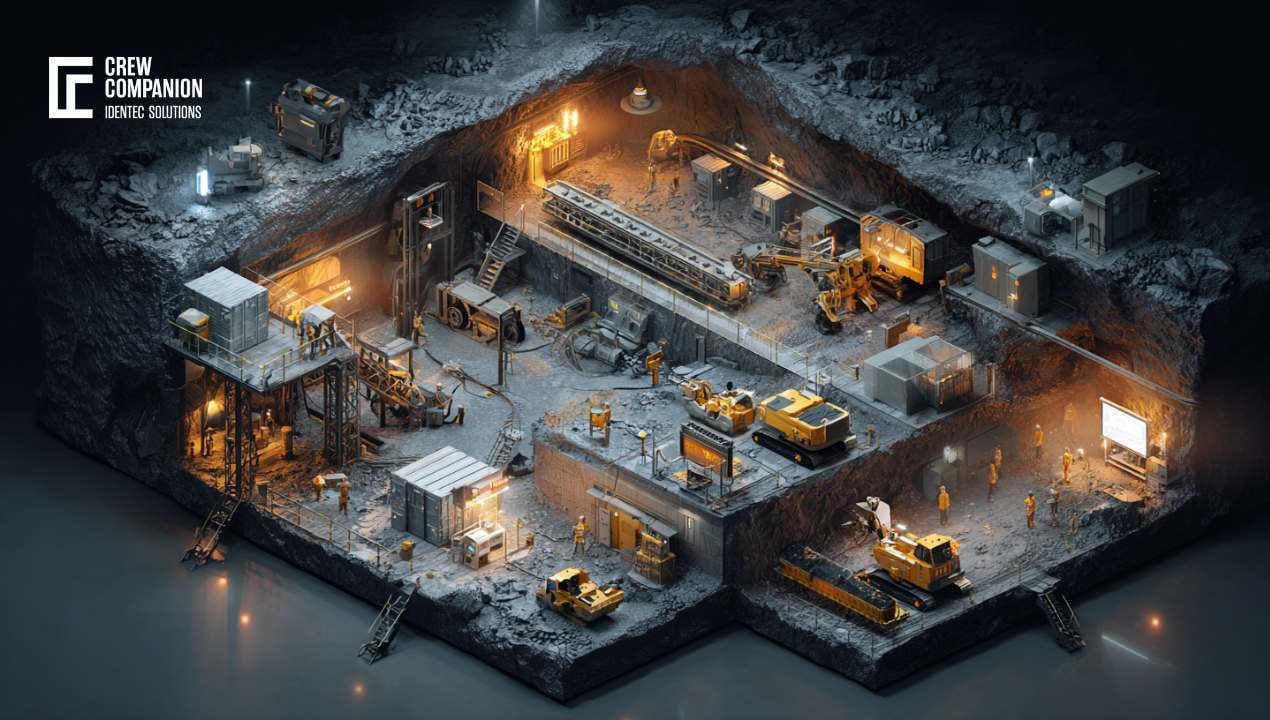
Table of contents:
- Robots in Mining: Applications, Benefits, and Industry Trends
- Why Process Management Matters as Much as the Robots
- Real-Time Localisation: The Foundation of Connected Mining Operations
- Crew Management and Fleet Management in the Autonomous Mine
- Building the Connected Mine of the Future
- FAQs
- Takeaway
- Glossary
Robots in Mining: Applications, Benefits, and Industry Trends
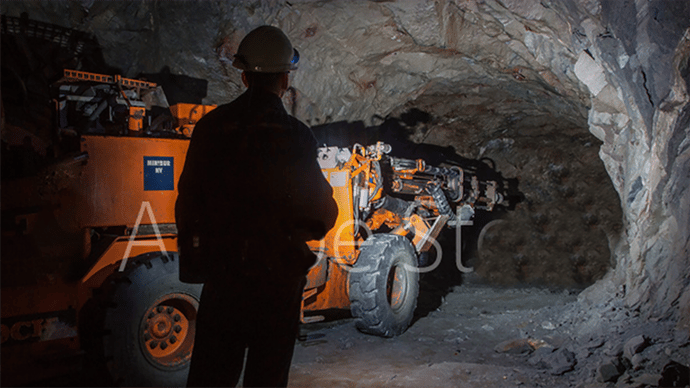
The mining industry has always been an early adopter of technologies that improve safety and productivity. Today, robots in mining are becoming a central component of modern operations, particularly in underground mines where hazardous conditions, limited visibility, and confined spaces create significant operational challenges.
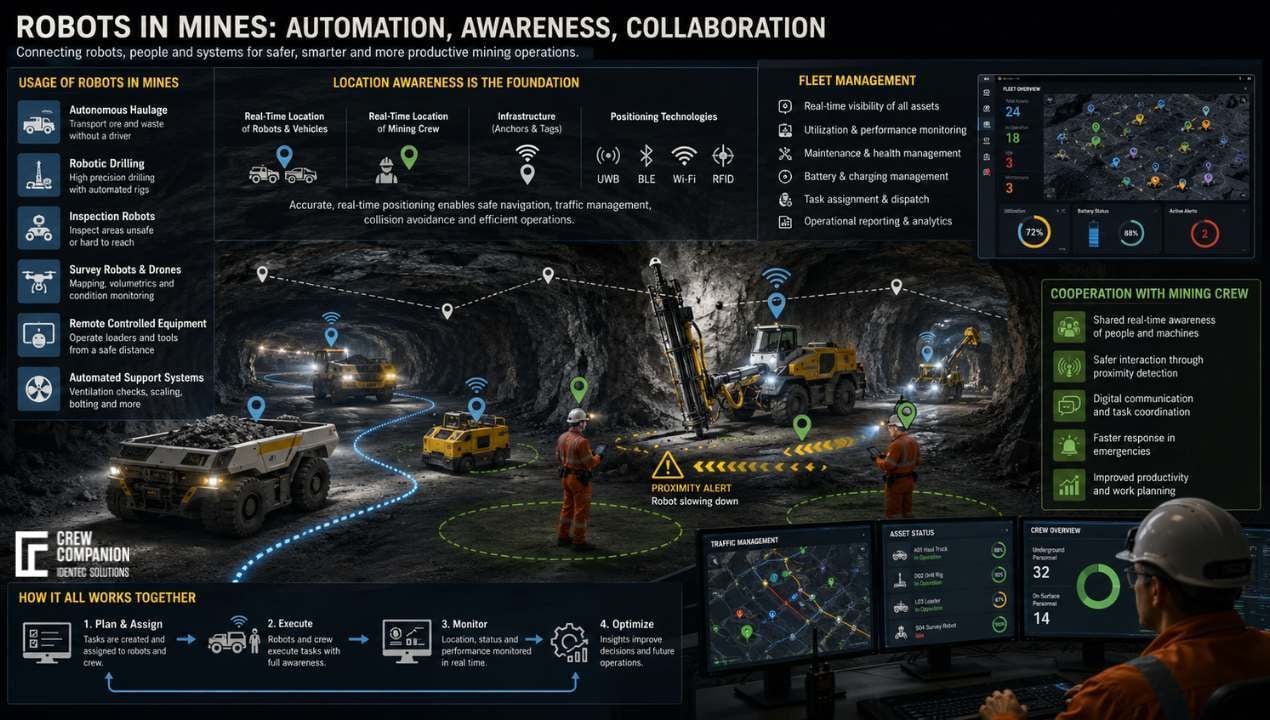
Mining robots take many forms. Autonomous haul trucks transport ore and waste material without a driver. Robotic drilling systems perform repetitive drilling tasks with high precision. Inspection robots can enter dangerous areas after blasting or during geotechnical assessments. Drones and autonomous survey vehicles create digital maps of mines while minimising human exposure to hazards (see for example: video analytics).
The benefits of robots in mining are significant. First and foremost, they improve worker safety by reducing human exposure to unstable ground conditions, dust, toxic gases, and heavy machinery. Autonomous systems can operate continuously, helping mines maintain production around the clock while reducing fatigue-related incidents.
Mining companies also gain productivity benefits. Autonomous equipment can follow optimised routes, maintain consistent operating speeds, and execute tasks with greater precision than manually operated machinery. According to industry experts, autonomous mining technologies can significantly improve equipment utilisation while reducing operational interruptions. (1)
However, successful mining automation depends on more than the machines themselves. The real challenge lies in integrating robots into broader operational processes.
See also: Mine safety: Why digital management?

Why Process Management Matters as Much as the Robot
A common misconception is that purchasing autonomous equipment automatically creates an autonomous mine. In reality, robots in mining require extensive operational support. Every robotic asset depends on a series of interconnected processes:
- Task assignment
- Charging and battery management
- Preventive maintenance
- Software updates
- Inspection schedules
- Spare-parts management
- Traffic coordination
Consider an autonomous underground loader. The machine may perform loading tasks independently, but it still requires a structured workflow. Production schedules must determine where the loader operates. Maintenance teams must monitor equipment health. Battery-electric vehicles require charging infrastructure and charging schedules that prevent bottlenecks. Without proper planning, even highly advanced robots can spend significant periods idle.
This is where fleet management becomes essential. Fleet management systems provide visibility into equipment availability, maintenance status, utilisation rates, and operational performance. Managers can identify inefficiencies before they impact production and ensure that autonomous equipment is assigned to the right tasks at the right time. (2) As automation increases, mines must focus on optimising the entire workflow rather than individual machines.
Real-Time Localisation: The Foundation of Connected Mining Operations
Perhaps the most important technology supporting robots in mining is real-time localisation. A robot can only operate safely and efficiently if it knows where it is located. Equally important, mine operators must know where workers, vehicles (see also underground mining vehicle), and other robotic systems are located at any given moment. Real-Time Location Systems (RTLS) provide this visibility. Depending on the environment, mines may use technologies such as RFID, Bluetooth Low Energy (BLE), Ultra-Wideband (UWB), Wi-Fi positioning, or GPS for surface operations.Localisation data serves several purposes.
For robots, location data enables:
- Navigation
- Route optimization
- Geofencing
- Collision avoidance
- Traffic management
- Automated dispatching
For miners, location data supports:
- Emergency response
- Worker accountability
- Restricted-area enforcement
- Lone-worker protection
- Evacuation management
The true value emerges when location information from robots and people is combined into a single operational picture.Imagine an underground haulage route where autonomous trucks and maintenance crews operate simultaneously. If localisation systems detect personnel entering a traffic corridor, autonomous vehicles can automatically reduce speed, change routes, or temporarily stop operations.
Similarly, if a robot encounters a fault, the system can identify the nearest qualified technician and dispatch them directly to the asset. Localisation therefore becomes more than a tracking tool. It becomes an operational intelligence platform that coordinates activities throughout the mine.
Read more about mine monitoring.
Crew Management and Fleet Management in the Autonomous Mine
As mining operations become more automated, managing people remains just as important as managing machines. Crew management provides visibility into the workforce. Mine operators need to know:
- Who is underground
- Where workers are located
- Which qualifications they hold
- Which shifts they belong to
- Whether all personnel have been accounted for during emergencies
Electronic mustering systems and digital personnel tracking solutions make this possible. Instead of relying on manual procedures, mines can automatically verify worker locations and support faster emergency response. At the same time, fleet management provides a complete picture of equipment operations.Modern fleet management platforms monitor:
- Equipment location
- Machine health
- Utilization rates
- Maintenance schedules
- Battery status
- Charging availability
The greatest benefits occur when crew management and fleet management share the same operational data environment. For example, maintenance dispatching becomes significantly more efficient when both personnel and equipment locations are visible in real time. Supervisors can identify the closest qualified technician and route them directly to the affected machine.
Similarly, production managers can optimise workforce allocation by understanding where both personnel and robotic assets are operating.
This integrated approach improves productivity while reducing response times and operational risk.
Building the Connected Mine of the Future
The future of mining will not be defined solely by autonomous trucks, robotic drills, or inspection drones. Instead, success will depend on creating a connected operational ecosystem.In this ecosystem, robots, vehicles, workers, sensors, communication networks, and management systems continuously exchange information.
Modern wireless communications infrastructure enables this connectivity. Underground Wi-Fi, LTE, private 5G networks, and industrial IoT platforms allow mines to collect and distribute operational data in real time.
As artificial intelligence and analytics become more advanced, mines will increasingly use location data to automate decision-making. Systems will optimise traffic flows, predict maintenance requirements, dynamically allocate resources, and support digital twin environments that model the entire operation.
The result is a mine that not only automates individual tasks but continuously optimises itself. Robots in mining represent an important step toward this future. Yet their greatest value emerges when automation is combined with localisation, communication, crew management, and fleet management technologies that provide complete operational visibility.
FAQ
What are robots in mining?
Robots in mining are autonomous or remotely operated machines used for tasks such as hauling, drilling, inspection, surveying, and material handling. They improve safety by reducing worker exposure to hazardous environments while increasing operational efficiency.
Why is real-time localisation important in mining?
Real-time localisation provides continuous visibility of workers, vehicles, and robotic equipment. This information supports traffic management, emergency response, collision avoidance, workforce accountability, and operational optimisation.
How do crew management and fleet management work together?
Crew management tracks personnel, qualifications, and workforce availability, while fleet management monitors equipment performance and location. When integrated, both systems enable better resource allocation, faster maintenance response, and safer operations.
Takeaway
Robots in mining are reshaping the industry by improving productivity, reducing operational risk, and enabling more consistent production. However, autonomous equipment delivers its greatest value when connected with real-time localisation, communication networks, crew management, and fleet management systems. In underground mines, these technologies support safer traffic management by maintaining visibility of both workers and vehicles, helping prevent collisions, coordinating movements, and ensuring rapid response during emergencies while keeping production running efficiently (continue reading here: Mining risk management and wearables).
Delve deeper into one of our core topics: Mining safety
Glossary
Operational scheduling is the process of assigning resources, equipment, personnel, and tasks across a defined period to achieve production objectives efficiently and safely. In mining, operational scheduling coordinates activities such as drilling, hauling, maintenance, charging of battery-electric vehicles, shift changes, and material movement. Effective scheduling minimises idle time, prevents resource conflicts, improves equipment utilisation, and ensures that autonomous and manually operated assets work together within a coordinated production plan. (4)
References:
(1) https://k-mine.com/articles/i-robot-mining-s-automated-future/
(2) https://www.epiroc.com/en-us/products/digital-solutions/data-driven-operations/fleet-monitoring
(3) Minería Pan-Americana. (2026, March). Robots en minería: seguridad y continuidad. Minería Pan-Americana, pp. 42–43.
(4) Burt, C. N., & Caccetta, L. (2018). Equipment Selection and Fleet Management. In: SME Mining Engineering Handbook, 3rd Edition. Society for Mining, Metallurgy & Exploration (SME).
Note: This article was partly created with the assistance of artificial intelligence to support drafting. The head image was generated by AI.

Related Articles
Related Product