| Written by Mark Buzinkay
Table of contents:
- Why is offshore safety training essential for oil rig workers?
- What topics should offshore safety training cover?
- How should training connect with processes on rigs and FPSOs?
- Which offshore safety training providers should operators compare?
- How can real-time crew-location data improve training results?
- FAQs
- Takeaway
- Glossary
Why is offshore safety training essential for oil rig workers?
Working offshore combines high-risk tasks with distance from shore-based emergency services. Oil rigs and floating production, storage and offloading vessels (FPSOs) operate in environments where weather, vessel movement, hazardous substances, lifting operations and complex process systems can affect people at the same time. A worker may also live on the installation for weeks, sharing work and accommodation with colleagues and contractors.
Training helps personnel recognise hazards, understand their responsibilities and respond consistently when conditions change. It should not be treated as a certificate alone. A course can teach general skills, but workers also need to know how those skills fit the procedures, layout and equipment on the installation where they will work.
The industry uses structured training standards for key elements of offshore readiness. OPITO’s Basic Offshore Safety Induction and Emergency Training (BOSIET) (1) is designed for people new to or returning to the offshore oil and gas industry. Its learning outcomes include recognising offshore hazards, using safety equipment, responding to helicopter emergencies, demonstrating sea-survival and first-aid techniques, and practising firefighting and self-rescue in low visibility. The specific course variant matters: requirements can differ with location, helicopter equipment and the employer’s arrangements.
Training also needs to continue after initial qualification. Workers may join a new installation, change roles, encounter revised emergency procedures or work alongside contractors with different experience. Refresher training, installation inductions, toolbox talks, and drills help keep knowledge current and clarify responsibilities.
In a NEBOSH interview, drilling safety engineer Mohamed Reda explains how formal HSE qualifications helped him connect safety principles to the realities of drilling operations (2). He also emphasises regular emergency readiness, workforce involvement and continuous learning. His perspective underscores a key point: training works best when it links to the decisions and tasks people face at work.
(see also: emergency response kit for FPSOs).
What topics should offshore safety training cover?
The right programme depends on a person’s duties, the asset, the employer and the relevant regulatory or industry requirements. Still, several themes commonly form the foundation of offshore safety preparation.
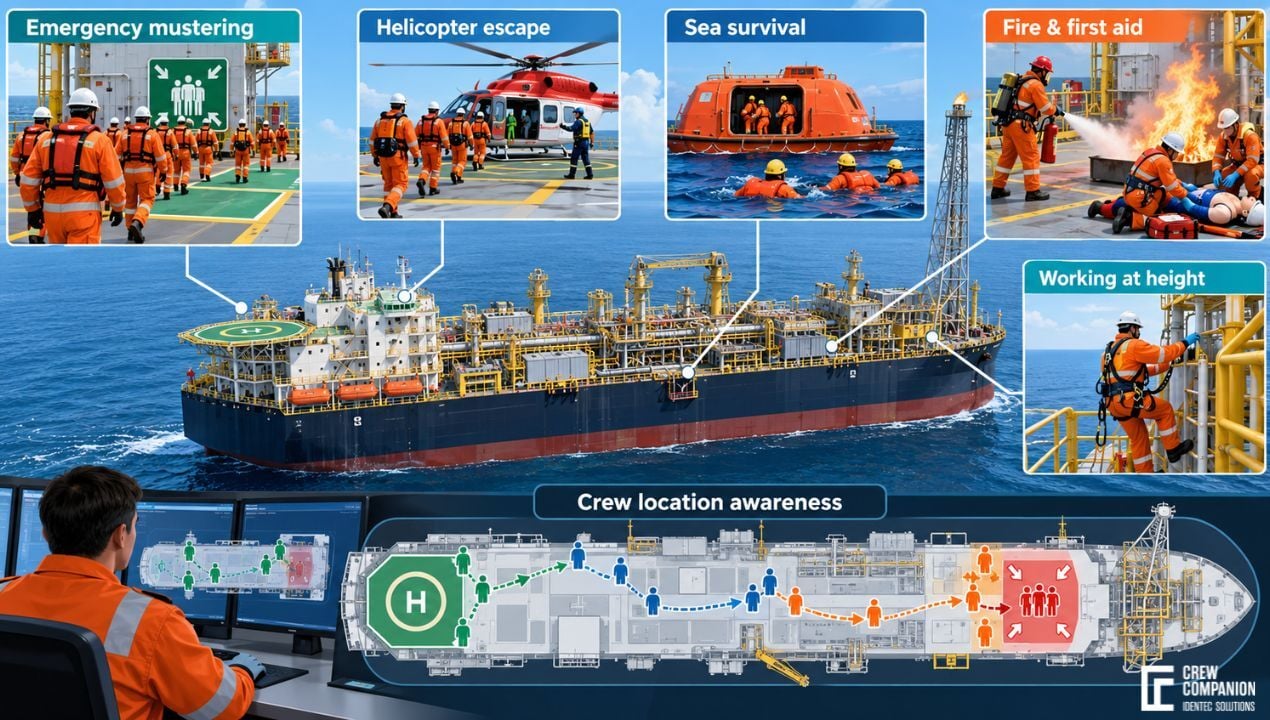
Offshore induction and hazard awareness introduce the work environment, emergency signals, safety rules, personal protective equipment, reporting expectations, and the principle of stopping work when conditions are unsafe. Workers should know how to raise concerns, who to contact and what to do if a task differs from its approved plan.
Helicopter and vessel transfer training prepares personnel for travel to and from offshore assets. Depending on the mode of travel and applicable course, this can include equipment familiarisation, safe boarding and disembarking, helicopter emergency procedures, escape from a submerged helicopter and use of an emergency breathing system. Vessel transfers require their own briefings and controls; a helicopter qualification does not automatically prepare someone for every marine transfer.
Sea survival and emergency response help workers understand how to protect themselves in the water, use survival equipment and act as part of a group during an emergency. Practical exercises can build familiarity with life rafts, survival craft and procedures for staying together and awaiting rescue.
Fire awareness, first aid, and self-rescue prepare workers to recognise a developing emergency, alert others, use basic firefighting equipment when safe, and evacuate or shelter according to procedure. Training should make clear that intervention is only appropriate when it does not expose the worker to unacceptable risk.
Working at height, manual handling and task-specific competence address routine exposures as well as major emergencies. Workers may need role-specific instruction for lifting operations, confined spaces, hazardous energy isolation, permit-to-work systems or other activities. These topics should align with the person’s job and the installation’s own controls.
Emergency mustering and evacuation deserve particular attention. Personnel need to recognise the alarm, stop work safely, follow the designated route, report to the assigned muster station, and provide accurate status information. They must also understand their role if evacuation proceeds by lifeboat, helicopter or another means. A muster drill should test communication and role clarity, not just whether people can reach a meeting point.
The ShipsEducation offshore safety resource (3) includes an interview with an experienced training instructor discussing standards, assessment and instructor-to-trainee ratios. The resource describes practical elements such as helicopter escape, sea survival, liferaft use, firefighting and self-rescue. Its useful reminder is that assessment and supervised practice are part of training, not add-ons after the classroom session.
Read more about emergency response training offshore!
How should training connect with processes on rigs and FPSOs?
A worker can pass a general safety course and still be unfamiliar with a particular installation. The asset’s layout, alarms, emergency command structure, muster stations, escape routes and available equipment all shape what the worker needs to do. Site-specific induction bridges this gap by explaining how the installation’s procedures work in practice.
The connection to daily processes matters too. Offshore operations often involve multiple work groups, contractors and simultaneous activities. A permit-to-work system, for example, helps coordinate work and define precautions, but its effectiveness depends on people understanding their roles and communicating changes. Similarly, emergency preparedness relies on clear lines of responsibility between the control room, installation leadership, department supervisors and muster coordinators.
FPSOs add a marine operating context to production and process-safety requirements. Personnel may need to understand vessel-related alarms, movement restrictions, transfer arrangements and the location of survival craft alongside the installation’s production hazards and emergency plans. Procedures should account for the asset’s configuration and the work being performed; a generic course cannot provide those details on its own.
Drills can test how well training carries into those processes. A useful exercise has a defined scenario and objectives, checks whether workers can follow the expected sequence, and ends with a debrief that identifies what worked and what needs adjustment. Operators can vary scenarios, such as a fire alarm during a maintenance task or a muster when some crew members are working in restricted-access areas. The aim is to practise coordination and decision-making, not to catch individuals out.
Reda’s interview highlights challenges such as remote operations, simultaneous operations and emergency readiness (4). His comments point to the need to connect training with the way work is actually planned and coordinated. The offshore wind interviews identified for this article also offer transferable examples of practical instruction: Nele Koberg describes working with trainers and customer feedback to translate standards into realistic courses, while Birk Schütte explains the role of fall-protection systems in rescue training. These are wind-sector examples, so they illustrate training principles rather than establish oil and gas course requirements.
Which offshore safety training providers should operators compare?
“Top-rated” can mean different things: an operator may prioritise course approvals, locations, available simulators, instructor experience, customer feedback or the ability to train a large contractor workforce. No single provider is automatically the best choice for every rig or FPSO. Operators should check current approval status and course details against their asset’s requirements before booking.
Three providers to include in a comparison are RelyOn Nutec, 3t Training Services and Maersk Training. Each publishes offshore oil and gas course information, including BOSIET-related training. Their offerings and locations vary, so the following is a starting point for evaluation, not a ranking.
- RelyOn Nutec offers BOSIET and refresher training. Its BOSIET course page (5) describes training in offshore safety, helicopter emergency response, sea survival, firefighting and first aid. Compare the course variant, practical assessment, centre location and availability against the travel and equipment requirements for the relevant asset.
- 3t Training Services lists oil and gas training, including BOSIET and HUET (6). Its oil and gas training information also explains that operators may require additional safety training alongside BOSIET. Check which courses are currently approved, what is included, and whether the provider can support job- or site-specific needs.
- Maersk Training offers BOSIET with CA-EBS for personnel travelling offshore by helicopter with a compressed-air emergency breathing system. Its course description (7) sets out the course’s intended audience and scope. Operators should confirm that the course matches their travel arrangements and the relevant duty-holder’s requirements.
A sound comparison should begin with the OPITO approved-centre network. OPITO maintains a training-centre search (8), allowing employers and learners to verify centres rather than relying only on a provider’s marketing claims. Then compare the exact course standard and version, any required medical fitness documentation, delivery locations, practical facilities, assessment approach and refresher arrangements. Verify acceptance with the employer or asset operator before an individual pays for training.
The training experience itself is another important criterion. Ask how much time learners spend practising skills, how instructors supervise practical exercises, and how they assess competence. Consider whether refresher courses are available locally and whether the provider can accommodate crews on rotational schedules. For contractors and large teams, consistency across courses and clear records of completion can also affect how easily training is managed.
Interviews can help readers understand what effective training looks like beyond a course catalogue. In the offshore wind sector, Iain Tindall discusses working at height, evacuation, sea survival, first aid and how training must adapt as projects move farther offshore (9). Rolf Fremgen’s interview focuses on sea-survival preparation, and Oronde Hale, a wind technician, describes repeated safety training and refresher courses. Those accounts are useful for illustrating realism, repetition and worker experience, but they should not be presented as evidence that a particular provider is “top-rated” for oil and gas (see also: emergency response technologies).
How can real-time crew-location data improve training results?
Training can improve by reviewing what happened during a drill, not just whether it was completed. Real-time localisation data gives authorised personnel a time-stamped view of crew movement through an installation. Used appropriately, it can help safety teams see how long it took people to reach muster, whether they reported to their assigned station, and where delays or unexpected movements occurred.
This makes it possible to compare the intended procedure with observed movement. If a team repeatedly takes longer to muster from a particular work area, the reason may be unclear signage, an unfamiliar route, poor communications, an access restriction or a training gap. Location data alone cannot explain a delay; a debrief and discussion with the people involved are needed to interpret it fairly.
For a training programme, the data can support a continuous improvement cycle: plan an exercise, observe the response, review movement and timing, discuss the findings with the crew, update the procedure or instruction where needed, and test again. Over time, aggregate results may show whether particular scenarios, routes or work groups need more practice. The purpose should be learning and preparedness, not turning every drill into a performance ranking.
Systems such as Crew Companion can support personnel visibility, personnel-on-board (POB) management and automated mustering. IDENTEC Solutions describes Crew Companion for Safe Energy as providing real-time tracking, automated mustering, access control and personnel visibility for installations including oil rigs and FPSOs. In a drill, such a system may help safety teams verify who has reached a muster point and identify people whose status still needs to be confirmed. These systems complement training and installation procedures; they do not replace them. A location record cannot show by itself whether a worker understood an instruction, acted safely or was prevented from moving by an operational constraint. Operators should define in advance what data is collected, who can access it, how long it is retained and how it will be used. Clear communication with crews builds trust and keeps the system focused on emergency readiness and learning.
Used in that way, real-time location information can make training reviews more specific. It can help an operator move from “the muster seemed slow” to a better question: which areas or steps in the process caused delay, and what change should be tested in the next exercise?
FAQ
Is BOSIET enough to work on an oil rig or FPSO?
Not necessarily. BOSIET covers core offshore safety and emergency response outcomes, but workers may also need an offshore medical, additional role-specific courses and installation-specific induction. Requirements depend on the employer, asset, location and travel arrangements. Confirm the current requirements with the operator or duty holder before booking.
How often should offshore workers repeat safety training?
There is no single refresher interval for every course or role. The interval depends on the training standard, employer requirements and local regulations. Operators should check the certificate’s validity and arrange refreshers before expiry, while also using drills and on-the-job briefings to keep installation-specific procedures familiar.
Can crew-tracking systems replace muster drills?
No. Tracking systems can support personnel visibility and help verify muster status, but crews still need to practise alarms, routes, reporting and evacuation procedures. Exercises test communication and decision-making; location information can help teams review the exercise afterwards.
Takeaway
Offshore safety training is most useful when approved courses, realistic practice and installation-specific procedures work together. Compare providers by current approvals, practical assessment, relevant course scope, and access to training that fits the crew’s roles and travel arrangements. Real-time location data can help teams review mustering (e-Mustering) and improve future drills when used transparently and alongside crew feedback.
Delve deeper into one of our core topics: Emergency Response Management
Glossary
NEBOSH is the National Examination Board in Occupational Safety and Health, a UK awarding organisation for health, safety, environmental and wellbeing qualifications. Its qualifications include the International General Certificate, which builds knowledge to identify workplace hazards, manage risk, and support health and safety systems. It is not an offshore emergency-response course or a substitute for role-specific competence training. See the official NEBOSH qualification page for its scope and current syllabus. (10)
References:
(3) https://www.shipseducation.com/info/offshore/safety.html
(5) https://relyon.com/course/bosiet
(6) https://www.3tglobal.com/oil-and-gas-training-courses/
(8) https://www.opito.com/centre-network
(9) https://tinyurl.com/2yx5arpy
(10) https://www.nebosh.org.uk/qualifications/international-general-certificate/
Note: This article was partly created with the assistance of artificial intelligence to support drafting.