| Written by Constance Stickler
Table of contents:
- Electrification changes the power equation
- Why does electrification put more pressure on terminal power?
- Seeing the Reefer Load Behind the Numbers
- What happens when energy demand becomes unpredictable?
- FAQ
- Takeaway
- Glossary
Electrification changes the power equation
Diesel powered the trucks, cranes, and other heavy machinery that kept cargo handling operations running. For decades, terminal energy management largely meant managing fuel. As vehicles and equipment electrify, electricity is becoming an increasingly significant operational resource. It is no longer used solely for offices and lighting; it increasingly powers terminal operations as a whole.
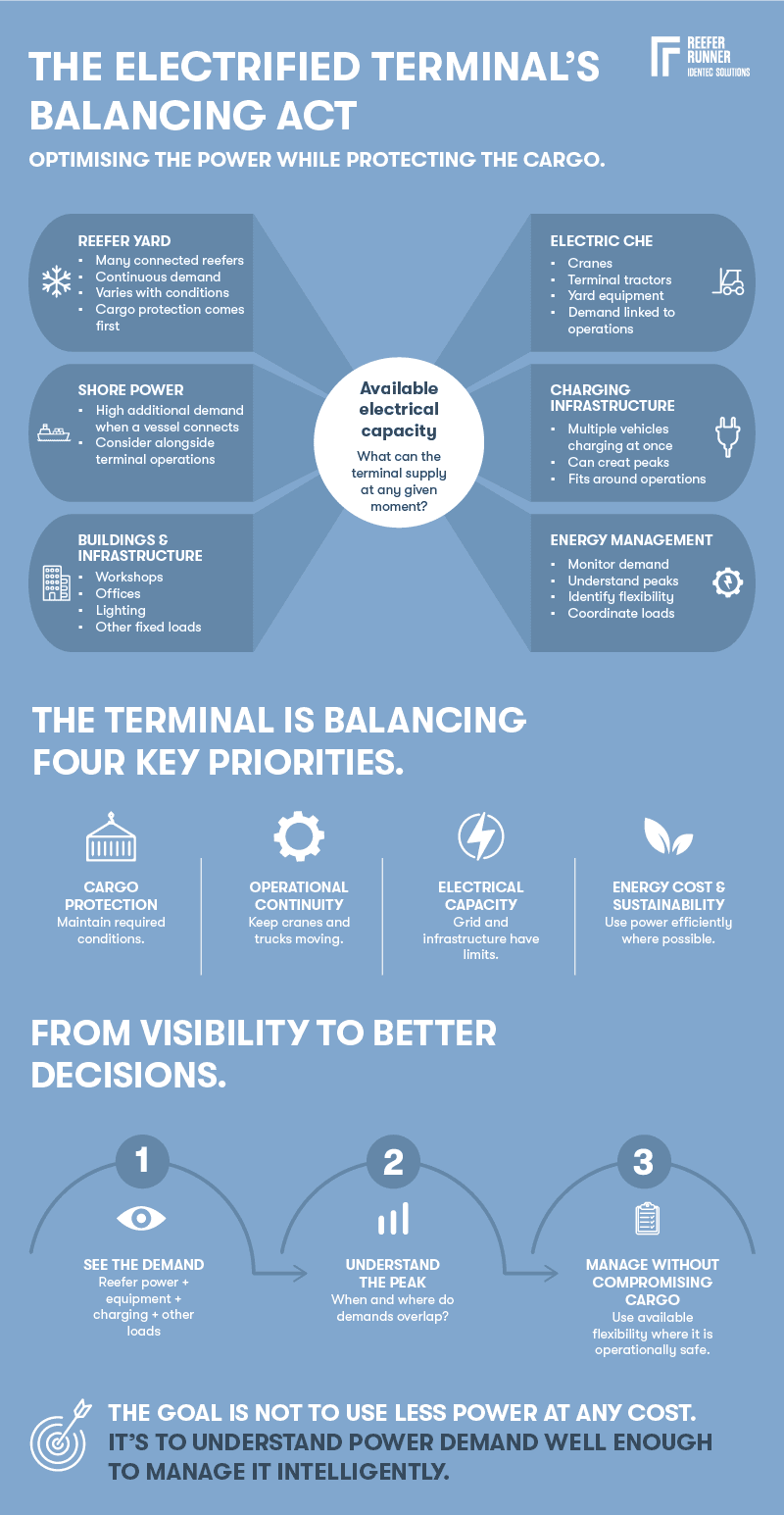
This creates a challenge: electrified terminals need enough capacity to handle periods when many systems demand power simultaneously. Cranes are unloading containers from a ship. Some container handling equipment is plugged into chargers. Rows of reefer units are already connected, and a ship is bringing in hundreds more. A vessel arrives and connects to shore power. The loads add up.
As a result, visibility is becoming increasingly important (see also: Cold chain temperature control). Terminal operators need to know not only how much electricity the terminal consumes, but also when demand rises, where consumption is highest, and how individual loads behave. For an electrified terminal, simply having more electricity available is not enough; the key is to better understand the electricity being used.

Why does electrification put more pressure on terminal power?
Electrification entails far more than just a switch in energy source; it alters when and where the terminal requires energy. As more and more systems are connected to the power grid, the terminal must manage a growing number of requirements—demands that may also overlap.
Electric vehicles, however, need to recharge, and several units may do so at the same time. Depending on the equipment and charging strategy, this can create a concentrated electrical load.
Standard (dry) ocean freight is subject to cycles that can be volatile, whereas temperature-controlled logistics is seeing steady growth. The modal shift—moving cargo from air to sea—driven by strict sustainability targets and high costs, is resulting—among other factors—in annual reefer transport growth of about 2,5% in 2024 (1). Ports are having to supply electricity for ever-increasing volumes of reefer containers.
While shore power is not yet widespread across all ports, its importance is set to grow. Under FuelEU Maritime, container and passenger ships above 5,000 GT will have to use shore-side electricity or another zero-emission technology while at berth in relevant EU ports from 2030, with the requirements expanding further from 2035. (2)
Why does electrification put more pressure on terminal power?
All these various developments exert pressure. The challenge, therefore, lies not merely in the total amount of energy consumed, but in the power required simultaneously.
This distinction is crucial when planning expansions. The terminal therefore has to consider both sides of the equation: infrastructure expansion and the intelligent management of energy demand. Greater transparency helps the terminal understand how these capacities are utilised.
This is particularly relevant for the cold chain process in general, and refrigerated containers in particular. Their consumption contributes to the terminal’s base load, yet individual units do not behave the same way. Without that information, the reefer area remains a large, largely undifferentiated load; with it, the terminal can start to identify patterns.
As mentioned above, Kenya and the Netherlands are examining a special refrigerated corridor, and recent trials have already demonstrated a successful route from Naivasha by rail to Mombasa and then by ship to Rotterdam .
Seeing the Reefer Load Behind the Numbers
The reefer units deserve special attention (learn more about reefer operations). Each connected refrigerated container represents an electrical load. When multiplied by hundreds or thousands of units, this results in a substantial total demand. Even more importantly, this demand is not constant. The cooling systems switch on and off based on whether they maintain setpoints, while outside temperatures, cargo characteristics, and operating conditions influence each unit's energy requirements.
Yet peak reefer power demand occurs during connection, as the cooling system undergoes the so-called "pull-down" phase (initial cooling) while also handling physical inrush currents. This can result in expensive load peaks that place a strain on the power grid. A study found that the arrival pattern of containers explained 77% of the variation in energy demand. (2) The terminal counters the strains by measures like connecting newly arrived reefer units to the power supply gradually rather than all at once. This practice is known as "peak shaving." It requires continuous monitoring of each unit's temperature—this is the only way to determine which ones need immediate power and which can wait a little longer.
The terminal knows how many refrigerated containers are connected. However, this reveals nothing about the individual units' actual power consumption. Yet precisely this is crucial for smart reefer handling.
Two container blocks with the same number of connected units can exhibit vastly different consumption profiles. One area may consistently show higher demand than another. A single reefer container might consume significantly more power than comparable units, while another consumes unusually little.
None of these scenarios automatically indicates a fault. Power consumption is an indicator, not a diagnosis. However, unusual patterns can warrant a closer investigation. This is where power monitoring adds another layer to conventional reefer container monitoring.
A comprehensive overall picture emerges only when all information regarding temperature, connection status, alarms, and power consumption is available. At the individual container level, consumption data can reveal unusual behaviour. At the zone level, it is possible to identify where demand is concentrated. Across the entire site, recurring patterns and periods of increased consumption can be visualised.
This transparency is essential because the terminal must monitor all power consumers at the same time. A spike in power demand from reefer units can coincide with crane operations, electric truck charging, or other major loads. The number of connected refrigerated containers alone does not reveal these interactions.
For the terminal operator, the question arises: "What is the level of consumption, where is it concentrated, and how does it change over time?"
What happens when energy demand becomes unpredictable?
A terminal can plan for a known load. Planning for a constantly changing load is significantly more difficult. This does not mean that every fluctuation poses a problem; the challenge lies in distinguishing between fluctuations that are normal and those that require attention.
Why is this important? Because electrical infrastructure has its limits. Transformers, cables, and substations are designed for a specific capacity. When multiple large loads occur simultaneously, peak demand can become more critical than total daily consumption.
This can have practical consequences. Higher peak demand can drive up electricity costs if tariffs include capacity-based charges. It can also reduce the available capacity for additional reefer connections, charging infrastructure or future electrification projects. In some cases, terminals may even need to invest in upgrading their electrical systems sooner than planned.
If a terminal knows when power demand typically rises, it can combine this information with its general energy profile to anticipate periods of high demand. Instead of reacting only when the infrastructure is already under heavy strain, operators can look for ways to manage suitable loads proactively.
However, there is a key constraint when it comes to refrigerated containers: protecting the cargo is the top priority. A terminal cannot treat every connected reefer as a flexible electrical load. Any optimisation strategy must take the cargo's cooling requirements into account.
The goal is not simply to reduce consumption. Rather, it is about understanding demand precisely enough to manage it without incurring unnecessary risks.
FAQ
Why Do Single Reefer Units Require More Power Than Others?
The power consumption of refrigerated containers is influenced by various factors.
One obvious factor is the ambient temperature. On hot days, the cooling system may need to run more frequently to maintain the specified setpoint temperature. The characteristics of the cargo also play a role: a container carrying frozen goods has different cooling requirements than one loaded with bananas.
The condition and configuration of the refrigerated container are crucial. Different cooling units have varying characteristics, and the condition of the equipment can affect energy efficiency; older or poorly maintained units may operate less efficiently.
The reefer's position in the yard is also a factor. Containers surrounded by other reefers may be subject to different conditions than those located in an exposed, outer position.
If a reefer's doors are opened frequently—for instance, during inspections—this is reflected in energy consumption. The duration of the stay at the terminal also has an impact: longer stays simply provide more opportunity for varying consumption patterns to emerge.
Consequently, higher power consumption does not necessarily indicate a problem. However, the situation becomes noteworthy if a refrigerated container consistently consumes more power than similar units under comparable conditions, or if its consumption pattern changes unexpectedly.
Takeaway
The electrified terminal is evolving into a complex energy system. An increasing number of vehicles, systems, and pieces of equipment rely on electricity. Demand for shore power and the volume of reefer units are steadily rising. Moreover, the costs associated with expanding electrical infrastructure mean that every additional megawatt requires careful consideration.
Monitoring reefer power consumption provides an important piece of the puzzle by making individual consumption patterns visible and showing how reefer demand contributes to the wider terminal load. This information can support broader energy management strategies—such as peak-load planning and, where appropriate, peak shaving.
However, there is a strict limit to these efforts regarding reefer units: protecting the sensitive and valuable cargo takes precedence. The higher the quality of the consumption data, the better the decisions that can be made without jeopardising the cargo.
One thing is certain: the terminal of the future will require more electricity. It will also need to know exactly how that power is being used. And reefer power monitoring plays a vital role in this context.
Delve deeper into one of our core topics: Refrigerated containers
Glossary
Inrush current refers to the brief surge of electrical current that can occur when equipment such as an electric motor or compressor starts. The current can temporarily exceed the equipment's normal operating current, which electrical infrastructure and protection systems must accommodate. Consequently, connection systems—including cables, sockets, transformers, supply lines, and motor protection switches—must be appropriately rated to prevent simultaneous connections from causing voltage drops, nuisance tripping, or equipment damage. (4)
The pull-down phase occurs when a reefer is connected to a power source and the air inside the unit (and often the cargo itself) is warmer than the target temperature. The compressor and fans must run at a higher load to dissipate this heat as quickly as possible. While normal maintenance operation subsequently requires only about 2 to 5 kW, a reefer often draws 10 to 15 kW during this initial phase. (5)
Reference:
(1) https://www.lloydslist.com/LL1153813/Global-reefer-trade-maintains-momentum
(3) https://link.springer.com/article/10.1186/s41072-019-0040-y
(4) Althouse, Andrew D.; Turnquist, Carl H.; Bowditch, William A.; Bracciano, Alfred F. (2021): Modern Refrigeration and Air Conditioning. Goodheart-Willcox.
(5) Gaur, P. K. (2017): Refrigerated Cargoes. Witherby Publishing.
Note: This article was partly created with the assistance of artificial intelligence to support drafting.

Author
Conny Stickler, Marketing Manager Logistics
Constance Stickler holds a master's degree in political science, German language and history. She spent most of her professional career as a project and marketing manager in different industries. Her passion is usability, and she's captivated by the potential of today's digital tools. They seem to unlock endless possibilities, each one more intriguing than the last. Constance writes about automation, sustainability and safety in maritime logistics.